Kanlı Pazar, Years Later
Decades have passed since Kanlı Pazar. Turkey experienced new coups and coup attempts after 27 May. The deaths and killings that began in the late 1960s steadily increased through the 1970s and 1980s. By the 2010s, more than 40 years had passed — enough time to allow for a reckoning. Specific to Kanlı Pazar, it is possible to find, among both Islamists and rightists, individuals and institutions who have questioned themselves. Some say what happened was a provocation, while others dwell on — and criticize — the pro-American stance of that period. Even those who take no critical stance have had to confront that period's pro-Americanism, and have tried to construct justifications of their own. The case of Mehmet Şevket Eygi, one of Kanlı Pazar's principal actors, is an example of this attitude. The relatives of those killed in Kanlı Pazar, meanwhile, still demand justice.
Kanlı Pazar is an event that the conservative right-wing masses need to seriously question. If only the devout, conservative masses had joined the youth described as leftist in protesting the U.S. Sixth Fleet. I was young at the time, but I wish the whole of the nation had reacted against the fleet there. I have carried this as a form of internal criticism for years. Perhaps Turkey's political development would have been different.
Fetullah Was a Special Warfare Department Operative
It is no longer a secret how members of FETÖ infiltrated the judiciary, the military, the police, universities, the bureaucracy — the state, in short. Nor is it a secret that this began back in the 1950s and '60s, and how Fetullah Gülen was protected and looked after for many years... For instance, İsmail Hakkı Pekin, retired Lieutenant General and former head of the General Staff's Intelligence Department, said the following recently on a television discussion program:
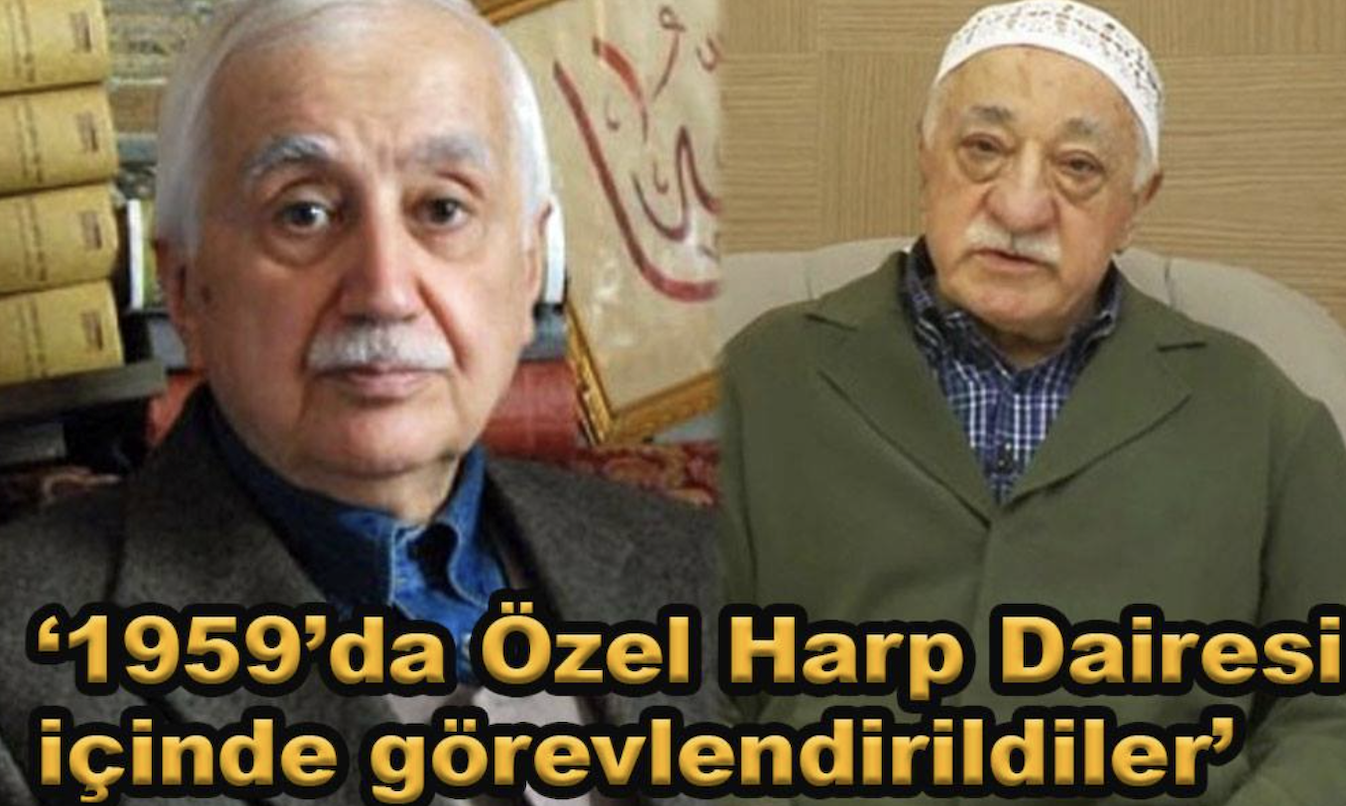
"Names like Fetullah Gülen and Mehmet Şevket Eygi were assigned within the Special Warfare Department in 1959. Their duties involved anticommunist activities under the Green Belt project. When Fetullah Gülen was caught after 12 September, the Chief of the General Staff was contacted for his release, and he was released."
İsmail Hakkı Pekin, television program, December 2018
We then called Pekin to ask for further details on the matter.
So Fetullah Gülen was a Special Warfare Department man?
"Yes. He was an operative of the Mobilization Research Board, attached to the Special Warfare Department. An 'operative' is not a permanent post like a serving officer. These are men registered by name, to be used when needed. Their whereabouts, their patterns of activity, are known, and they have been granted various forms of facilitation, various privileges. If he's a politician, he's supported; if he's a merchant, he's given an edge in tenders and credit; if he's an opinion leader, his activities are allowed to proceed unhindered, and so on. Indeed, in 1980, the Martial Law Commander, an admiral, had Fetullah Gülen arrested in İzmir — but later released him."
İsmail Hakkı Pekin
Why was he arrested?
"For engaging in activity contrary to the martial law decisions. Because his name was on the wanted list. There had most likely been a complaint. At the time, I was serving as a captain in Bursa-İznik. There were many complaints about that area too — complaints that these Fetullah followers were influencing people, getting out of hand. But these complaints were covered up. Because they were using these men at the time. That's why nothing was said, no action was taken against him."
İsmail Hakkı Pekin
How was he released?
"To get Fetullah Gülen released, first the Naval Forces Commander called, then the Land Forces Commander telephoned. He was finally released after a call from Kenan Paşa."
İsmail Hakkı Pekin
Could American influence also have been involved?
"That's possible too. Fetullah had by then come under American influence, and the pressure could well have come, in some form, from the American embassy... Would they say it directly to Kenan Paşa? I doubt it — perhaps they said it to people around him, and those people had an influence. Because an opinion leader carried a great deal of weight at the time. Particularly after a certain stage of 12 September, a great backlash had built up in Turkey over the closing of parties and the measures that were taken. These men were used to reduce that backlash... Those who came afterward used him too, out of concern for votes. One of the reasons Fetullah managed to infiltrate the state so extensively is that he proved usable under every government, and because he was used under every government, he came to occupy very critical positions within the state."
İsmail Hakkı Pekin
So it's not possible that the state didn't know who Fetullah was?
"This is clear and plain: it's not possible the state didn't know. When I say the state, I mean the bureaucracy, the police, the armed forces, and so on — all of them knew what this man was. The politicians knew too..."
İsmail Hakkı Pekin
İsmail Hakkı Pekin, retired Lieutenant General and former head of the General Staff's Intelligence Department, stated on a television program he took part in on 10 December 2018, naming names, that Mehmet Şevket Eygi and Fethullah Gülen had been assigned within the Special Warfare Department in 1959. On the same day as this television program, Tunca Bengin of the newspaper Milliyet interviewed Pekin and asked him about these claims. It was primarily after Bengin's piece that these claims spread through the public eye, and Eygi wrote numerous columns rejecting them. For the full account of this claim and the debates that followed, see Chapter 3.
16 February 1969 went down in Turkish political history as "Kanlı Pazar." Another group attacked those who had gathered in Taksim to protest the Sixth Fleet. Two people died in the incident. The MTTB was named among the instigators of the event.
Abdürrahim Boynukalın, MTTB Deputy Chairman, who made that day the subject of his thesis, says: "What happened was a complete provocation. We are not in the streets because we learned our lesson from those days."
The Kanlı Pazar incident took place while youth organizations were gathered in Taksim Square to protest the U.S. Sixth Fleet. Before the demonstration, the Association for the Struggle Against Communism called on the public to react. It was reported that certain meetings had been organized within the Milli Türk Talebe Birliği (MTTB) as well. On 16 February 1969, one more of the period's many right-left clashes took place. As a group attacked those staging the action, young people named Ali Turgut Aytaç and Duran Erdoğan died in the events, and 114 more were wounded. The MTTB, one of the institutions named in connection with this event, broke its silence a full 42 years later.
Abdürrahim Boynukalın, an International Relations master's student at Istanbul University and MTTB Deputy Chairman, chose this event as the subject of his thesis. Carrying out a study titled "The Transformation of the Turkish Right and the MTTB," Boynukalın says this carries the meaning of a reckoning with 'Kanlı Pazar.' Stating that "it later emerged that the incident was a deep-state operation, that clubs were distributed by plainclothes police, and that shots were fired from apartment rooftops and hotels," Boynukalın says the right-wing milieu learned its lesson from this and withdrew from the streets from the '70s onward. Noting that no one was "above reproach" in those days and that everyone needs to engage in self-criticism, Boynukalın says: "The country is transforming and changing right now. In this process, those who criticize themselves best and settle their accounts with the past are the ones who survive."
We must tear down the neighborhood walls.
The left in Turkey must reexamine its relationship with Islam. One can be without religion, but one cannot be without conscience. And besides, which religion? Whose interpretation of religion? It's clear that a great many mistakes have been made here through sweeping generalizations. In my view, the Quran should be reread through the eyes of those at the bottom, the oppressed; there should be no shame in being influenced by it, no pride or arrogance, and they should stop treating Islam as just one religion among others.
The religious world in Turkey, for its part, must also reexamine its relationship with the left. It must abandon sweeping approaches of the "godless communists" variety. It should reassess the socialist experience across the world, read Das Kapital, and feel no shame in being influenced, no pride or arrogance. At the very least, for the sake of those who came to face death alongside them — as fellow passengers on the same ship — it should take stock of its conscience.
It must, for example, put distance between itself and the rightist/religious generation of the '70s. It must reject the disgrace of "Kanlı Pazar," and restore its honor by saying that what happened there does not bind today's Islamists, and that they now stand — even if only symbolically — with the Deniz Gezmişes who stoned the American Sixth Fleet.
For the sake of newer generations, let us recall: "Kanlı Pazar" refers to the events that took place in Istanbul's Beyazıt Square on 16 February 1969, while 76 leftist youth organizations gathered to protest the U.S. Sixth Fleet. In the days before the demonstration, the "Association for the Struggle Against Communism" issued warnings calling on the public to react. That day, another group also took up position in Beyazıt Square with stones and clubs. The two groups met in the square. During the events, young men named Ali Turgut Aytaç and Duran Erdoğan were stabbed to death. Roughly 200 more people were wounded.
Today's Milli Gazete columnist Mehmet Şevket Eygi was one of that day's rightist/traditionalist/religious agitators. Today's Fethullah Gülen Hocaefendi was one of the founders of the Association for the Struggle Against Communism's Erzurum branch that day. Today's President Abdullah Gül was a member of the "40s Council" within the Milli Türk Talebe Birliği (MTTB), the organizing body of that day's attackers.
As a member of the following generation, I spent my youth in the climate of the MTTB — I come from those same roots.
And today I reject this shameful legacy handed down to us.
Consider this disgrace: because the American Sixth Fleet was coming, the brothels in Karaköy had been freshly painted for the occasion! Instead of joining forces with the Deniz Gezmişes to protest the Sixth Fleet, the traditionalists/rightists/religious of the period defended the American fleet and stoned the leftists!
However you look at it, it was inconsistent; however you look at it, it was foolish!
I was eight years old when Kanlı Pazar happened (1969) — which means I hadn't even started primary school yet. The mistakes of one generation do not have to continue into the next. Today's Islamic circles must renounce their inheritance when it comes to this event.
Islam and the left are not enemies, cannot be enemies, must not be enemies. Certain people, deliberately, by design, made them enemies!
The Kanlı Pazar Manifesto
IF...
On that cold, "bloody" second Sunday of February 1969...
Had I been old enough...
And had I been in Beyazıt Square...
Even if I were devout, even if I attended imam hatip school, even if my mother wore a headscarf and my father had a beard, even if I called myself "an Islamist"...
My place...
...would certainly have been beside the leftist youth protesting the American Sixth Fleet — that is, beside Deniz Gezmiş and his friends...
Never, under any circumstance...
...would I have stood with the so-called Muslims who joined forces with the police and launched an attack on those young people, shouting takbir.
Because...
As I understand it...
This matter has nothing to do with religion / piety, with the cultural environment one was born into, or even with one's ideological stance.
It is a matter of character and morality.
And the matter is that simple.
* * *
If...
Had I been old enough...
On that Sunday...
My heart would not have beaten for the Sixth Fleet...
...it would have beaten for the leftist youth protesting the Sixth Fleet.
I would not have let myself be swept up by the vile propaganda and incitement that people like Mehmet Şevket Eygi — who these days heap foul curses upon Deniz Gezmiş and his friends — carried out in those days in the name of "religion and faith."
I would not have given the slightest credence to the explanations of Eygi and his ilk, along the lines of "On one side there's the Soviet Union, on the other the U.S.... We should side with the U.S. as the lesser evil."
Because...
I would have found this kind of approach, at the very least, "shameful"...
I would have been aware that seeking salvation from one "evil" in another "evil," and attempting to "choose between evils," is a demeaning thing to do.
I would have thought such a choice unworthy of human dignity.
Whatever the circumstances I lived through...
Thanks to a little sense, a little humanity, and a little awareness...
I would have been able to grasp which side I needed to choose.
I would have stood up against those who launched their attack shouting takbir...
I would have cried out, "Are you mad? What are you doing?"
I would have said, "Did it fall to you to defend the lesser evil?"
* * *
But as it happened...
Divine decree, that's what it was!
I was not there that day...
And yet...
From the moment I came of understanding...
Even though I had not been there...
...I felt "guilt" over what happened there.
Whenever that "Bloody" Sunday came up, my face would flush with shame...
Especially seeing how the men who, in those days, called and incited the nation to "jihad for God's sake" on the side of the Sixth Fleet, instead of feeling even a shred of shame today and at least falling silent...
...still keep their old grudges alive and heap foul curses upon Deniz Gezmiş and his friends...
...my face continues to flush with shame.
I am writing this manifesto in that very state of shame, and I say this:
Please do not write my name alongside the likes of Mehmet Şevket Eygi.
If you absolutely must write it beside someone's...
...you may write it beside Deniz Gezmiş and his friends...
I would not mind at all...
On the contrary, I would consider it an honor.
"At that time, we were in the Türkiye Milli Talebe Federasyonu. This Federation was under the leadership of our group — the one we described as idealist, nationalist. The Milli Türk Talebe Birliği, at the time — I'm talking about 1968–69 — was more under the control of Islamic thought. We used to call them "ecmain" back then. Later, they came to call themselves akıncılar. The Milli Türk Talebe Birliği was under their leadership too, but as the nationalist group, we also took part in the Milli Türk Talebe Birliği's activities. A fight broke out at the Istanbul congress. They then moved it to Kayseri. The Justice Party government supported them at the time.
At the Kayseri congress, even the delegates weren't let into the hall. Arguments broke out and they lost the leadership. During this same period, 1968–69, we were taking part in some of the Milli Türk Talebe Birliği's activities. We wanted to take control of it. During that process, a rumor started one day: "The communists are marching, they're going to occupy Taksim, we're going to take action against this." This news was brought to us. We were curious too. We said, let's look into what they're planning to do. On Saturday, the Milli Türk Talebe Birliği, our friends and administrators who came from there, asked: "How many of you will take part as a group?" They came from the Federation and asked us. I wondered what this was for, why they were asking.
"Let's have a big crowd there," they said. "However many of you there are, we'll hand out clubs," they said. This time I got even more uneasy. So I told my friends, "Say five hundred people." Not that we were going to take part — just to see, "what's going to happen"…
If I'm not mistaken, we were told, "Come to the Türk Talebe Birliği on Saturday at five, as a token delegation." Seven or eight of our friends went there. There's Şeref Efendi Street, right next to the Milli Türk Talebe building. Two trucks pulled up there. There — as it later turned out, of course — clubs came out in bundles.
I told our lads, "Take the clubs. We're not going to go, but don't say we're not going to go." Then, at the same place, blue ribbons were also handed out. We asked what the ribbons were for. They said: pin these blue ribbons to your lapel when the communists enter Taksim Square — it shows two things. First, if trouble breaks out there, you'll be able to recognize each other. Second — the police knew about this too — those wearing blue ribbons would be the anticommunists. Sure enough, the next day we went there, seven or eight of us. In other words, we didn't take part as idealists. We just watched from a distance. There was a crowd of at least twenty or thirty thousand people. Some had even come after the morning prayer. The Fikir Kulüpleri Federasyonu entered from Gümüşsuyu. Right as they came in front of the Marmara Hotel, those who had been waiting in the square with clubs in hand attacked those arriving.
The police were watching — if you had a blue ribbon, they left you alone as a friend; if you didn't, they went at you with their truncheon. So we said, let's put on our ribbons too, because even though we were far off, a group was heading toward us as well.
There were Associations for the Struggle Against Communism. This was something they organized together. Days before this, there was also a journalist named Mehmet Şevki Eygi. He was making calls through the newspaper. He had been stirring things up for perhaps 10–15 days with pieces along the lines of "The communists, the lackeys of Moscow, are coming, they're cursing our religion." He was organizing communal morning prayers. This kind of groundwork had been laid. A photograph spanning 6–7 columns in the newspaper Hürriyet on 'Kanlı Pazar' is still burned into our eyes...
One person there killed a leftist young man with a knife, right in front of the police, and the police just watched. They did not intervene at all. Two of our people, sadly, were killed there in this manner. This is, of course, an event that left very deep scars. I regard Kanlı Pazar as a mass organization, and I attach great importance to the process that followed it. Indeed, three days before that incident, the police raided 8 universities [ed. — Yaşar Okuyan misremembers the date of Vedat Demircioğlu's death. The dormitory raid that led to Demircioğlu's death took place in July 1968.] A brother of ours named Vedat Demircioğlu was, according to one claim, beaten by police and thrown from an upper floor, and lost his life. There is also a claim that some fell while fleeing, but in the end, he lost his life in a struggle that arose from the police raid on that place.
In this Kanlı Pazar incident, I wonder — among those who were active in the Milli Türk Talebe Birliği at the time, who now occupies the highest positions in Ankara? This question needs an answer. In the Ergenekon investigations, for some reason, everything is being connected and investigated, but 'Kanlı Pazar' is never pursued at all.
I hope that the answer to this question — since they themselves know who they are — will be given by those serving in Ankara's highest positions. Did they take part in those organizations? Were they among those who, that Sunday, answering the calls, attacked those who came to sabotage a lawful rally in Taksim Square? Did they carry these lathe-turned clubs? Who did they instruct to have blue ribbons pinned to their lapels?
Since we are supposedly going to expose 'Gladio' and every past event, these questions need to be answered. With a little thought, it could well emerge who these friends of ours are.
I could of course name a name from 40 years ago right now. But the moment I name someone, the first response you'll get from the other side will be, "No, that's a lie." Whereas if the media outside the government's control pursued these matters a bit, we would bring this onto Turkey's agenda. And once it's on the agenda, the spotlights come on, and the truth comes to light."
Women remember it well — in those days we couldn't walk down İstiklal Street. Because of harassment by American soldiers. Women were afraid, they were being harassed. It was as if we were living in their country. So first we taught them a lesson at the Sixth Fleet, and then a march was organized that my husband also took part in. There was great turnout, but they weren't even let into the square — even their banners were confiscated, so they wouldn't have anything club-like in their hands. And they let only a hundred people into the square, and then they attacked.
I don't want this pain to remain a private matter. One of those who must answer for the past is Süleyman Demirel. He can still speak. Demirel is one of the greatest culprits of the "Kanlı Pazar" incident. Demirel was prime minister at the time, and he is one of those who turned a blind eye and covered it up. Every year, the martyrs of Kanlı Pazar are commemorated at the place where they were killed, and I take part too. But in my view, it should be done collectively — a day should be set, and something should be organized together.
I Bear No Responsibility for Kanlı Pazar
You're 73. Looking back, is there nothing in your life you regret?
In principle, I have no regrets about the Islamic activities I have carried out. But I may have made mistakes in their methods, in their style. Of course, as one grows older and settles down, one says, "I wish I hadn't done it that way."
Does this regret extend to Kanlı Pazar as well? Do you not feel morally responsible?
No, I feel no unease, no responsibility, in my conscience. If the same circumstances existed today, I would do the exact same thing again, without hesitation.
Even though the incident resulted in two deaths?
I am definitely not responsible for that. I wasn't even aware of it. I couldn't have known that the piece I wrote would run in the newspaper that particular day. I was in Saudi Arabia. I would send 15–20 columns to the newspaper by post at a time. The piece just happened to be published that day.
Soviet imperialism was the lesser evil compared to America
On 16 February 1969, leftists were protesting the American Sixth Fleet. You chose American imperialism over Soviet imperialism.
Since Turkey was not a great power, it was necessarily on the American side. That doesn't mean supporting American imperialism. The choice was forced upon us. I, of course, chose the lesser evil.
Is America the lesser evil because it's a "People of the Book"?
American imperialism is like egg-farming poultry raising. They feed the hens, treat them when they get sick, and take their eggs. Soviet imperialism, by contrast, is about chicken meat. They slit the hen's throat and produce meat. If you were the hen, which would you choose? To survive, of course you'd choose the egg.
But we're not hens!
We resemble hens, sir. Some analogies are fitting.
It's a Lie, It's Slander
On a TV program, İsmail Pekin, former head of the General Staff's Intelligence Department, said, "Names like Fethullah Gülen and Mehmet Şevket Eygi were assigned within the Special Warfare Department in 1959." Some people then wrote reckless pieces on the matter, accusing me, casting suspicion on me.
ATTENTION
After retiring, this general served as deputy chairman of the Vatan Partisi, of which Doğu Perinçek is chairman.
MY RESPONSE TO THE CLAIMS
I am speaking for myself:
These claims are a lie, a slander, baseless, a fabrication, entirely made up, and have nothing to do with reality.
In 1959, I was a minor 26-year-old civil servant, working as a French translator at the Presidency of Religious Affairs. I was not a journalist. I had no standing, fame, or influence in Islamic circles. No one outside a small circle knew me. I was an insignificant, minor civil servant.
That I was assigned within the General Staff... This isn't just a lie, it's a huge lie. A huge slander. A huge fabrication. What kind of lie and slander is it? A rather amateurish one...
Claims like this absolutely must be proven. Where's the proof, the evidence?.. There is none, none, none.
Throw enough mud of lies and slander, and it's bound to leave some trace — that's the philosophy at work.
In Erzurum, in the courtyard of the Murat Paşa mosque, there was supposedly a shack-shop belonging to Mehmet Şercil, a Nurcu tailor. M. Şevket Eygi is said to have met Fethullah Gülen there...
Here is the truth of the matter: that shop really did exist, and I went there a few times while I was doing my reserve officer service. On one occasion, Fethullah Gülen — a 16-year-old seminary student at the time — is said to have come as well. I don't remember it; Gülen wrote about it in one of his books.
This humble servant, a young reserve officer, and Fethullah Gülen, a 16-year-old mullah student, are supposed to have met in the tailor Mehmet Şercil's shop and decided to overthrow the regime... My, my!.. What a script.
Now, I call upon the person who invented this fabricated General Staff story to prove his claim. If he has valid, genuine evidence, let him produce it. He won't be able to. It's all lies, slander, fabrication.
This humble servant has always stood against the corrupt order, the ruling-minority system, the tutelary regime, the terror of official ideology. What business would I have with the General Staff's Special Warfare Department?
Ah... it's possible that, without my knowledge, someone said, this man is against Communism, let's use him indirectly. That, too, is not a valid explanation. The tutelary, ruling-minority regime has done me great injustice. Because of my ideas and beliefs, it dragged me through heavy penal courts, left me to rot in prison; it forced me to live abroad for nearly six years; it sank and bankrupted my daily newspaper.
Let no one speak off the top of their head on this matter. Let them prove their claims legally. Let them bring consistent, valid evidence.
They can't, of course — but if they do prove it, I will break my pen and withdraw from writing altogether.
Before 15 July, I published many columns and warnings about the mistakes of the Fethullah community. I had also written a telegram warning the Gentleman about the community's infiltration into official posts.
It reads exactly as follows:
An Open Telegram to an Important Person
"Honorable Sir: May I have your attention for a moment... I will be very brief. The ground beneath you is being quietly and stealthily dug out and hollowed. In the future, you may face very grave, irreversible surprises. Unfortunately, there is no loyalty in politics. Do not trust everyone who appears loyal, faithful, and friendly. Turkey's present structure cannot bear a monopolistic and sectarian system. As far as possible, and in its positive sense, a structure based on pluralism and diversity must be kept standing. If you cannot stop this monopolistic infiltration into official posts, this infiltration may end your career. I wish you success in your good works. With my regards and respects."
30 November 2011
(By monopolistic and sectarian structuring, I meant the Community, which had infiltrated the army, the judiciary, and every institution, entrenching its own cadres.)
While I was criticizing him, warning him, a number of zealots who now pose as opponents of Fethullah Gülen were, at that time, praising him to the skies and lining up to kiss his hand. These insincere men and women now curse him without pause.
Let no one go looking for a calf beneath an ox.
My column titled ŞEREFSİZLER [THE SHAMELESS] (Milli Gazete, 16 December 2018) should be read.
This humble servant is a patient man. I do not react in sudden anger. I am consulting with my lawyer friends.
There is also the matter of curses in this business. Atheists and unbelievers do not fear Him, but if a curse takes hold and a blow comes down upon them, they will be struck to the ground.
I challenge those who wish to finish me off: if you prove your claims, I will put an end to my writing career. And I will not stop there — I will give the house I live in as a prize as well.
Come on, gentlemen, find your evidence, prove it... Stop playing executioner and be like a fair judge instead. Be fair witnesses. Lying and slander are a want of virtue.
CONCLUSION
The claims are a lie.
İsmail Hakkı Pekin, retired Lieutenant General and former head of the General Staff's Intelligence Department, stated on a television program he took part in on 10 December 2018, naming names, that Mehmet Şevket Eygi and Fethullah Gülen had been assigned within the Special Warfare Department in 1959. In response to this claim, Eygi rejected the allegations in numerous columns, this one among them. For the full account of this claim and the debates that followed, see Chapter 3.
İsmail Hakkı Pekin, Tele 1 social media — May 2026
Eygi: "Yalandır İftiradır" — Milli Gazete, 18 December 2018 — May 2026
Bengin: "Fetullah, Özel Harp Dairesi Elemanıydı" — Milliyet, 10 December 2018 — May 2026
The English translation is in progress; untranslated chapters below open the original Turkish edition.
Preface Preface Introduction The Road to 16 February 1969 Ch. 1 The Political Climate After 27 May 1960 Ch. 2 Toward Kanlı Pazar Ch. 3 Bugün Newspaper and "Kanlı Pazar" Central Chapter Kanlı Pazar: A Step-by-Step Account Ch. 5 What Was Said After Kanlı Pazar