The Political Climate After 27 May 1960
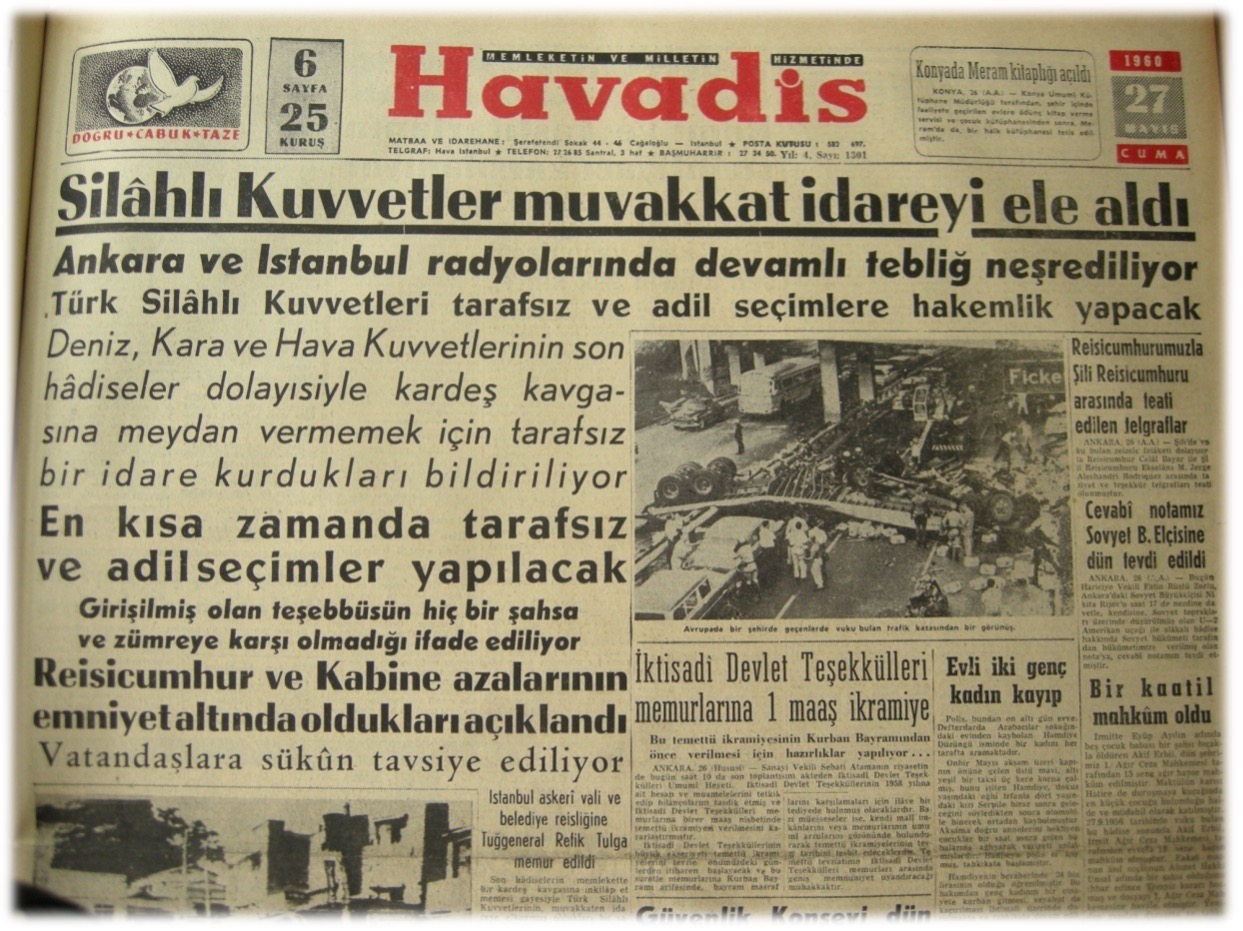
Taking a bird's-eye view of Turkey's political life, we can sketch out the following periodization:1
1— The period of Republican People's Party (CHP) rule, running from the 1920s — that is, from the founding of the Republic — to 1946–1950. Setting aside the Progressive Republican Party and Free Republican Party initiatives, this can also be called the single-party period.
2— The multi-party period after 1950. CHP rule came to an end at this point, and the Democrat Party (DP) took its place in parliament and in power with a sweeping electoral majority.
This multi-party period was interrupted three times:
- 1960–1961 (by the 27 May coup)
- 1971–1973 (by the 12 March coup)
- 1980–1983 (by the 12 September coup)
Alongside these three coups, mention should also be made of the 28 February "postmodern coup," the alleged coup plots known as "Sarıkız," "Ayışığı," "Yakamoz," "Eldiven," and "Balyoz," and the coup attempts Talat Aydemir carried out on 22 February 1962 and on 20–21 May 1963. Because the "military intervention" that came to be known as "28 February," following decisions taken at a National Security Council meeting on 28 February 1997, did not lead to the closure of parliament, it does not rank as a fourth interruption among these; even so, it is well known that 28 February caused the resignation of Necmettin Erbakan, then prime minister in the Welfare Party (RP)–True Path Party (DYP) coalition government, and that the government ultimately collapsed. Also still fresh in memory is the description, by then Deputy Chief of the General Staff General Çevik Bir, of the tanks driven through Sincan — one of the first steps in this "intervention" — as "giving democracy a balance adjustment."2 The alleged coup plots known as "Sarıkız," "Ayışığı," "Yakamoz," "Eldiven," and "Balyoz" surfaced in 2003–2004, on claims that they had been planned against the then Justice and Development Party government, and became the subject of court cases.3
On 27 May 1960, the army put an end to ten years of DP rule, seized control of the government, and dissolved parliament. Together with the later 28 February "postmodern military intervention," the alleged "Sarıkız, Ayışığı, Yakamoz, Eldiven, Balyoz" coup plots, and Talat Aydemir's coup attempts, this "military intervention" became one of the most debated of Turkey's coups. The "twin twelves" (the 12 March 1971 and 12 September 1980 coups) are rarely debated as "coups" at all — indeed, they can be described as "military fascist juntas" — whereas 27 May can be characterized as a "revolution" or "political revolution,"4 and 28 February, unable to fit the classic mold of a "coup," can be called "a coup, but a postmodern one."5
Following 27 May, elections were held on 15 October 1961, and on 20 November 1961 a CHP–AP (Justice Party) coalition was formed. In the interval between these dates, the country remained under the administration of the National Unity Committee — that is, of the army.
The Army After 27 May
The National Unity Committee (MBK)
The 27 May coup was carried out by a group of colonels and senior officers. The fact that it was carried out against the wishes of the generals is one feature that distinguishes it from the coups that would follow. 27 May was directed against the military hierarchy just as much as against DP rule.6
Thirty-eight of the officers who carried out the 27 May coup took power under the name National Unity Committee (MBK). The MBK held power until 25 October 1961. Immediately after the coup, however, purges took place within the army that also affected the MBK itself — a sign that there was disagreement and a power struggle within the military as well.
The MBK's first significant actions were the following:
1— The Yassıada Trials
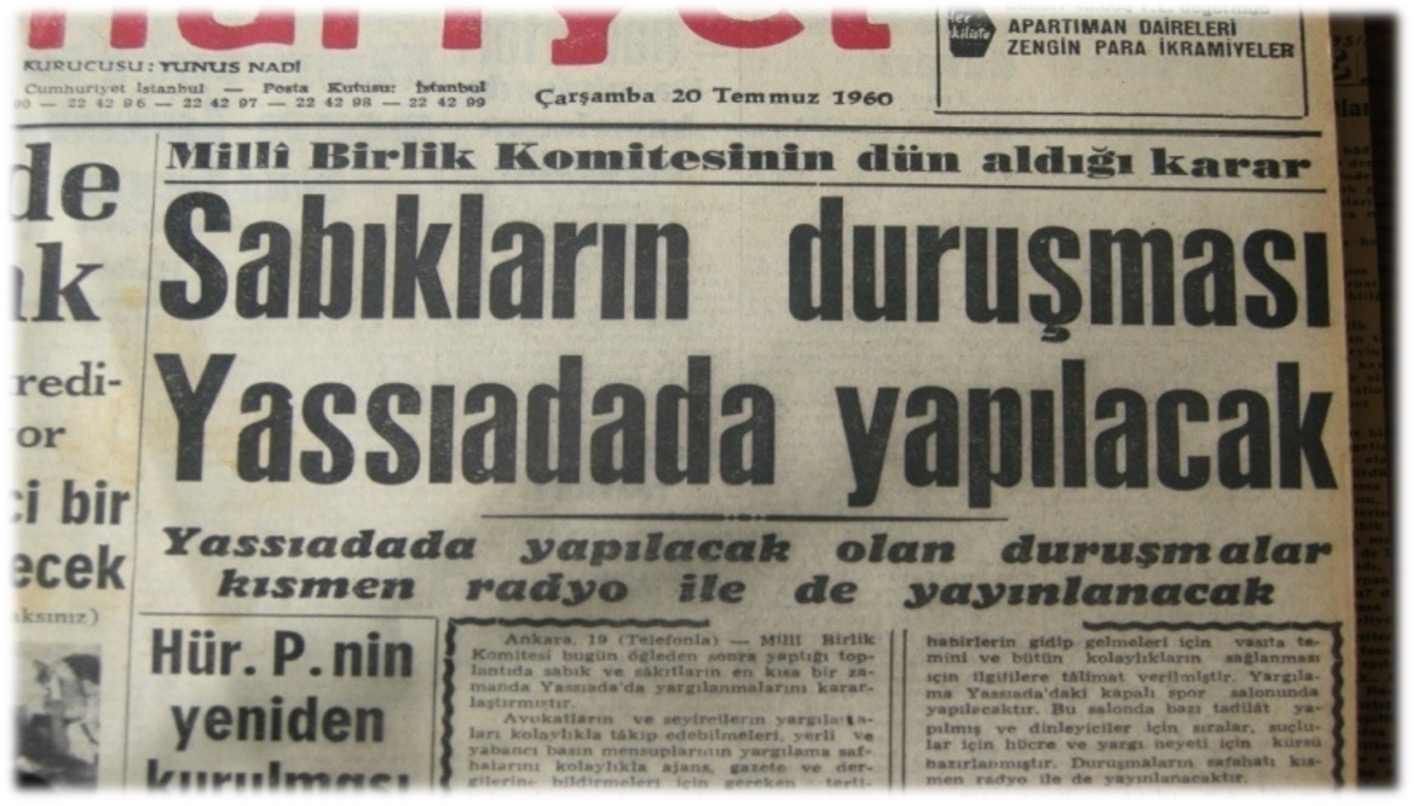
The trials of DP members arrested after 27 May were held on Yassıada, an island in the middle of the Sea of Marmara that could be described as sterile [i.e. isolated]. The hearings, which began on 14 October 1960, ended on 15 September 1961. The death penalty was sought for 288 of the 592 "defendants." Fifteen were sentenced to death, 31 to life imprisonment, 418 received various other sentences, and 123 were acquitted. The MBK approved only 3 of the 15 death sentences. Fatin Rüştü Zorlu and Hasan Polatkan were executed on 16 September, and Adnan Menderes on 17 September.
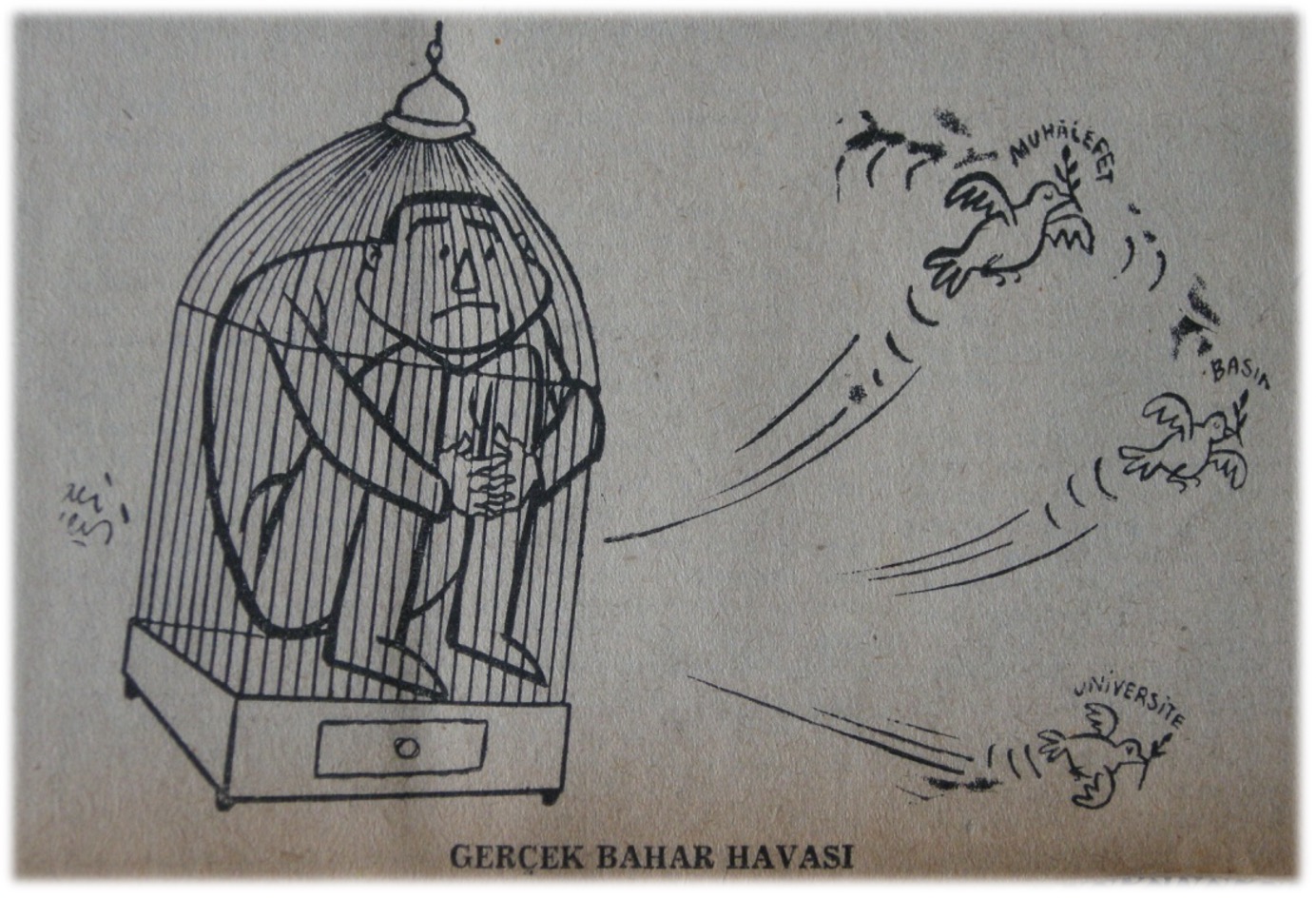
2— The Purges at the Universities: The "147s" Affair
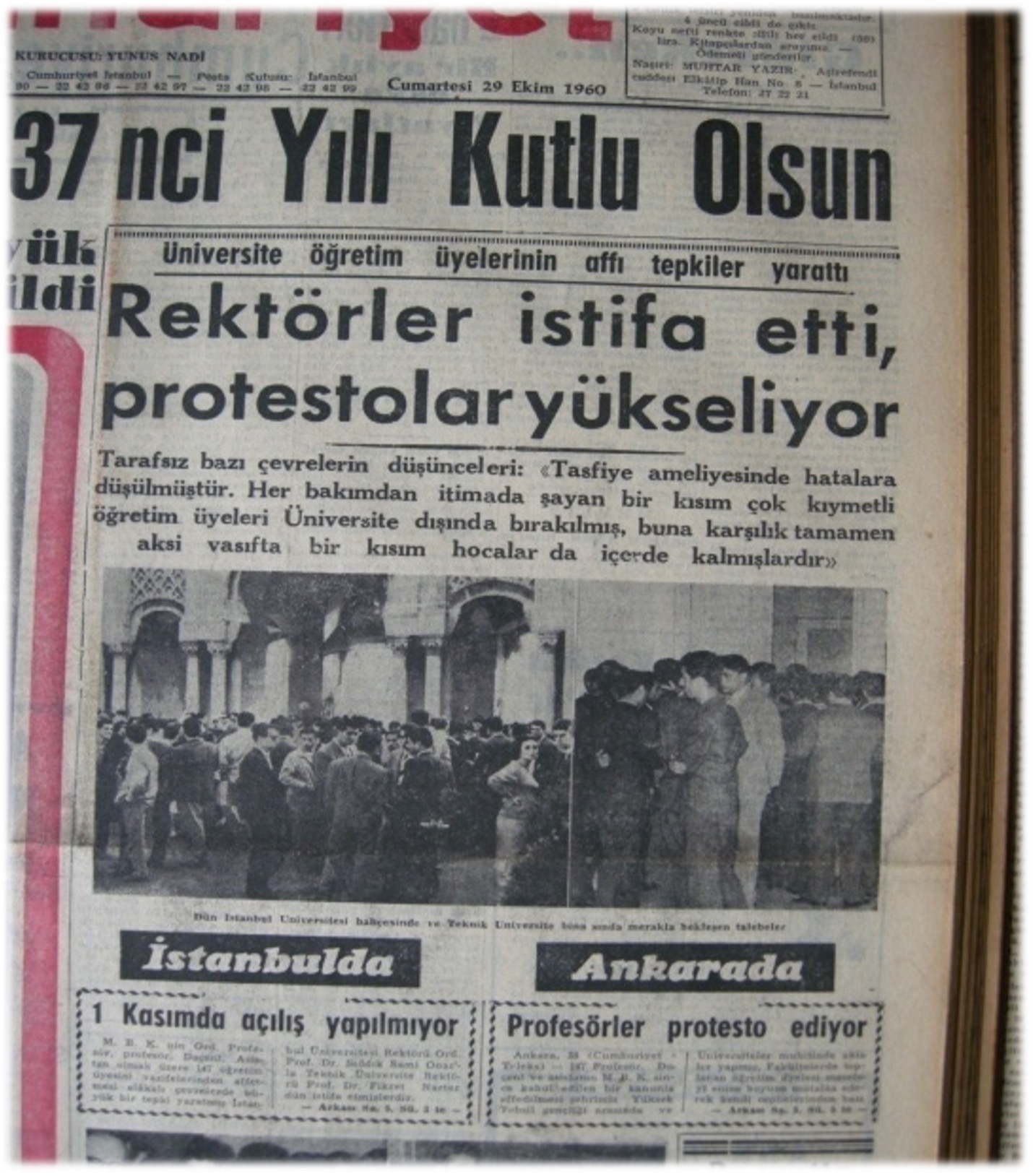
In October 1960, the MBK removed 147 faculty members and assistants from their university posts. This purge came to be known as the "147s affair," and those purged as "the 147s."7 In its wake, many rectors and faculty members resigned in protest. Prof. Mina Urgan, who was herself among those removed, described the episode as the administration "feinting right while striking left."
3— The Attempt to Suppress Kurdish Opposition and the "Sivas Camp"
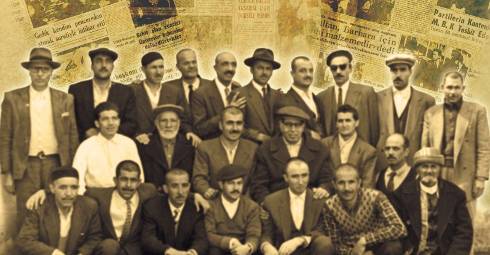
One of the targets of the 27 May coup was possible Kurdish opposition. Within four days of the coup, 485 people — ranging in age from 14 to 70, and known either as Kurdish notables or as members of prominent Kurdish tribes — were taken into custody. A special camp was set up for them within the military garrison of the 5th Recruit Training Brigade in Kabakyazı, Sivas. The 485 were held there, at this "Sivas Camp," for 90 days. At the end of this forced ninety-day stay, 55 of them were sent into exile.
4— Purges Within the Army: The Eminsu, the Fourteen, Talat Aydemir, and the Armed Forces Union
One of the MBK's first actions was to carry out purges within the army itself. The first purge took place on 3 August 1960. Citing Law No. 42, which allowed for the retirement of officers who had completed 25 years of active service, the MBK administration retired 235 generals and admirals along with nearly 5,000 officers. These purged officers would later come to be known as the Retired Revolutionary Officers (Eminsu). This purge served, through restructuring, to legitimize the MBK's authority over the armed forces.8
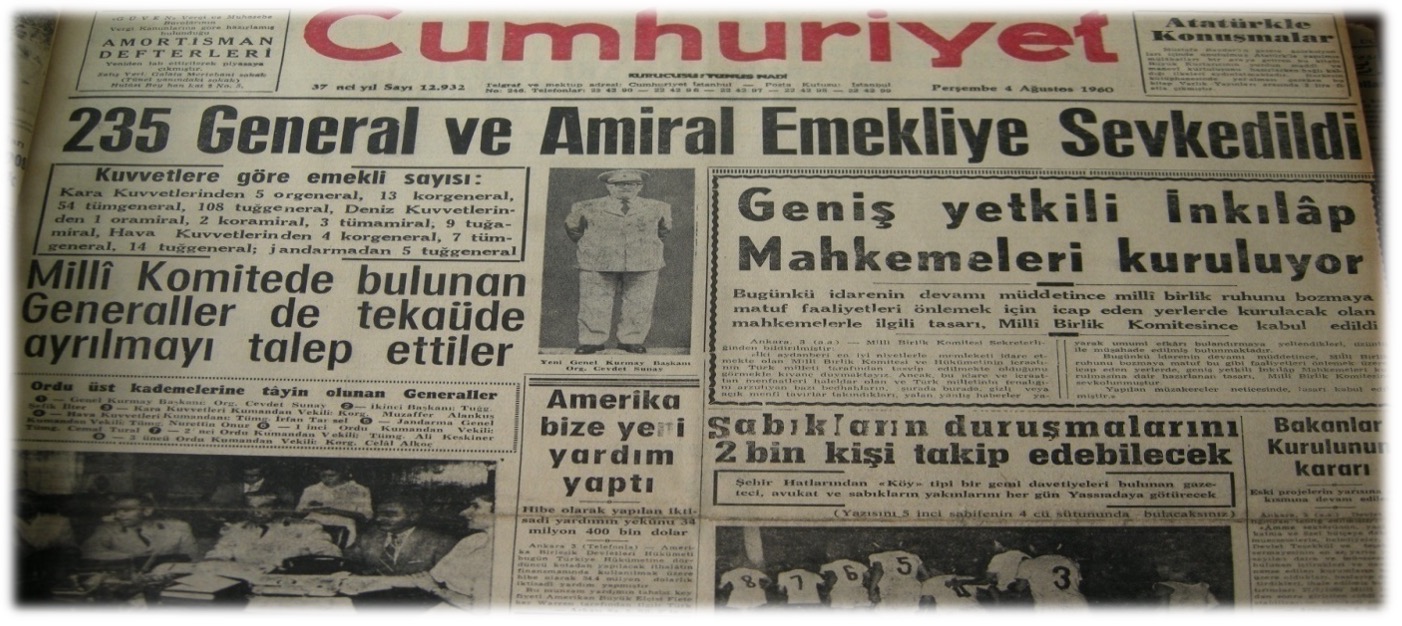
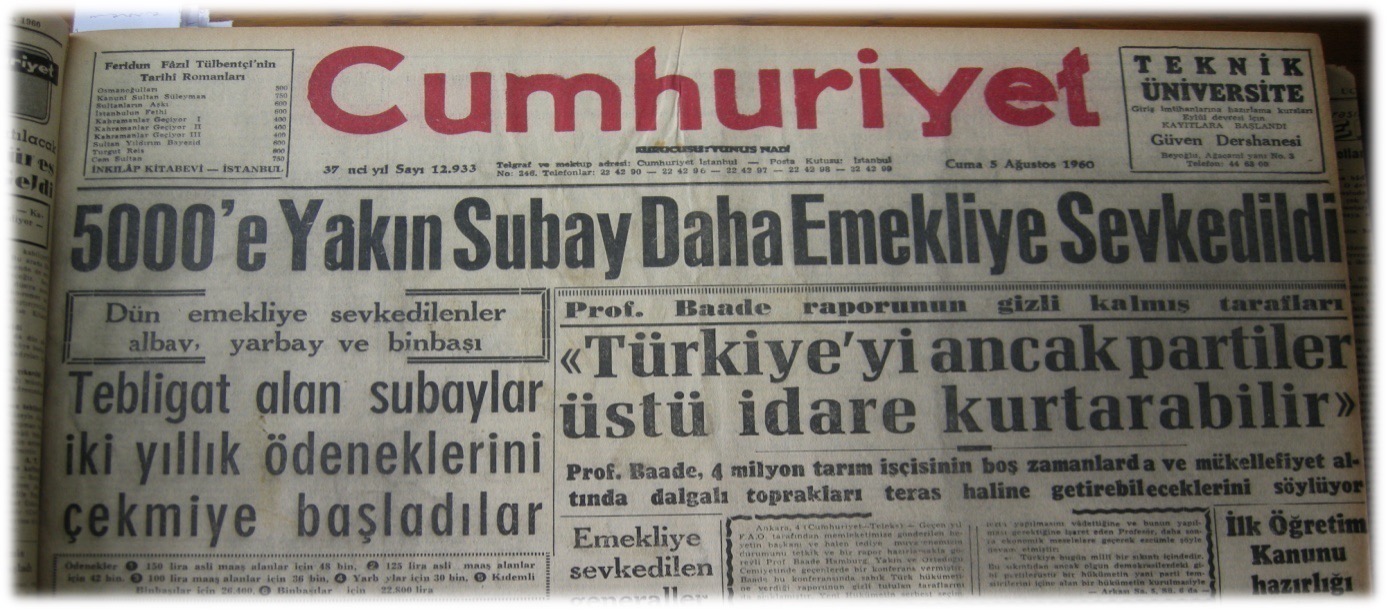
Along with the Eminsu, General Ragıp Gümüşpala — whom the MBK had earlier appointed Chief of the General Staff — was also purged. Gümüşpala, retired on 2 August 1960, would later go on to found the AP.
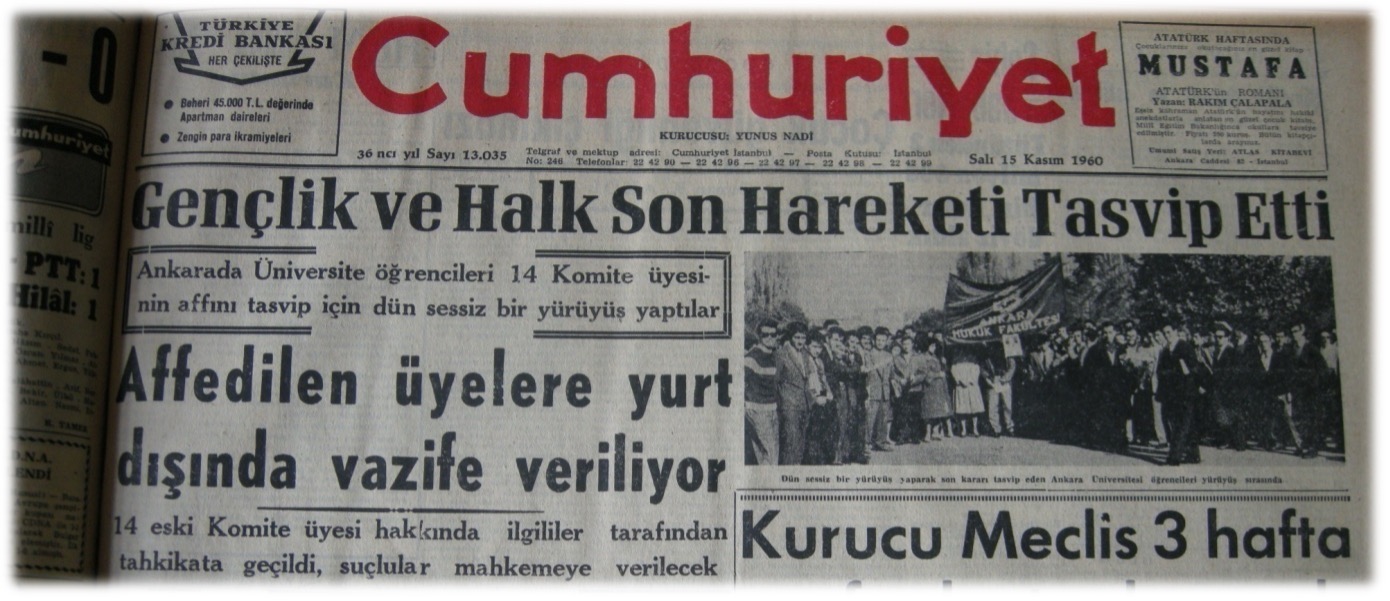
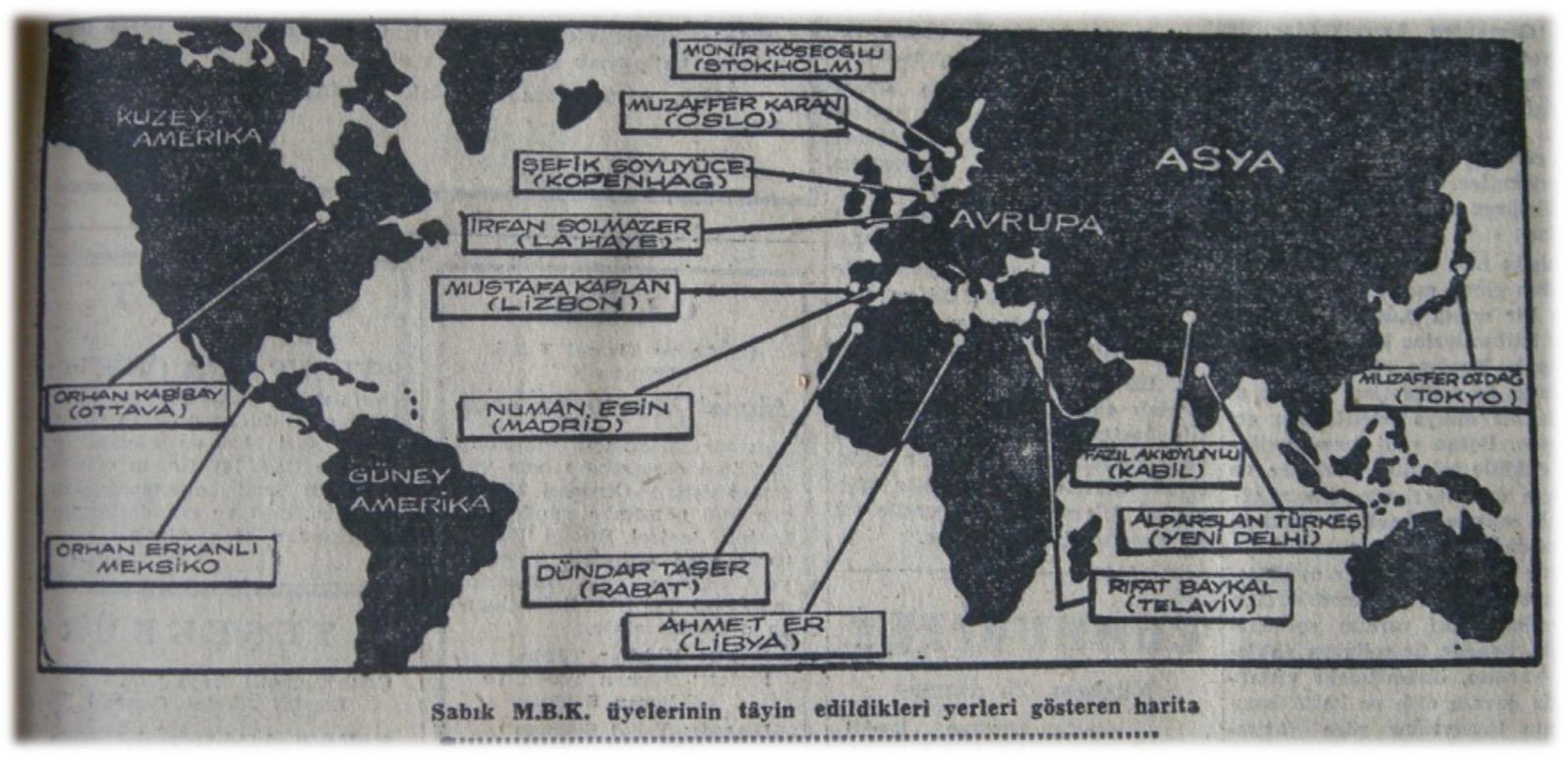
The second purge within the army took place on 13 November 1960. Those purged became known as the "Fourteen." Within the 38-member MBK, two distinct tendencies had emerged immediately after the coup. Members of the first — who might be called the "extremists"9 or the "radical wing"10 — wanted to continue governing the country under military rule even after the coup succeeded.11 Instead of a parliament made up of parties, they envisioned establishing a single national assembly that could work in cooperation with representatives of various professional organizations yet to be formed.12
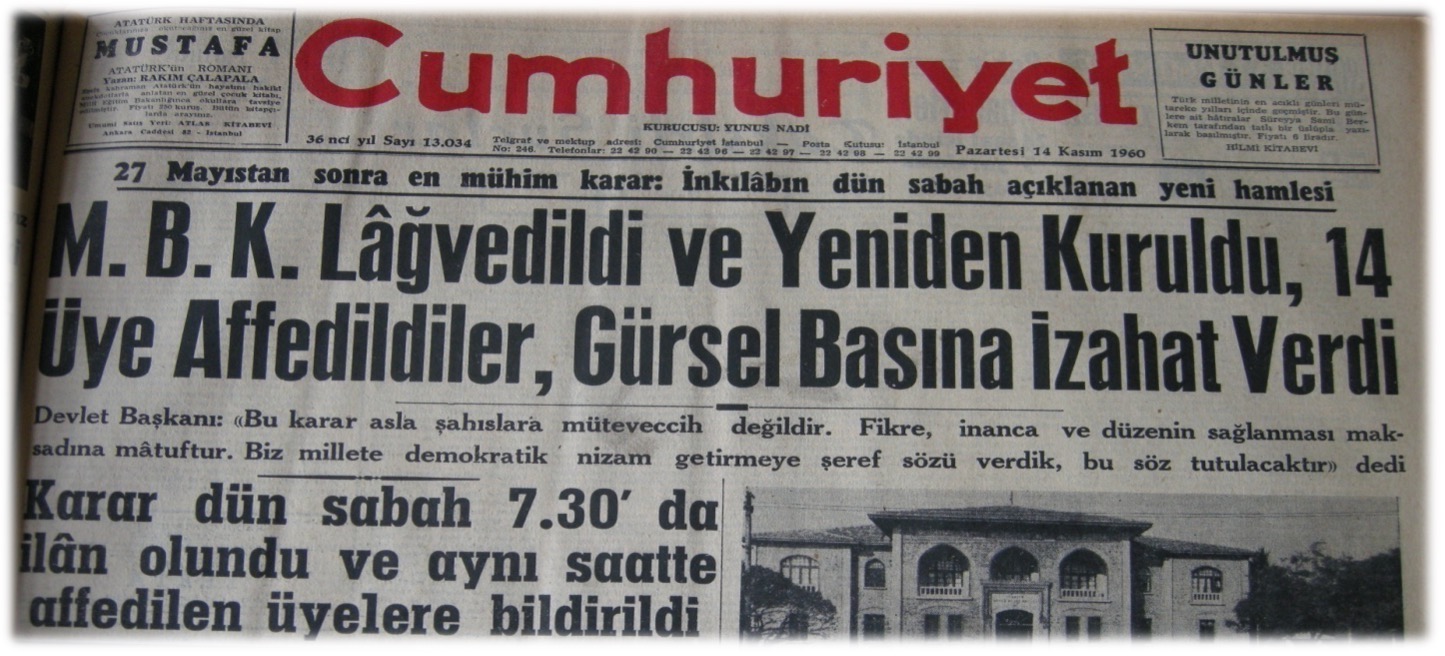
Twenty-one of the MBK's 38 officers belonged to this group. Those in the second tendency — who might be called the "moderates"13 — held, under the influence of İsmet İnönü, that elections should be held and power transferred to parliament as soon as the necessary legal and political arrangements had been made.14 It is an interesting detail that the "extremists" had an average age of 37.2, while the "moderates" had an average age of 45.3.15 Taken together with the fact that everyone who carried out this particular coup came from the relatively lower ranks of the army, this suggests that the younger coup-makers held the more extreme demands.
The most prominent figure among the "extremists" was Alpaslan Türkeş, who had stood trial in the 1940s in the "Turanism"16 cases. Türkeş is known as the architect of the "extremists'" designs.
Ali Gevgilili writes as follows about the sides in this power struggle:
"The strongest pushback against Türkeş and a group of radical young MBK officers in power — suspected of harboring ambitions, through Pan-Turanist ideology, to open a new nationwide single-party, single-man era — came from the leftist circles and the CHP that had once led the opposition against the DP. The left and the CHP raised, as their proposed solution, the demand for a Constituent Assembly."
Ali Gevgilili, Yükseliş ve Düşüş (1987)17In the end, 14 of the most prominent among the 21 officers belonging to the "radical wing" were purged, with the approval of General Cemal Gürsel, by a more moderate MBK faction under the leadership of General Cemal Madanoğlu. Within days of being removed from the MBK and purged from the army, these 14 officers were given advisory status and sent into exile at Turkish embassies abroad.
The Armed Forces Union (SKB)
Madanoğlu, who had carried out the purge of the Fourteen, would himself see his own power curtailed not long after. This was accomplished by a structure that would emerge within the army and, despite the MBK, run the government from behind the scenes: the Armed Forces Union (SKB). This structure demonstrated itself and its strength when the MBK sought to remove General İrfan Tansel from his post, issuing an ultimatum to the General Staff on 6 June 1961. Alongside its demand that Tansel be reinstated as commander of the Air Force, the ultimatum also included a list of military officials whose retirement or reassignment was demanded. Madanoğlu himself appeared on this list, with the demand that he be removed from the Ankara Martial Law Command. The ultimatum further demanded that the MBK no longer interfere in promotions and purges within the army. In the end, the MBK was forced to withdraw its decision to remove Tansel, while Madanoğlu, on 6 June, resigned both his MBK membership and his post as Ankara Martial Law Commander. In this way, the new center of power holding the reins of government in the country became clear: the Armed Forces Union.18
But the SKB, too, was not an internally unified structure. The MBK "was an organization born of the hasty coming-together of various secret committees that had emerged within the army at different times," while the SKB, in turn, arose out of the senior cadres of these groups within the MBK operating among themselves like a kind of council.19 The figure to whom all the groups within the SKB ultimately deferred as leader was the Chief of the General Staff, Cevdet Sunay.20
One of the groups within the SKB was "the colonels' junta that emerged in Ankara under the dominance of Colonel Talat Aydemir and his associates — Aydemir having been among the original core group that organized 27 May, but excluded from the MBK because he was on assignment in Korea at the time of the action."21
Talat Aydemir and the Colonels' Junta
Aydemir was born in Bilecik in 1917. He graduated from the Military Academy in 1939 and the War College in 1954, was posted to Korea in 1959, and remained there until June 1960. Despite his absence from Turkey, however, he took part in the preparations for 27 May. After returning home, he was appointed, while holding the rank of staff colonel, as commander of the Military Academy by the MBK. It was after this that the developments that would bring Aydemir's name to prominence began. Following 27 May, Aydemir would go on to make two further coup attempts.
After 27 May, the share of the vote won by the AP, and its participation in government, caused unease in many quarters within the army. This unease gave rise to the idea that the mission of 27 May remained unfinished, and that the military's guiding role needed to continue, through a new intervention, until matters were set on the right track. For this reason, the period is spoken of in terms of "juntas" — juntas that certain factions within the army were preparing. It was not a single "junta" but several. The one that stood out, and that was actually put into action, was the "Colonels' Junta" led by Talat Aydemir.
Because of the growing unease and mounting coup attempts within the army, İsmet İnönü felt compelled, in a radio address in January 1962, to declare that "I will take part in no movement against democracy — on the contrary, I will fight against it."22 Again at İnönü's initiative, the Chief of the General Staff, Sunay, urgently convened the Expanded Command Council. At this meeting, held on 19 January 1962, those within the army who wanted intervention and those who did not would have it out. Seventy-two commanders gathered at General Staff Headquarters. "They had split into two camps: on one side, Talat Aydemir and the colonels demanding intervention… on the other, Sunay and the generals opposing it…"23 At this meeting, Aydemir told the generals and the Chief of the General Staff, in effect, that they should take the lead in a coup, saying, "I am one hundred percent certain there will be a second revolution in this country. A revolution carried out through the hierarchy would do the least harm." He did not stop there, adding a veiled threat: "I am warning you. There is a fracture within the army. Pressure from the lower ranks is growing." Talat Turhan, then head of the private secretariat of the Minister of National Defense, describes this meeting and the mood among the colonels as follows:
"It was an extremely harsh speech — the kind of thing that simply wouldn't happen in the military under normal circumstances. On one side, the Chief of the General Staff and the force commanders, the generals; facing them, a colonel leveling the harshest criticism, and no one able to say a word in response. Why? Because, along that particular line, the colonel was in the right. This wasn't a matter of being for or against democracy. Given the circumstances that had brought things to this point, there was a shared understanding. And within that shared understanding, there was a particular stance: power must not be handed to the counter-revolutionary. Now Sunay, for his part, was pushing the position that it should be handed over — not because he was for democracy, but because he now saw his own interest lying there…"
Talat Turhan, then head of the private secretariat of the Minister of National Defense24Aydemir's views were clear. In response, Sunay convened a new meeting with the leading commanders on 18 February, found that "the major factions" stood with him, and decided to purge Aydemir and those around him.25 22 February was chosen as the day of the purge. Aydemir and his circle, meanwhile, gathered at Balmumcu on 9 February and decided to seize power within twenty days, having also won over the command echelon and the Air Force. To this end, a written document that would become known as the "9 February Protocol" was signed by the 54 officers present at the meeting.26
The purge plan called for the officers leading the coup attempt to be removed from their posts and reassigned to the East. The reassignment orders were delivered to Aydemir on 21 February, and the coup attempt began the following day.
"What set in motion Aydemir's action on the evening of 22 February 1962 — mobilizing the entire student body of the Military Academy and, with the support of other units, moving to seize control of Ankara — was Sunay's purge plan. Aydemir was so confident that events would unfold as he expected that, having taken İnönü and members of the government captive at Çankaya Palace, he even allowed them to be released. Yet not long after setting his action in motion, Aydemir would find himself alone, as the other senior factions broke away from him one by one. Toward morning, the rebel colonel yielded to Prime Minister İnönü, who announced that those who surrendered without bloodshed would be pardoned and set free. İnönü, even in the eyes of the AP, appeared in that moment as the hero who had saved democracy. Parliament would rise to greet him the following day. Aydemir and his cadres, meanwhile, now stood outside the machinery of the state."
Ali Gevgilili, Yükseliş ve Düşüş (1987)27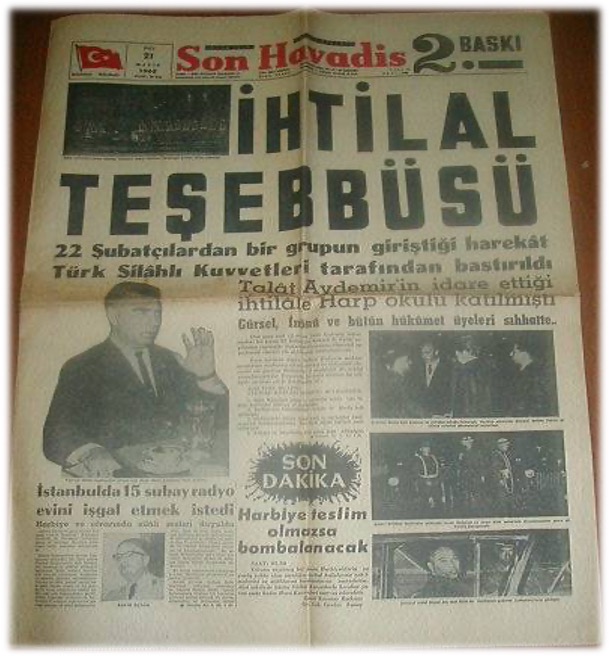
Eight thousand soldiers took part in this coup attempt, 500 of them officers. In the end, 69 officers, Aydemir among them, were forced into retirement, and some generals were replaced. But Aydemir set to work on a new attempt from the very first day.
The second coup attempt took place on 20–21 May 1963. Reports circulated at the time that Aydemir had held talks with, and joined forces with, the Fourteen, who had by then returned to the country. In this coup attempt, however, Aydemir would prove "more alone than ever." "According to rumor, even Türkeş — one of the Fourteen who would for a time be tried alongside him — was among those who had abandoned him long before."28
During the events, 1 air force colonel, 1 major, 2 Military Academy cadets, and 4 privates lost their lives, and 26 people were wounded, including senior generals and officers. Following this coup attempt, the entire student body of the Military Academy was expelled, and charges were brought against 1,439 people, including Aydemir. After the trials, Aydemir and six of his associates (Fethi Gürcan, Erol Dinçer, İlhan Baş, Cevat Kırca, Osman Deniz, and Ahmet Güçal) were sentenced to death; 30 people to life imprisonment; and 33 people to prison terms ranging from 3 months to 15 years. Thirty-eight people, including some former officers among the Fourteen, were acquitted. Of the military cadets arrested at the Military Academy, 1,293 were acquitted, while 91 received 3-month sentences and 75 received 4-year sentences. Of those sentenced to death, Major Gürcan was executed on 26 June 1964, and Aydemir on 5 July 1964.29
Although the unrest among the army's lower ranks appeared to have been suppressed by these sentences and executions, it would continue to simmer beneath the surface and would manifest itself again in 1971, in the form of two separate coup attempts. In 1971, there were two coup preparations underway: one, characterized as "leftist," known as "9 March," and the other, characterized as "rightist," known as "12 March." It was the 12 March faction that carried out the coup.30
Governments from 27 May to 12 March
Five governments were formed between 27 May and 12 March. On average, one might say a government changed roughly every two years. But even this does not give the full picture. In the first five years after 27 May, the government changed almost every year, and four separate coalition governments were formed. This alone is enough to show the political turbulence and tension of the period. These five governments were as follows:
1— 20 November 1961 – 1 June 1962 — CHP–AP coalition (First İnönü Coalition)
2— 25 June 1962 – 2 December 1963 — CHP–YTP (New Turkey Party)–CKMP (Republican Peasants' Nation Party) coalition (Second İnönü Coalition)
3— 25 December 1963 – 13 February 1965 — Third Coalition period. The CHP formed the government with the participation of independents, while the YTP provided outside support.
4— 20 February 1965 – 10 October 1965 — Fourth Coalition period. An AP–YTP–CKMP coalition headed by Suat Hayri Ürgüplü. The deputy prime minister was Süleyman Demirel, the AP's chairman, who was not yet a member of parliament.
5— 27 October 1965 – 12 March 1971 — The AP government period, under Prime Minister Süleyman Demirel.
27 May was carried out to end DP rule. Yet in every election held after 27 May, one of the two strongest parties was the AP, seen as the DP's successor. What is more, the AP, together with the other right-wing parties in parliament, was in a position to form a government from the very first election onward. Seen from the military's side, the intervention had failed — it had not worked. The first three coalitions formed after the military intervention came about, in effect, at the army's own prodding. In an arithmetic dominated by the right, every option was tried in an effort to form CHP-led coalitions, but this succeeded only three times. For this reason, the fourth coalition period, from which the CHP was absent, is also seen as marking the beginning of the end of the "transition to civilian rule" — the point at which the army's cold shoulder toward the AP came to an end.31 This assessment, however, does not mean that this process unfolded without difficulty.
The 21 October Protocol and Gürsel's Presidency
The results of the first election held after 27 May sent shockwaves through the army and the CHP alike.32 The newly founded AP, seen as the DP's successor, won an unexpectedly high share of the vote. The parliamentary arithmetic allowed for a right-wing coalition that would leave the CHP out.
Results of the 15 October 1961 Election33
| In the National Assembly | In the Senate | ||||
|---|---|---|---|---|---|
| Party | Vote Share (%) | Seats | Party | Vote Share (%) | Seats |
| CHP | 36.7 | 173 | AP | 35.5 | 71 |
| AP | 34.8 | 158 | CHP | 37.1 | 36 |
| CKMP | 14 | 54 | CKMP | 13.5 | 16 |
| YTP | 13.7 | 65 | YTP | 14 | 27 |
| Independent | 0.8 | — | Independent | 0.4 | — |
The first reflection of this shock within the army was the 21 October Protocol. Ten senior generals and admirals, along with 28 colonels, signed a document that would come to be known as the 21 October Protocol and delivered it to the Chief of the General Staff, Cevdet Sunay. The aim of the protocol was to neutralize, through an intervention to be carried out no later than 25 October, the parliament due to open on 26 October. In other words, parliament was to be shut down before it had even opened! It was only through İsmet İnönü's open declaration that he would stand against any new intervention, and his role as an intermediary, that parliament was able to open.34 To this end, party leaders and commanders met at the Presidential Residence, where negotiations took place. The commanders had four demands:
1— Gürsel's election as president would be made certain
2— The Yassıada convicts would not be pardoned
3— The Eminsu would not be readmitted to the army
4— The 147s would not return to the universities
At this meeting, in which İnönü played the decisive, balancing role, the party leaders accepted the terms concerning Gürsel and the Eminsu; the condition against pardoning DP members was approved with the qualifier "for now"; and the item concerning the 147s was dropped.
In accordance with this "agreement," Ord. Prof. Dr. Ali Fuat Başgil — the AP's presidential candidate, elected senator from the Istanbul list — "was forced, that same evening in Ankara, at gunpoint and with certain MBK members present, to submit his resignation from parliament, and was removed from the capital at midnight."35 In the end, the AP was compelled to form a coalition with the CHP, and Gürsel was elected president.
Considered together with all of this, the characterization of this period as a "transition to civilian rule" becomes easier to understand.
Parties in the Grand National Assembly After 27 May
As the table above shows, four parties took part in the first election held after 27 May. Of these, the CHP, led by İnönü, and the CKMP, chaired by Osman Bölükbaşı, were the only two parties that survived from before 27 May. The AP and the YTP were both founded in 1961. One more party was founded in 1961: the Turkish Labor Party (TİP).
The Justice Party
It was founded on 11 February 1961. It is known as the DP's successor. Because the DP's leading cadres had been neutralized and stripped of their political rights, it was people from the lower ranks of the party hierarchy who contributed to the founding of the AP. It would be wrong, however, to say that the AP's founders were entirely former DP members; cadres with no DP background were also involved in its founding.
"At its founding stage, the Justice Party lived out both of these possibilities at once. In this way, a door to political struggle and a climb toward power was opened even to the most distant relatives of the DP members being tried on Yassıada. Through this door would pass grieving spouses, and ambitious, resentful children."
Ali Gevgilili, Yükseliş ve Düşüş (1987)36The AP's first chairman, though not himself a DP member, was another figure who had suffered from 27 May — a soldier, and no ordinary one: a general who, while serving as the first Chief of the General Staff after 27 May, was removed from his post during the purge carried out by the MBK: Ragıp Gümüşpala. Most of the retired officers purged from the army and known as the Eminsu also gave Gümüşpala their support.
The New Turkey Party
A second party on the "right," alongside the AP, was the New Turkey Party, founded in February 1961. Although, just as with the AP, former DP members took part in its founding, the YTP was a party that underscored certain differences setting it apart from the DP.
"There, too, were former DP members. And yet Ekrem Alican, who would go on to lead the YTP, along with Prof. Aydın Yalçın, Yusuf Azizoğlu, and others like them, were people from the liberal wing who, past a certain point, found themselves at odds with the DP's outlook. In keeping with the name they had chosen, they aimed, in this respect, to bring Turkey together along new lines. The feelings of resentment and revenge held by Democrat and Justice Party members were simply not a factor for them."
Ali Gevgilili, Yükseliş ve Düşüş (1987)37The Turkish Labor Party
A third party founded in February 1961 was the Turkish Labor Party. It was founded by 12 trade unionists.38 In 1962, in order to bring the working class together with intellectuals, a call was issued inviting intellectuals to join the party; in response, many intellectuals joined, among them Mehmet Ali Aybar, Behice Boran, Adnan Cemgil, Nazife Cemgil, Cemal Hakkı Selek, and Fethi Naci. On the founders' recommendation, Assoc. Prof. Dr. Mehmet Ali Aybar was made the party's chairman.
TİP was unable to take part in the first general election held after 27 May. In the 1963 local elections, it was able to run in 9 provinces and 31 districts, winning more than 35,000 votes, 20,000 of them in Istanbul. TİP secured its first representation in parliament in February 1963, when independent senator Niyazi Ağırnaslı joined the party.39 Following Ağırnaslı, appointed senator Esat Çağa also joined TİP.40 In the 1965 election, running in 51 provinces, it won 2.83 percent of the vote and sent 15 deputies to parliament. In the 1966 partial Senate elections, it won a Senate seat as well with a vote share of 3.79 percent, bringing its total representation in parliament to 16. In the 1969 general election, although it won 2.56 percent of the vote, it was able to elect only two deputies because the electoral law had been changed.41
Aybar resigned as chairman on 16 November 1969. After his resignation, the chairmanship was held first by Mehmet Ali Aslan and then by Şaban Yıldız. At TİP's Fourth Grand Congress, held in October 1970, Behice Boran was elected chairman. Following the 12 March coup, the party was shut down by decision of the Constitutional Court on 20 July 1971. The main TİP trial concluded on 17 October 1972, with the party's leaders given heavy prison sentences.
The Republican Peasants' Nation Party – The Nationalist Movement Party
The CKMP was founded on 16 October 1958 through the merger of the Republican Nation Party (CMP) and the Turkish Peasants' Party. Osman Bölükbaşı, previously chairman of the CMP, was elected chairman of the CKMP as well, and led the party until his resignation in 1962. Bölükbaşı resigned as party chairman because the CKMP had joined İnönü's Second Coalition government. After Bölükbaşı, the party was led in turn by Ahmet Tahtakılıç, Ahmet Oğuz, and Alpaslan Türkeş.
Türkeş began to gain influence within the CKMP starting in 1963. The exiled Fourteen began returning to the country from 1963 onward, and Türkeş was among them. After returning, he joined the CKMP at its congress of 22–23 February 1964, together with several other members of the Fourteen (Dündar Taşer, Ahmet Er, Muzaffer Özdağ, Rıfat Baykal, Mustafa Kaplan…). Less than a year after joining, in 1965, he was elected party chairman and steered the party according to his own views. That same year, he was elected as a deputy from Ankara.42
The youth organization of the CKMP (MHP) was the structure known as the "Ülkü Ocakları" (Idealist Hearths). Alongside it, however, the Young Idealists Organization, whose organizing began in 1967, was also for a time among the party's youth organizations. The first Ülkü Ocakları opened in Ankara in 1966. Following the Ülkü Ocakları established at the Ankara Faculty of Law, the Faculty of Language, History and Geography, and the Faculty of Agriculture — which announced their founding on 18 March 1966 — these hearths spread more widely in 1968. On 15 March 1969, in opposition to the leftist youth's Federation of Idea Clubs, the Ülkü Ocakları Birliği [Idealist Hearths Union] was formed as an umbrella organization for the Ülkü Ocakları. Namık Kemal Zeybek, chairman of the CKMP Youth Branches; Dündar Taşer, CKMP deputy chairman; and Muzaffer Özdağ, CKMP deputy secretary-general, all played major roles in the founding and spread of the Ülkü Ocakları.43 Ahmet Karabacak, a leading MHP figure of the period, describes the founding of the Ülkü Ocakları and the Young Idealists Organization as follows:44
"In 1967, the ÜLKÜ OCAKLARI began to be established, centered in Ankara. At first, each Ülkü Ocağı operated independently within its own faculty. Later, they came together as a union. These founding efforts were organized by Sadi Somuncuoğlu, the party's youth branches chairman at the time.
Sadi Somuncuoğlu sent me a hearth charter so that a branch could be opened in Istanbul. We first carried out this work in the faculties where we could find people. Once we had enough numbers, we worked to establish the Istanbul Ülkü Ocakları Birliği. Given the conditions of the time, renting a place right away wasn't possible. We put together a team of university students. Our shop was used as the center of the Istanbul Ülkü Ocağı. The first union was established under the chairmanship of Osman Bahadır. After the hearth had operated out of the provincial party headquarters for a few weeks, I rented a two-room place on Nuruosmaniye Avenue, and the hearth began operating from there.
I had heard that work was underway in Ankara to organize high-school-age youth as well. One day, when I had gone to the general headquarters in Ankara and was sitting at the party office, my dear friend and brother Salih Dilek — an idealist who could never sit still — came up to me. He was working to get our Millî Hareket [National Movement magazine] sold in Ankara. I believe he was in his second year of high school at the time. Showing me a drawing he was holding, he said: 'Brother, we're founding the Young Idealists Organization to organize high-school youth. We're thinking of using this as the emblem.' It was a drawing of a wolf with its head raised toward the sky. I took out my pen and drew a crescent around the wolf, open side up. I said it would look better this way. That emblem then became the emblem of both the youth branches and the Young Idealists Organization.
Salih Dilek, as chairman, spread this organization across the whole of Turkey."
Ahmet Karabacak, Üç Hilal'in Hikayesi (2011)The official website of the Ülkü Ocakları describes the period as follows:45
"An important point to note here is that the young people who embraced these ideas founded, within the universities, the Young Idealists Organization and the Ülkü Ocakları — bodies that would later become formal associations, and that were engaged first and foremost in intellectual and cultural work. But the communists' increasingly aggressive political activity within the universities from 1968 onward, tied to intimidation, and their efforts to keep idealist youth out of the schools, forced the idealists into a position of self-defense. Filled with a love of nation and homeland strong enough to say 'My homeland! For your sake, whether it be bread or a bullet,' these young people gave nearly four thousand martyrs — Ruhi Kılıçkıran, Dursun Önkuzu, and Süleyman Özmen chief among those who became emblematic — in the effort, before 12 September, to block the communists' strategy of "liberated schools/zones," entering it, as it were, 'as though stepping into a rose garden.'
Even today, in a way that still inspires astonishment, the Ülkü Ocakları and the Idealists belonging to this institution organized themselves almost down to the village level across Turkey, becoming the sole address for nationalist-traditionalist youth. One right that has still not been restored to the idealists today is that, by blocking the communists' efforts to nest within the universities, and through the idealist pushback the communists found themselves facing, the communists were prevented from attempting a revolution. The idealists also founded the Büyük Ülkü Derneği [Great Ideal Association] aimed at pre-university youth. The Ülkü Ocakları Derneği [Association] was, from time to time — particularly during periods when the CHP was in power — forced to continue its activities under names such as the Idealist Youth Association or the Ülkü Yolu [Path of the Ideal] Association."
Official website of the Ülkü OcaklarıThe CKMP took the name Nationalist Movement Party (MHP) at its congress held in Adana on 6–8 February 1969. Along with the name, the party's emblem also changed: the scales that had previously served as its emblem gave way to the three crescents. The party's youth branches, meanwhile, began using the wolf-within-a-crescent emblem. This period also saw a split within the party between the "grey wolf faction" and the "crescent faction" led by Türkeş.46
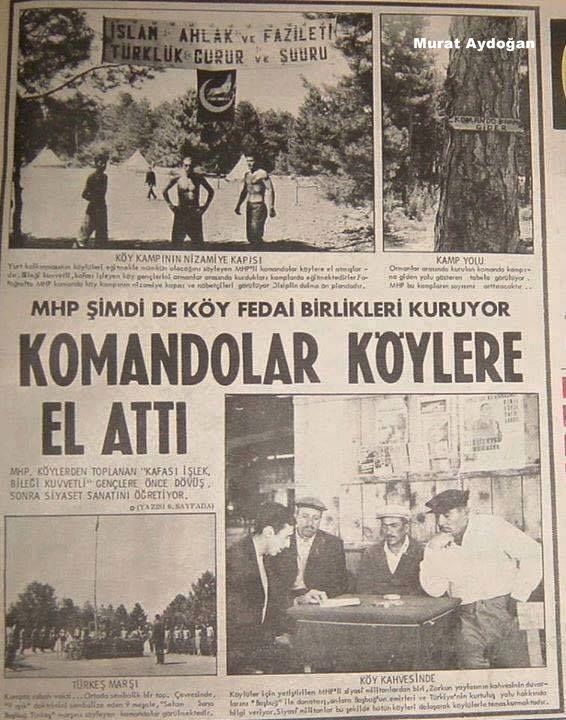
From 1968 onward, the party's name became associated with the "Commando Camps" it established. The "Commando Camps" deserve close attention, as they were among the important actors and parties responsible for this period.
The Commando Camps
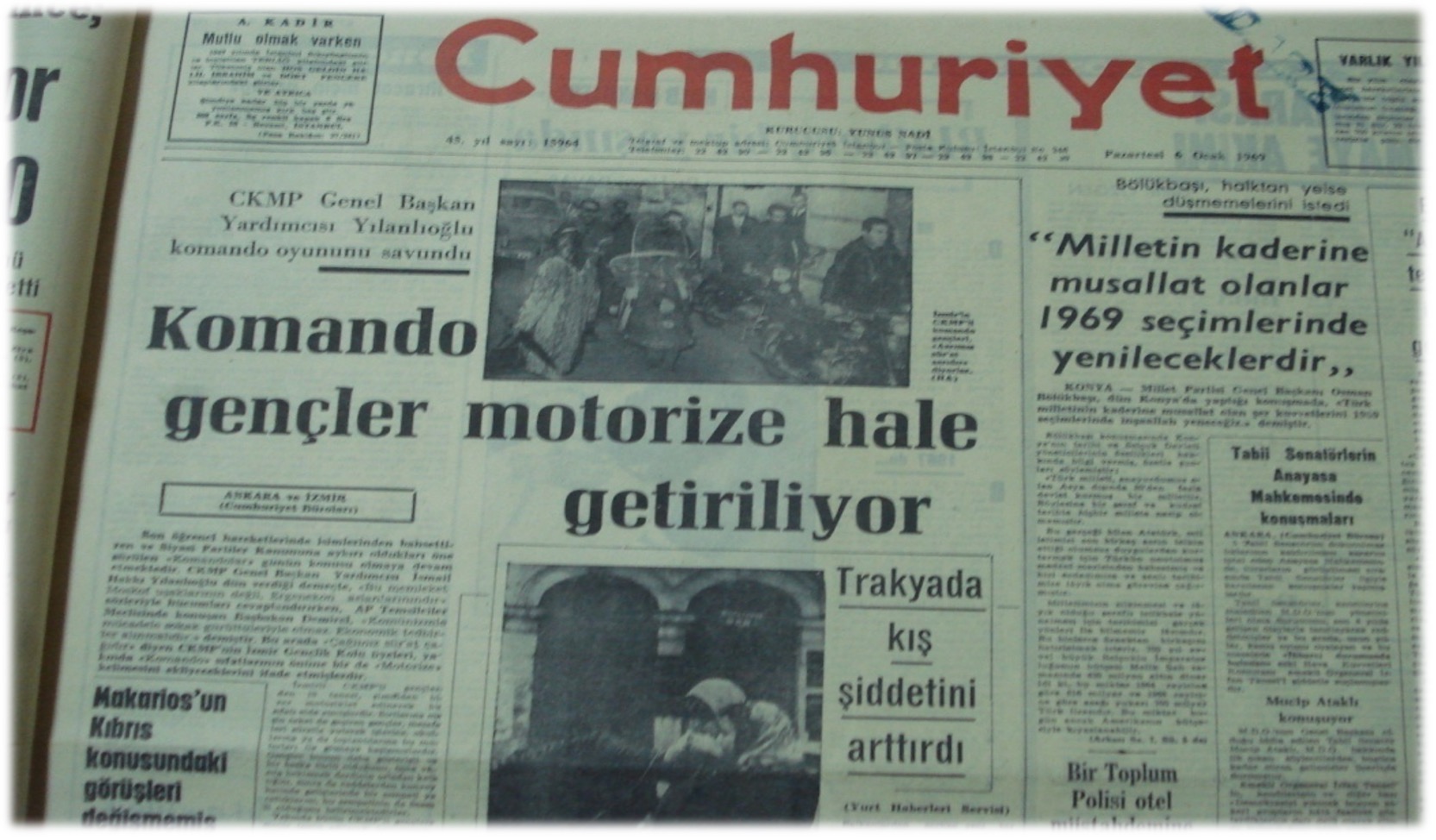
The "Commando Camps" first entered public discussion through newspaper reports in 1968. In those days — when Ambassador Komer's car was set on fire, when the Sixth Fleet's anchoring in Turkish ports was being protested, and when leftist youth's protest actions were steadily escalating — CKMP spokesman Rıfat Baykal announced that his party would provide commando training to young people at camps.47
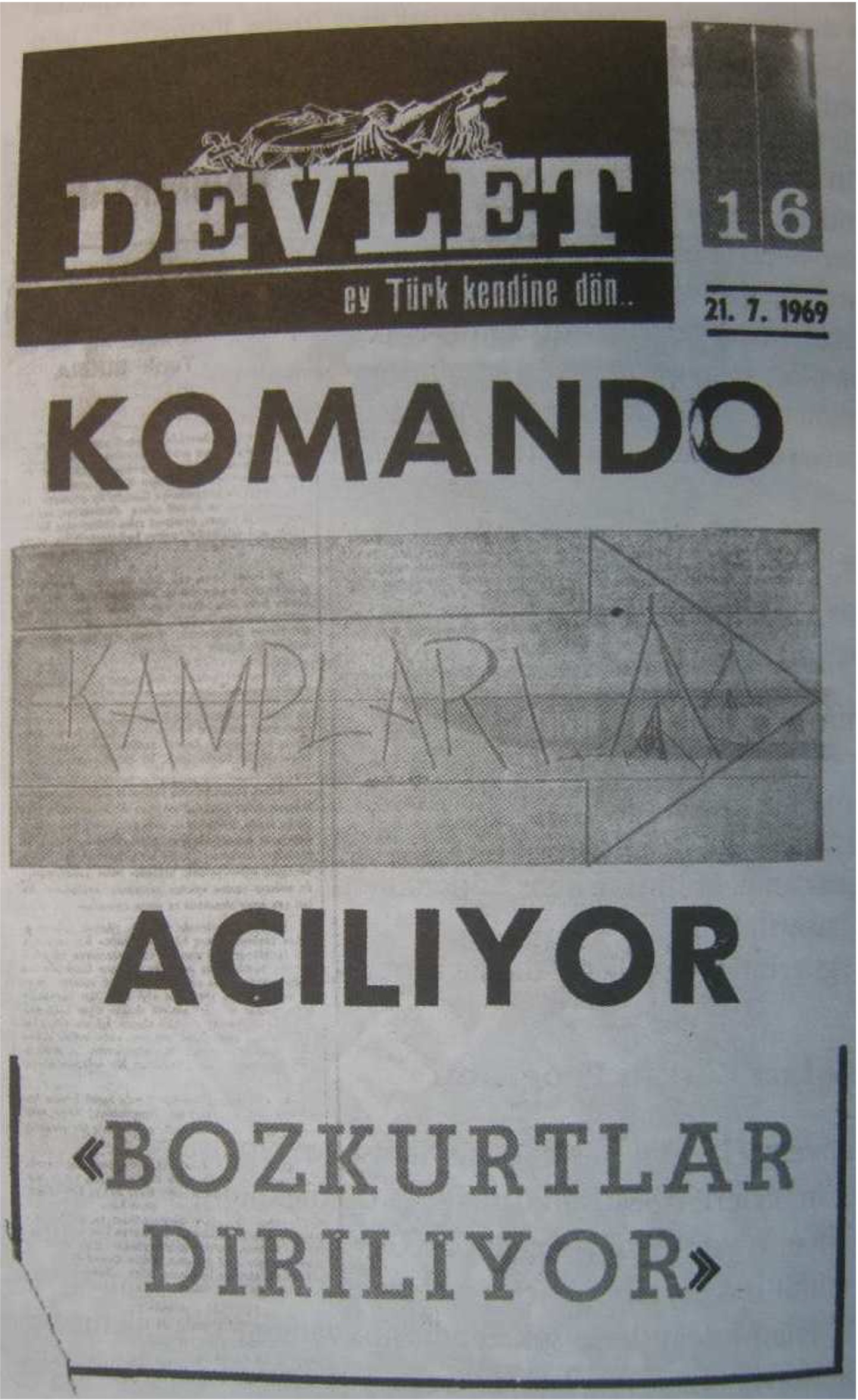 Devlet magazine — "Reviving with the Grey Wolf / Commando Camps Opening"
Engin Konuksever, a journalist who entered one of these camps and took photographs at the time, describes what he saw as follows:
"We had gone to a commando camp in Çanakkale. There, they taught things like close-combat techniques and how to make Molotov cocktails. And after the camp ended, of course, people went straight into the events…"
Engin Konuksever, journalist48
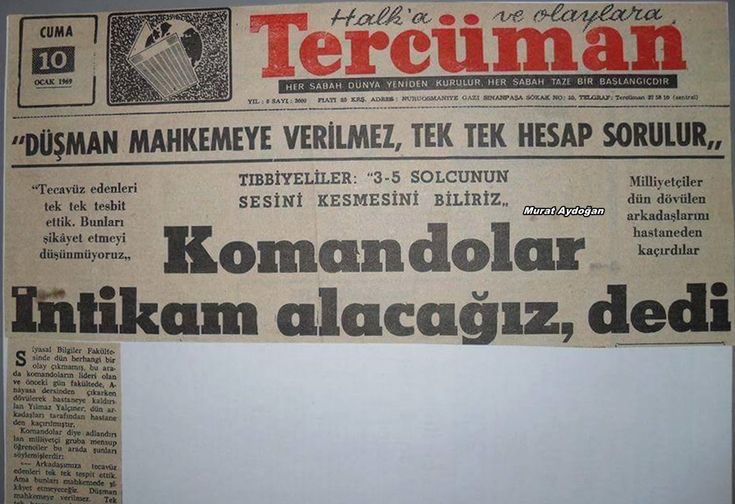
Although the connections behind the Commando Camps remain a matter of debate, no one denies their existence. Türkeş himself acknowledges the existence of these camps.49 Türkeş's interview, published in the newspaper Hürriyet on 10 January 1969, openly demonstrates this acknowledgment:50
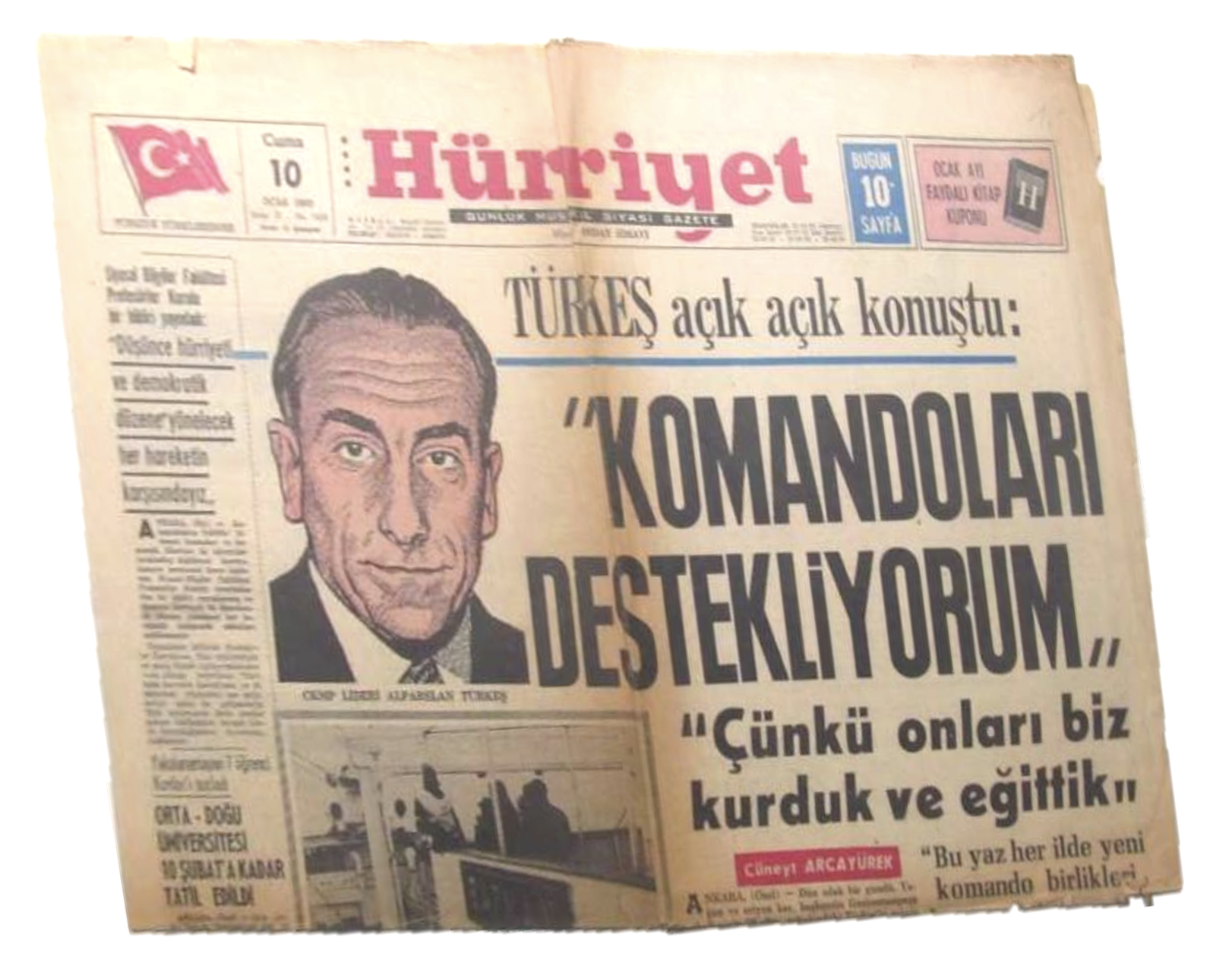 📎 Hürriyet, 10 January 1969. Türkeş: "I support the commandos. Because we founded and trained them."
Added later — May 2026
📎 Hürriyet, 10 January 1969. Türkeş: "I support the commandos. Because we founded and trained them."
Added later — May 2026
Türkeş spoke plainly: I support the commandos. Because we founded and trained them… Question: If the clash between the two groups widens further, even spreading to the general public, wouldn't that be dangerous? Answer: No, because we've built a dam with these young people of ours. The communist movement can no longer grow. There may be a few more incidents in the coming days, but things will settle down after that. Because we stand against them. The young people they call "commandos" have embraced the Nine Lights.
Alpaslan Türkeş, Hürriyet, 10 January 1969
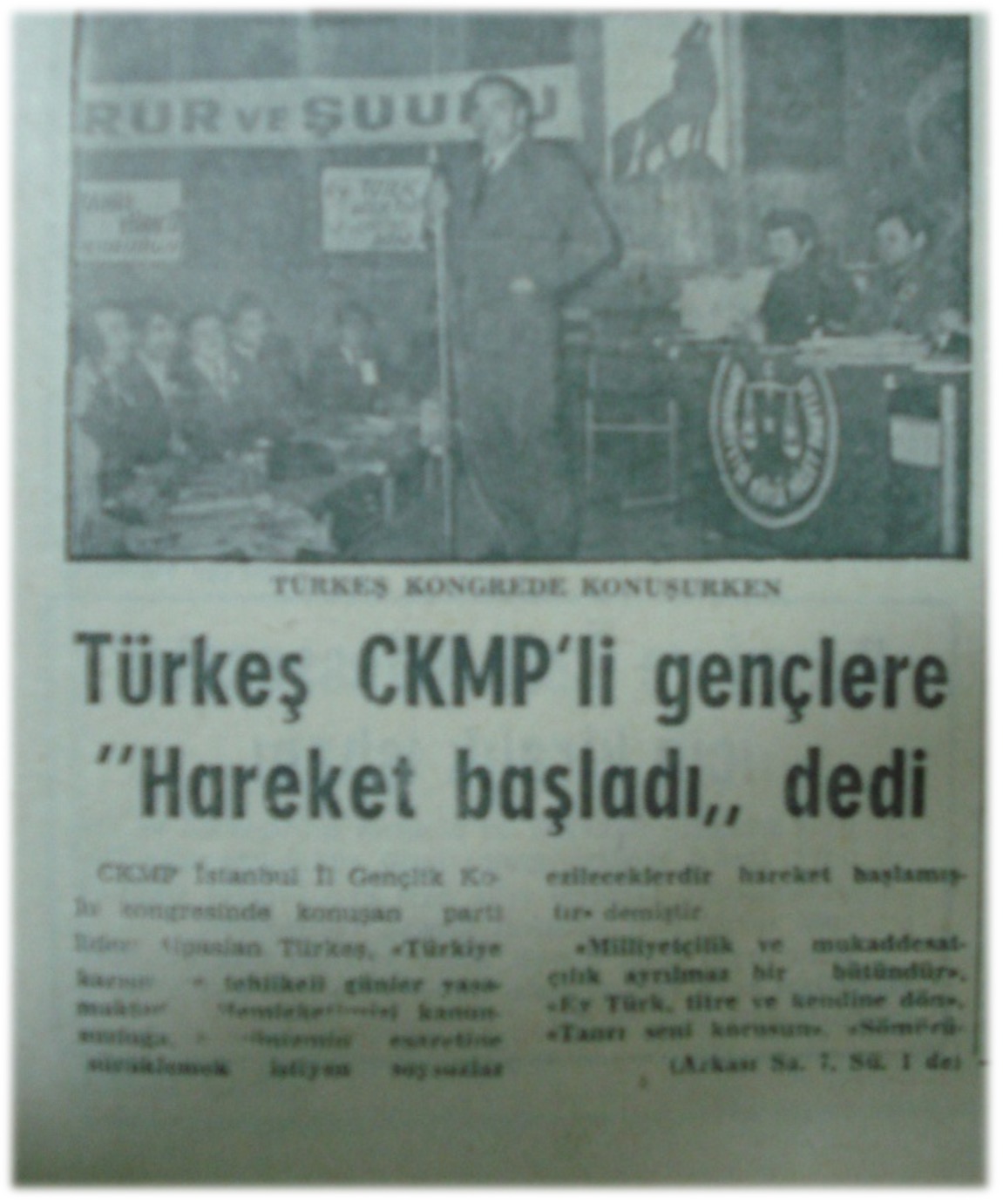 27 January 1969, Cumhuriyet
First-hand accounts of the founding of the Commando Camps can be found in Ahmet B. Karabacak's book Üç Hilal'in Hikayesi, in Ahmet Haldun Terzioğlu's book Komando, and in the third volume, titled "Conspiracies and Provocations," of Hakkı Öznur's book Ülkücü Hareket. Karabacak, who was himself part of right-wing youth circles at the time, states that in 1967 their first objective was "to bring young people into a position of intellectual superiority against the communists and separatists nesting in the universities,"51 and that they then began founding the Ülkü Ocakları Derneği, centered in Ankara.52 The Commando Camps also entered the picture during this period:53
"While this organizing continued, communists loyal to Moscow, together with their sympathizers in the press and other centers of influence, kept attacking us across Turkey. The police, because of the government's passivity, could not act effectively. It had become dangerous even for idealist youth simply to enter schools, or to walk in the streets.
This had to be prevented — Turkey, and with it the schools, had to be defended. The task had fallen to us; we were going to do what the government could not.
Starting in 1967, we began opening training camps across every part of Turkey during the summer months. The press pinned the name COMMANDO CAMPS on them. These camps spread so quickly that even we found it impossible to keep control of them. National Consciousness was spreading rapidly across Turkey, especially among the youth.
In Istanbul, the first was opened in Silivri by my late friend Ufuk Şehri, president of the Istanbul University Students' Union; the following year, one opened under my own direction in Küçüksu. These camps continued to open every summer for several years, and here young people were trained both intellectually and physically."
Ahmet B. Karabacak, Üç Hilal'in Hikayesi (2011)
Terzioğlu, too, states that the idea for the Commando Camps was formed by Türkeş and other leading CKMP cadres, and that it was put into practice with the goal of "a hundred thousand commandos":54
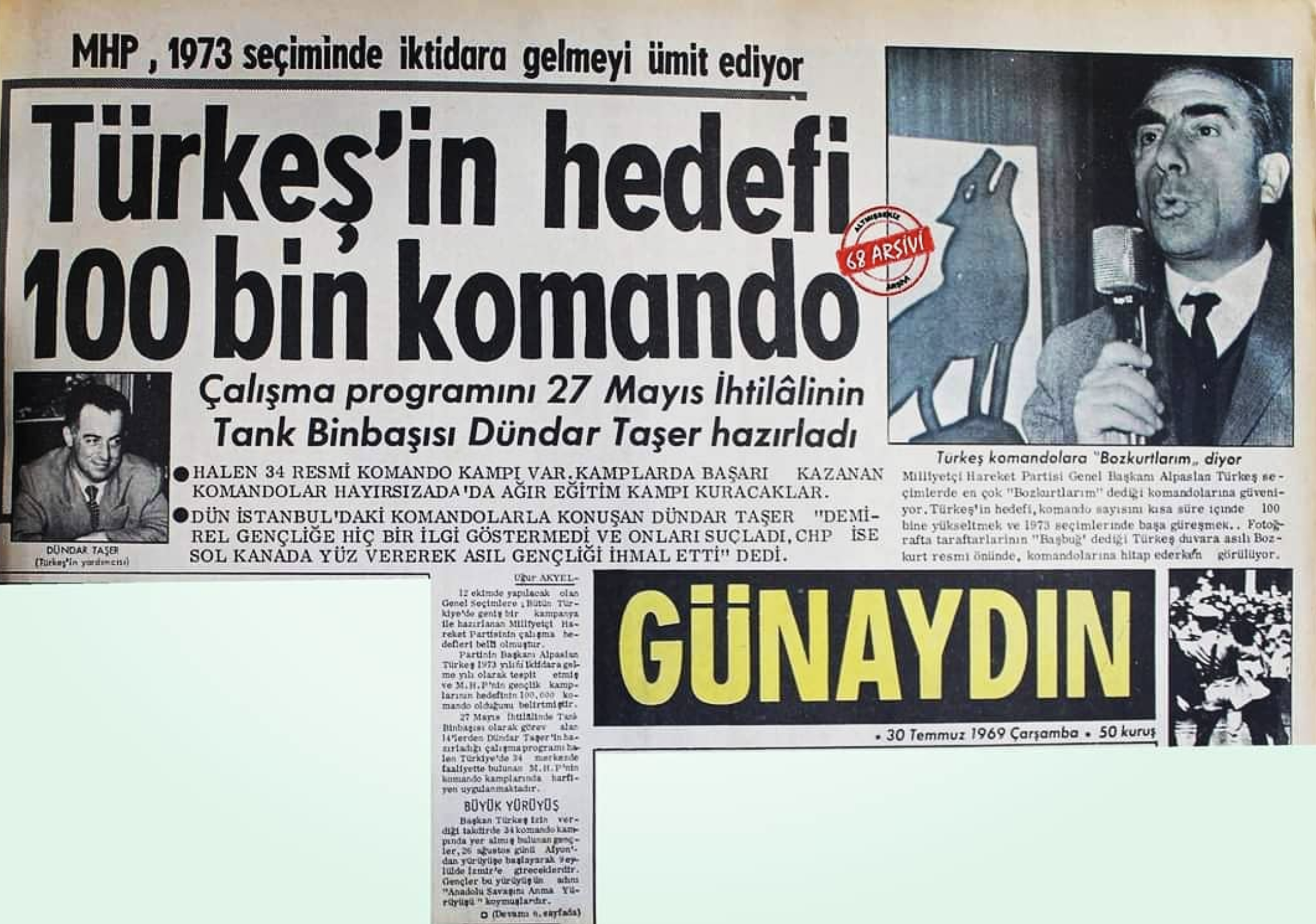 📎 Günaydın, 30 July 1969 — Türkeş's target: 100,000 commandos.
Added later — May 2026
📎 Günaydın, 30 July 1969 — Türkeş's target: 100,000 commandos.
Added later — May 2026
In Ankara, CKMP chairman Alpaslan Türkeş, along with his close friend and comrade-in-arms from the army and from the National Unity Committee during the 27 May Revolution, were working to solve this problem.
"How are we going to train the Grey Wolves? How will we build the intellectual structure, how will we establish the ideology, the doctrine?"
"Let's set up youth camps!"
"A hundred thousand young people… A hundred thousand Idealists…"
"A hundred thousand commandos…"
"Commandos…"
They had taken up this name and made it their own. They saw it as a source of strength, a foundation to stand on. Nor did they see any harm in it. Since their opponents were already calling them "commandos," and since this name unsettled those opponents, there was value in keeping it — at least until they had grown strong, until they had consolidated. There was a clear need to write a legend.
Ahmet Haldun Terzioğlu, Komando (2010)
Terzioğlu also relates, as follows, the exchange of ideas that took place among the CKMP's leading figures before these camps were put into practice:55
The foundations of the idea had been laid; it was now time to plan what needed to be done to put it into practice. The talks and discussions went on for days. Their fellow travelers were consulted. Their views were taken into account.
"These young people, mostly university students — we mustn't keep them away from their schools, or set them back in their studies. So during the summer break…"
"The midyear break…"
"The location!"
"Away from the cities and towns, but close to the provinces and districts where our associations are strong…"
"Coastlines, highland plateaus, forests…"
"These are suitable places for setting up camps — without disturbing the local people, but not too far from view either…"
"Let it be known what's there, what's being done! We have nothing to hide from this nation!"
Ahmet Haldun Terzioğlu, Komando (2010)
Terzioğlu also notes an important detail concerning how the Commando Camps were reflected in the press, and how, for a time, CKMP officials — Türkeş foremost among them — publicly owned the camps as their own:56
"Let's quietly feed stories to the press, keeping in mind the psychological impact, the propaganda effect! Let's get news items written!"
"The coverage is bound to be negative! The press will use its rented mouth in the language of whoever's renting it — and that will work against us, misrepresent us!"
"So be it! Sometimes negative propaganda has a better effect than positive. Let our own people also explain our purpose."
"Let's also make direct statements ourselves, from the party, straight from the source!"
"A hundred thousand young people… A hundred thousand Commandos…"
Ahmet Haldun Terzioğlu, Komando (2010)
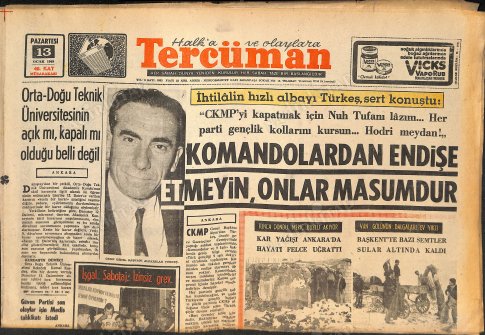 📎 Tercüman, 13 January 1969 — Türkeş defends the commandos' innocence in the press.
Added later — May 2026
📎 Tercüman, 13 January 1969 — Türkeş defends the commandos' innocence in the press.
Added later — May 2026
Karabacak, for his part, describes in detail how the commandos were fed to the press, and the serialized feature that ran in the newspaper Günaydın:57
I had a nationalist friend at the time named Namık (now deceased), who worked at the popular, best-selling newspaper Günaydın. (…) I asked him whether an interview could be done at our Commando Camp in Küçüksu. He said this would be very difficult, that the paper wasn't ready for it, but that during a period when he was acting as night editor he could get it started, since the paper wouldn't be able to cut off a series once it had begun. We made a plan together. I would prepare the photographs and the text.
I went to the camp and took photographs by day and by night. I prepared a series meant to run over four days.
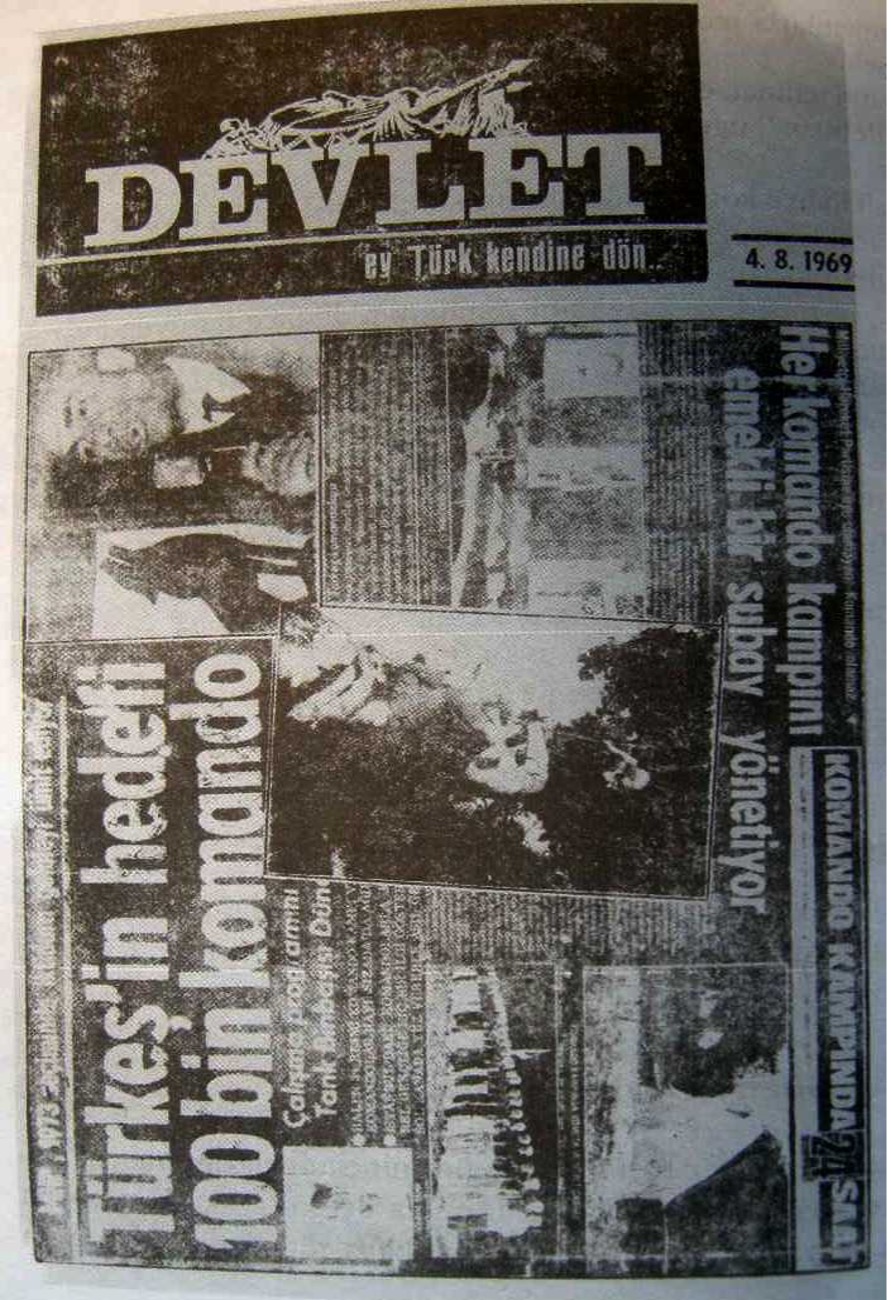
Two days later, my friend began running the interview as the lead front-page story. The headline, spread across 8 columns in very large type, read: Türkeş's target: 100,000 commandos…
I had prepared the piece to run over four days. But Namık ran the first two pieces together on the first day, with the first one taking up the entire front page. The series was finished in three days. The photographs of young men climbing ropes, training at night, caused an immediate uproar. Other newspapers, too, gradually began running stories about us — even if unfavorable ones.
Ahmet B. Karabacak, Üç Hilal'in Hikayesi (2011)
The Commando Camps were also featured on the covers of, and promoted in, Milli Hareket and Devlet — the magazines that served as the CKMP's (MHP's) publications.58
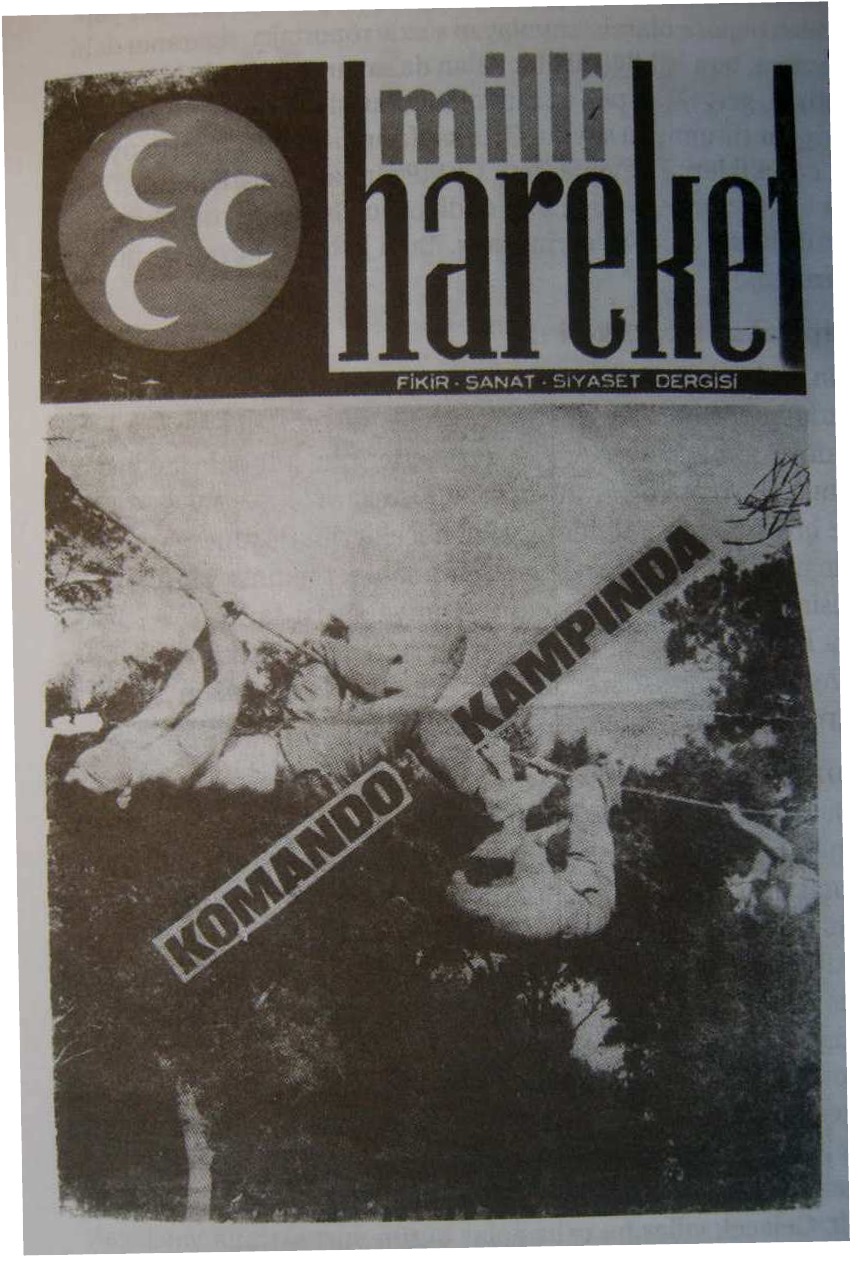 Devlet magazine
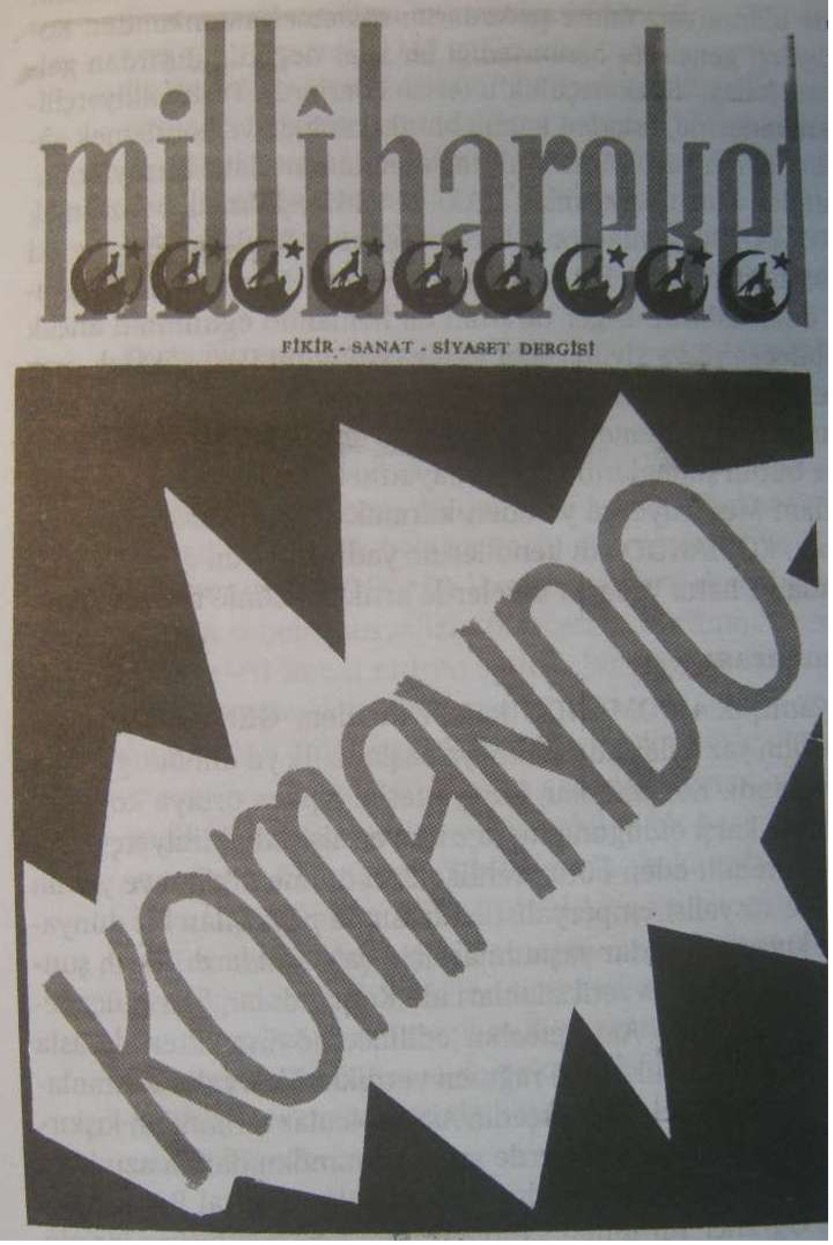 Milli Hareket magazine
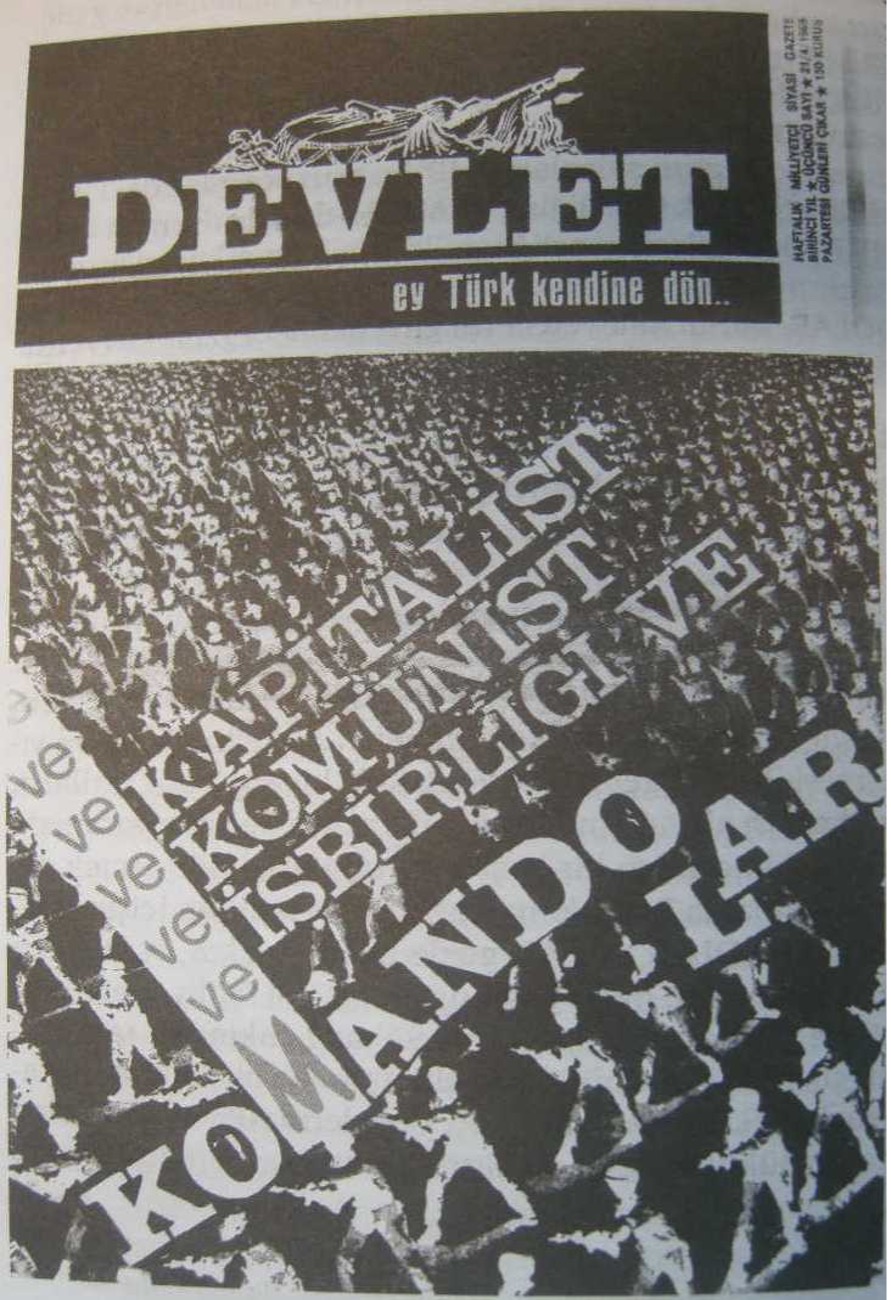 Devlet magazine
 Milli Hareket magazine
The commando training fed to the press would also be completed by a ritual of visual display. Idealist youth began holding Nine Lights marches, wearing matching uniforms and marching in military formation. These marches were repeated in Istanbul, Ankara, İzmir, and many other parts of Turkey.59
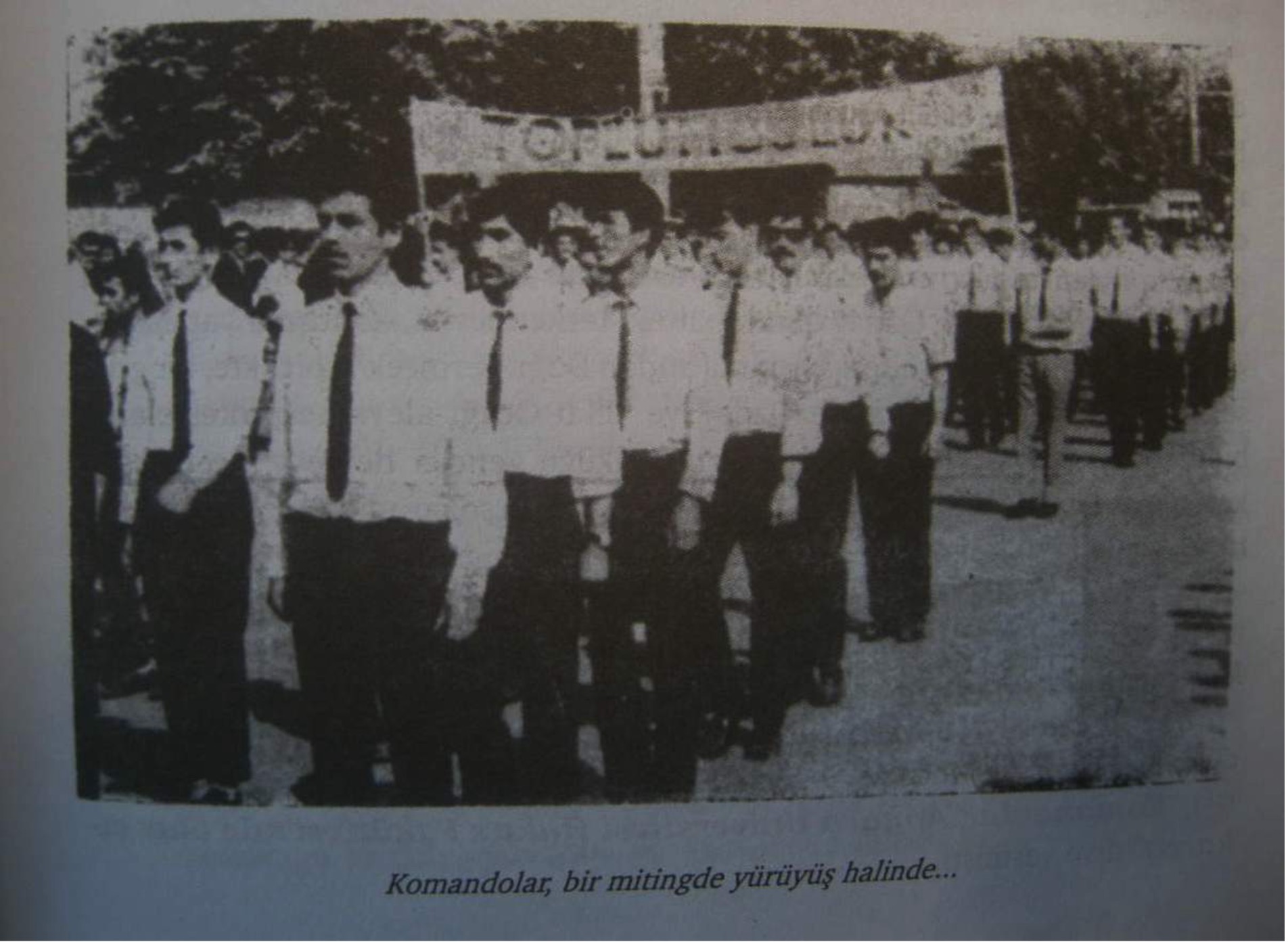 "Commandos marching at a rally in matching uniforms"60
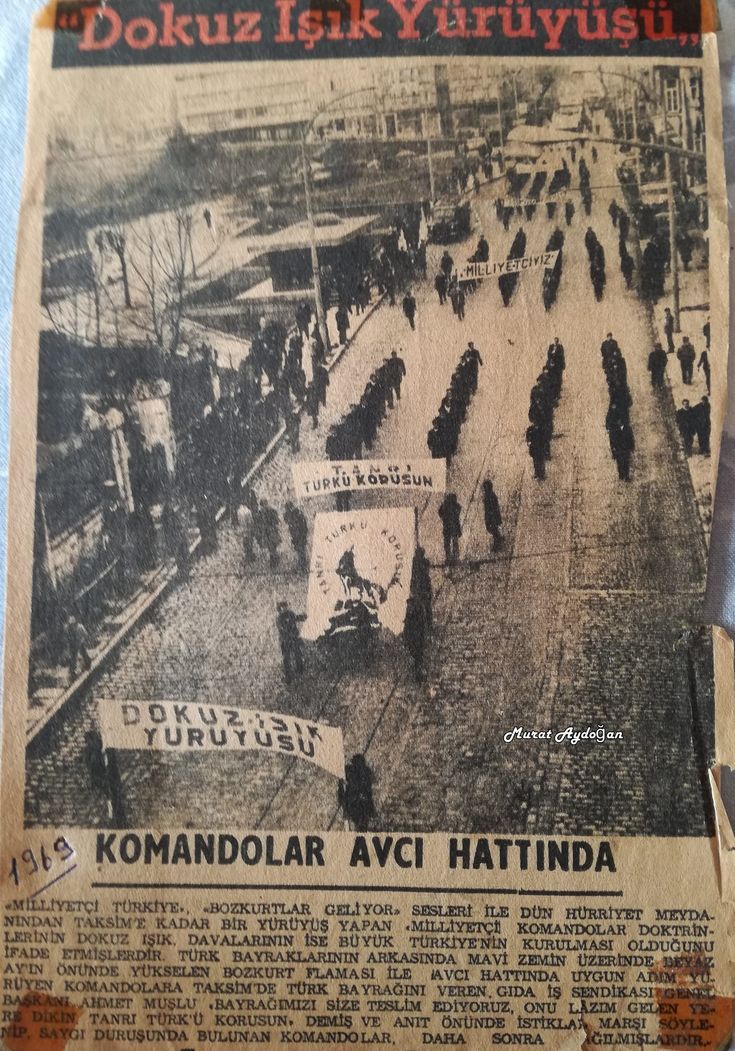 📎 "Nine Lights March" — Commandos in Skirmish Line Formation, 1969.
Added later — May 2026
📎 "Nine Lights March" — Commandos in Skirmish Line Formation, 1969.
Added later — May 2026
Terzioğlu states that the Commando Camps were initially planned to be set up in 34 locations, with university students to take part first, before this restriction was lifted and all young people were invited.61
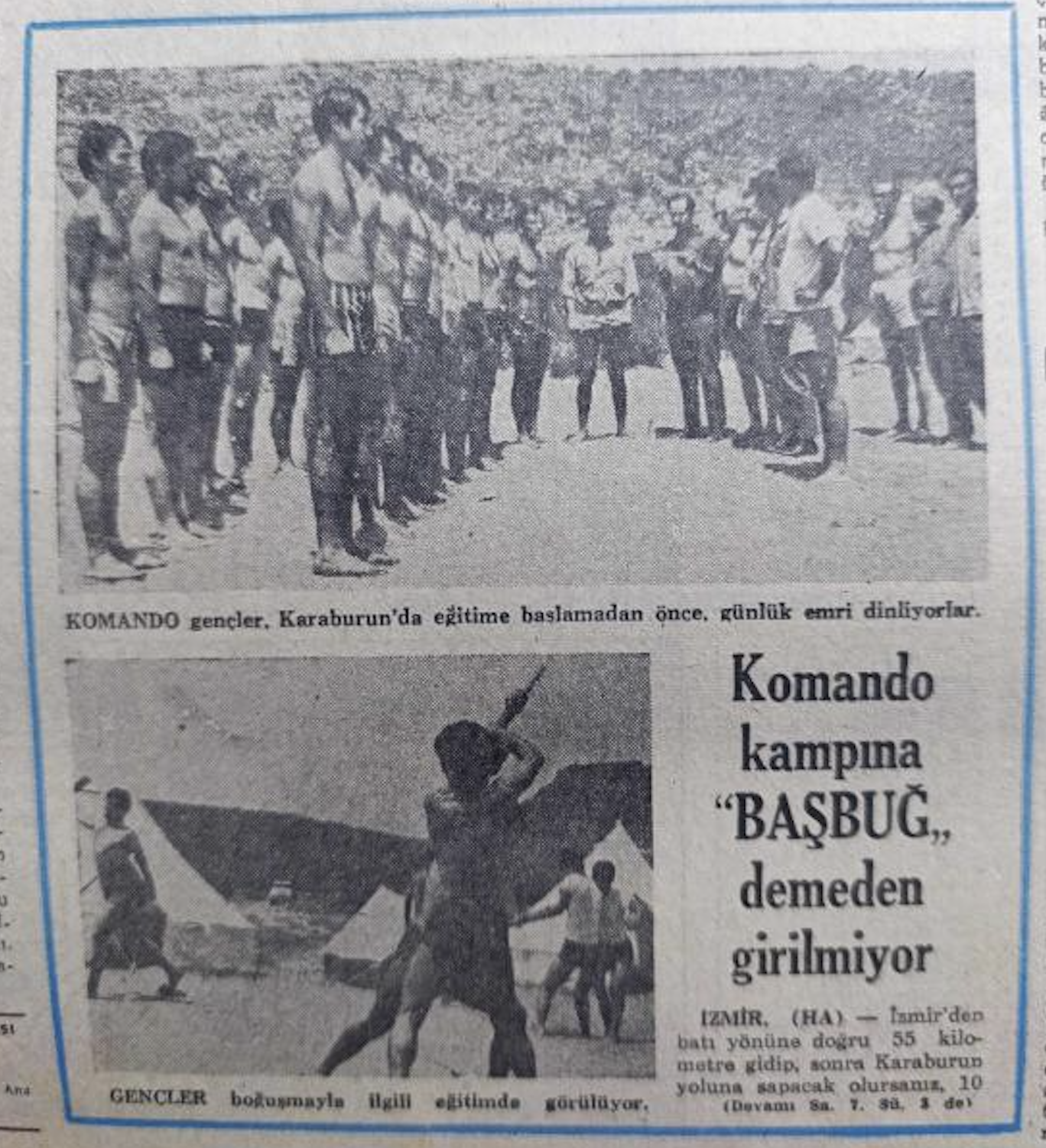
Terzioğlu describes the daily schedule at the Commando Camps as follows:62
The "Commando Camps" first entered public discussion through newspaper reports in 1968. In those days — when Ambassador Komer's car was set on fire, when the Sixth Fleet's anchoring in Turkish ports was being protested, and when leftist youth's protest actions were steadily escalating — CKMP spokesman Rıfat Baykal announced that his party would provide commando training to young people at camps.47
Engin Konuksever, a journalist who entered one of these camps and took photographs at the time, describes what he saw as follows:
"We had gone to a commando camp in Çanakkale. There, they taught things like close-combat techniques and how to make Molotov cocktails. And after the camp ended, of course, people went straight into the events…"
Engin Konuksever, journalist48Although the connections behind the Commando Camps remain a matter of debate, no one denies their existence. Türkeş himself acknowledges the existence of these camps.49 Türkeş's interview, published in the newspaper Hürriyet on 10 January 1969, openly demonstrates this acknowledgment:50
Türkeş spoke plainly: I support the commandos. Because we founded and trained them… Question: If the clash between the two groups widens further, even spreading to the general public, wouldn't that be dangerous? Answer: No, because we've built a dam with these young people of ours. The communist movement can no longer grow. There may be a few more incidents in the coming days, but things will settle down after that. Because we stand against them. The young people they call "commandos" have embraced the Nine Lights.
Alpaslan Türkeş, Hürriyet, 10 January 1969
First-hand accounts of the founding of the Commando Camps can be found in Ahmet B. Karabacak's book Üç Hilal'in Hikayesi, in Ahmet Haldun Terzioğlu's book Komando, and in the third volume, titled "Conspiracies and Provocations," of Hakkı Öznur's book Ülkücü Hareket. Karabacak, who was himself part of right-wing youth circles at the time, states that in 1967 their first objective was "to bring young people into a position of intellectual superiority against the communists and separatists nesting in the universities,"51 and that they then began founding the Ülkü Ocakları Derneği, centered in Ankara.52 The Commando Camps also entered the picture during this period:53
"While this organizing continued, communists loyal to Moscow, together with their sympathizers in the press and other centers of influence, kept attacking us across Turkey. The police, because of the government's passivity, could not act effectively. It had become dangerous even for idealist youth simply to enter schools, or to walk in the streets.
This had to be prevented — Turkey, and with it the schools, had to be defended. The task had fallen to us; we were going to do what the government could not.
Starting in 1967, we began opening training camps across every part of Turkey during the summer months. The press pinned the name COMMANDO CAMPS on them. These camps spread so quickly that even we found it impossible to keep control of them. National Consciousness was spreading rapidly across Turkey, especially among the youth.
In Istanbul, the first was opened in Silivri by my late friend Ufuk Şehri, president of the Istanbul University Students' Union; the following year, one opened under my own direction in Küçüksu. These camps continued to open every summer for several years, and here young people were trained both intellectually and physically."
Ahmet B. Karabacak, Üç Hilal'in Hikayesi (2011)Terzioğlu, too, states that the idea for the Commando Camps was formed by Türkeş and other leading CKMP cadres, and that it was put into practice with the goal of "a hundred thousand commandos":54
In Ankara, CKMP chairman Alpaslan Türkeş, along with his close friend and comrade-in-arms from the army and from the National Unity Committee during the 27 May Revolution, were working to solve this problem.
"How are we going to train the Grey Wolves? How will we build the intellectual structure, how will we establish the ideology, the doctrine?"
"Let's set up youth camps!"
"A hundred thousand young people… A hundred thousand Idealists…"
"A hundred thousand commandos…"
"Commandos…"
They had taken up this name and made it their own. They saw it as a source of strength, a foundation to stand on. Nor did they see any harm in it. Since their opponents were already calling them "commandos," and since this name unsettled those opponents, there was value in keeping it — at least until they had grown strong, until they had consolidated. There was a clear need to write a legend.
Ahmet Haldun Terzioğlu, Komando (2010)Terzioğlu also relates, as follows, the exchange of ideas that took place among the CKMP's leading figures before these camps were put into practice:55
The foundations of the idea had been laid; it was now time to plan what needed to be done to put it into practice. The talks and discussions went on for days. Their fellow travelers were consulted. Their views were taken into account.
"These young people, mostly university students — we mustn't keep them away from their schools, or set them back in their studies. So during the summer break…"
"The midyear break…"
"The location!"
"Away from the cities and towns, but close to the provinces and districts where our associations are strong…"
"Coastlines, highland plateaus, forests…"
"These are suitable places for setting up camps — without disturbing the local people, but not too far from view either…"
"Let it be known what's there, what's being done! We have nothing to hide from this nation!"
Ahmet Haldun Terzioğlu, Komando (2010)Terzioğlu also notes an important detail concerning how the Commando Camps were reflected in the press, and how, for a time, CKMP officials — Türkeş foremost among them — publicly owned the camps as their own:56
"Let's quietly feed stories to the press, keeping in mind the psychological impact, the propaganda effect! Let's get news items written!"
"The coverage is bound to be negative! The press will use its rented mouth in the language of whoever's renting it — and that will work against us, misrepresent us!"
"So be it! Sometimes negative propaganda has a better effect than positive. Let our own people also explain our purpose."
"Let's also make direct statements ourselves, from the party, straight from the source!"
"A hundred thousand young people… A hundred thousand Commandos…"
Ahmet Haldun Terzioğlu, Komando (2010)
Karabacak, for his part, describes in detail how the commandos were fed to the press, and the serialized feature that ran in the newspaper Günaydın:57
I had a nationalist friend at the time named Namık (now deceased), who worked at the popular, best-selling newspaper Günaydın. (…) I asked him whether an interview could be done at our Commando Camp in Küçüksu. He said this would be very difficult, that the paper wasn't ready for it, but that during a period when he was acting as night editor he could get it started, since the paper wouldn't be able to cut off a series once it had begun. We made a plan together. I would prepare the photographs and the text.
I went to the camp and took photographs by day and by night. I prepared a series meant to run over four days.
Two days later, my friend began running the interview as the lead front-page story. The headline, spread across 8 columns in very large type, read: Türkeş's target: 100,000 commandos…
I had prepared the piece to run over four days. But Namık ran the first two pieces together on the first day, with the first one taking up the entire front page. The series was finished in three days. The photographs of young men climbing ropes, training at night, caused an immediate uproar. Other newspapers, too, gradually began running stories about us — even if unfavorable ones.
Ahmet B. Karabacak, Üç Hilal'in Hikayesi (2011)The Commando Camps were also featured on the covers of, and promoted in, Milli Hareket and Devlet — the magazines that served as the CKMP's (MHP's) publications.58
The commando training fed to the press would also be completed by a ritual of visual display. Idealist youth began holding Nine Lights marches, wearing matching uniforms and marching in military formation. These marches were repeated in Istanbul, Ankara, İzmir, and many other parts of Turkey.59
Terzioğlu states that the Commando Camps were initially planned to be set up in 34 locations, with university students to take part first, before this restriction was lifted and all young people were invited.61
Terzioğlu describes the daily schedule at the Commando Camps as follows:62
1— Waking with the morning call to prayer. Washing up and communal prayer…
2— Morning exercise. Rest and breakfast.
3— Ottoman military band music and national anthems. Marching.
4— Seminar and lecture (time allotted according to topic)
5— Group work, rest, midday prayer, lunch, and a half-hour break.
6— Field exercises. Individual training. Boxing, wrestling, judo, karate.
7— Rest. Communal afternoon prayer. Sleep (1 hour)
8— A short march. Preparation exercises with night drills. Evening prayer and dinner.
9— Discussion of the day's events and press criticism. Reading.
10— Night prayer and lights out.
11— Alarm for night training at unannounced times.
Terzioğlu, after stating that "a red movement had begun in Turkey too, just as had been tried in many other countries," says that "there were signs it would soon turn into armed struggle," and finishes this thought by writing: "What was underway were preparations for a coming civil war. If nothing stopped it…"63 These sentences can be read as a veiled acknowledgment that the Commando Camps were, in fact, preparation for armed struggle. Likewise, the statement on page 258 of the book — "Many idealists, especially those trained at the camps, had become aware of the danger and now went about constantly armed" — is another indication of this same acknowledgment.
Hakan Akpınar, too, in the chapter of his book titled "The Commando Camps," states that "weapons and anti-terror training" was also provided at these camps, writing: "At the Commando Camps, idealist youth — most of them university students — turned toward the anti-communist struggle. They entered directly into armed struggle with the left-wing groups concentrated in the universities." In doing so, he indicates that these camps were established with the aim of preparing for armed struggle.64
M. Emin Değer, who had also served as legal advisor to the Ministry of National Defense, likewise draws attention, in his book Uğur Mumcu ve 12 Mart – Geriye Dönüşün İlk Adımı, to the background of the commando camps, established, in his account, in preparation for civil war:
Instead of raising our children according to the founding principles of the Republic and instilling in them the Turkish enlightenment revolution, we divided them into camps as rightists and leftists. We trained the right-wing faction in camps. Labeling demands for social change as communism, we set loose upon them the young people we had trained.
Change was, according to the dominant thinking, a dangerous ideology in its own right. As with every ideology, its opposite was immediately created. Fascism was organized; young people, as a striking force, were trained in special camps established in plain view of the state. Trained under the roof of the Nationalist Movement Party and its affiliated organizations, through special training and under the mission of "protecting the state," these young people supposedly represented resistance to communism.
(…) The young people trained at these camps — popularly known as the idealist commandos — were trained in methods designed to sideline leftists in the schools and in society at large. Alongside ideological training, they were taught combat techniques, particularly the Far Eastern self-defense methods of judo and karate. As is clear from this report, it is unthinkable that these developments occurred without the knowledge of the ruling cadres. (…) According to a section of the press, and according to the government, it was the left that was on the attack, while the idealists were helping the state defend the established order. From the most authoritative voices, it was said that these young people were being trained as "auxiliaries to the security forces." We would later learn that this organizing and training was, in fact, counter-guerrilla training.
The following passage, which we will quote from the Bissell Report, will shed further light on the matter and make clear that we are dealing with a CIA arrangement:
"… On the other hand, while it is a difficult undertaking requiring time, it is both possible and useful for us to establish an unofficial covert operations service in these countries. To achieve this, use should be made of special organizations, or such organizations should be established. Since the personnel of these organizations will not be American, they will be able to blend in more easily with those societies. The name of the United States will not be officially tied to the activities… Finding people to work with the CIA in these covert actions is a delicate matter; they must be people who believe in the same purpose as the organization, or people who can be steered toward that purpose."
M. Emin Değer, Uğur Mumcu ve 12 Mart – Geriye Dönüşün İlk Adımı (1996)65Comparing the date these camps opened with the date this report was read and adopted offers a clue as to the purpose and manner of their founding. Another fact should be emphasized here: the fact that the MHP and the Commando Camps went unmentioned in the State Briefings given after 12 March — the first on 11 April 1971, and the second on 3 November 1972 — strengthens the impression that the camps were in fact established under the supervision of the Special Warfare Department. This, too, is a separate point that deserves careful attention.
Değer points to the "Gladio" formation — much discussed after the relationships exposed by the Susurluk car crash — in connection with the Commando Camps. He argues that the Commando Camps can be regarded as an extension of the "counter-guerrilla" organizations set up in many countries during the Cold War through CIA organization.66
The report Değer cites was prepared by the "Ministry of the Interior, General Directorate of Security, Department of Important Affairs," and was presented, on 26 October 1970, to the then Prime Minister Süleyman Demirel and to the governors of 67 provinces. It is true that after this document, marked "confidential," came to light in the press in 1978, both Demirel and Türkeş described it as "a figment of the imagination" and claimed they had never seen it before. However, the then Minister of the Interior, İrfan Özaydınlı, proved on 5 November 1978, by pointing to the state archives, that these documents did in fact appear in the official record.67
In the section of this document titled "National Socialism," the "organizations" holding a "national socialist" outlook are listed as follows:68
1— The Ülkü Ocakları Birliği [Idealist Hearths Union]
2— The Young Idealists Organization
3— The Federation of Free Thought Clubs
4— The Former Military Academy Cadets' Mutual Aid Association
5— The Nationalist Turkish Women's Association
6— The MHP (Nationalist Movement Party)
7— The Commando Camps
The document states the following regarding the Commando Camps:69
The commando camps — organized, run, and supported both materially and morally by the youth branches of the Nationalist Movement Party, the Ülkü Ocakları Birliği, the Young Idealists Organization, and the National Turkish Students' Union — were established in various provinces and districts of the country starting in the summer of 1968, with the aim of developing young people intellectually and physically and instilling in them the ideal of Turanism.
Report of the Ministry of the Interior, General Directorate of Security, Department of Important Affairs, 26 October 1970The next section of the document lists information on 28 commando camps and recounts the "Significant Incidents They Caused." Beyond this, the document contains, in order, the following headings: "Relations with Turks Abroad," "Armament," "Biographical Information on Active Turanists," and "Conclusion."
Karabacak's words — "The task had fallen to us; we were going to do what the government could not" — which also appear in Değer's assessment, are telling. These words reflect the feelings and thinking of the young people who were part of the Commando Camps at the time. They believed they had built a "dam" against "communist traitors" whose "roots lay abroad," and that they were doing "what the government could not." First put into practice in major cities such as Istanbul, İzmir, Ankara, and Adana, the camps set up a total of 170 tents in their first year, training more than a thousand young people.70 In 1969, more than five thousand idealist youth took part across 34 separate camps. In 1970, the number of young people trained reached seven thousand.71
The Commando Camps withdrew from Turkey's political stage in the early 1970s. Öznur states that these camps never reopened after the 12 March coup. There is, however, information suggesting the opposite. In 1988, Kartal Demirağ, detained in connection with the assassination attempt against then President Turgut Özal, was found — according to Uğur Tönik, the prosecutor investigating the assassination attempt — to have served as deputy chairman of the Ülkü Ocakları in his hometown of Afyon Dazkırı, and to have trained as a young man at camps alongside MHP youth. Tönik testified to the Parliamentary Investigation Commission: "We have established that a counter-guerrilla organization was set up in Afyon Dazkırı between 1974 and 1977 to prevent leftist movements arising in the Aegean, and that Kartal Demirağ was a trained operative of this organization."72 According to the information Tönik provided, Demirağ was trained at a camp set up there by retired soldiers. In statements he made later, Tönik stated that he had come under pressure from Sabri Yirmibeşoğlu, a general of the period, to halt the investigation, and that his own daughter had been kidnapped.73 It is also alleged that General Sabri Yirmibeşoğlu once headed the "Special Warfare Department," known as Turkey's "Gladio" organization.74
In light of this information, it can be argued that the Commando Camps did not close down, but simply continued on, transformed into a more organized and structured counter-guerrilla organization. Indeed, in 1978, when then Prime Minister Bülent Ecevit, suspecting that certain members of the civilian organization tied to the Special Warfare Department had "taken part in incidents," asked Yirmibeşoğlu — then a major general — "Hypothetically speaking, couldn't the local MHP provincial chairman here also be one of the secret operatives within the civilian extension of the Special Warfare Department?", he received the answer from Yirmibeşoğlu: "Yes, he is, but he is a very trustworthy, patriotic friend of ours."75 This answer alone is telling, both of the trajectory of the Commando Camps and of the MHP as a whole in the 1970s.
The Free Thought Clubs
Another right-wing organization notable for its founders and members was the Free Thought Clubs (HDK). The first HDK was founded in 1964 at the Faculty of Political Science, in opposition to leftist students' SBF Idea Club. Under the chairmanship of Hasan Celal Güzel,76 the HDK began operating first in Ankara's other faculties and later in other provinces. During Güzel's chairmanship, the deputy chairman was Esat Güçhan,77 and the secretary-general was Murat Karayalçın.78 Other prominent names included İbrahim Melih Gökçek,79 Abdülkadir Aksu,80 Mehmet Keçeciler,81 Veysel Atasoy,82 Ahmet Mesut Yılmaz,83 and Hüsnü Doğan. In 1967, the HDK became a federation and took the name Federation of Free Thought Clubs. The federation's first chairman was Hasan Celal Güzel. Murat Karayalçın was elected chairman after Güzel.
Güzel says that the HDK, at an SBF dominated by the left, took a stance "along a line running from the center to the right" and that it was "genuinely a difficult undertaking."84 According to Güzel, this difficulty lay in the fact that the HDK — under his chairmanship, and holding "libertarian and liberal views" — "remained weak in this struggle" against an "internationalist socialist whirlwind."85 An attempt was made to remedy this weakness through nationalism:86
"The 'Free Thought Club,' with its libertarian and liberal outlook, which I chaired, was remaining weak in this struggle. I'll never forget: one day, Murat Karayalçın, who was our association's secretary-general at the time, and my deputy chairman Esat Güçhan, told me they wanted us to adopt a more nationalist atmosphere as well, and to put out a magazine and sell it in Kızılay the way the Marxists did."
Hasan Celal Güzel, Radikal, 11 February 2007
In response, they began publishing a magazine called "Milli Düşünce" [National Thought] and took part in founding an "Ülkü Ocağı" at the faculty. Güzel says they "handed over" the management of the Ülkü Ocağı they had founded to Yılmaz Yalçıner,87 as he puts it.88 Yılmaz Yalçıner, who took part in founding the Ülkü Ocağı, was one of the leading figures of idealist youth before gradually moving toward an Islamic line; Mehmet Şahin, a co-founder alongside Yalçıner, would years later become Rector of Erciyes University.89
Almost all of the HDK's leading figures entered politics after 1980 through the Motherland Party (ANAP), were elected as deputies, and went on to serve as ministers — even as prime ministers — and as mayors.
Note 76 — Hasan Celal Güzel was elected as a deputy for ANAP in 1986; he subsequently served as a minister, ministerial advisor, and undersecretary to the prime minister. In 1992, he left ANAP and founded the Yeniden Doğuş Partisi [Rebirth Party].
Note 77 — Esat Güçhan would go on, after 1970, to become active within the MHP, take on responsibilities during the Nationalist Front governments, head the "Research Center" established within the MHP, and serve within the Aydınlar Ocağı [Intellectuals' Hearth].
Note 78 — Murat Karayalçın would later become a "leftist," would for a time serve as chairman of the Social Democratic Populist Party (SHP) — the successor to the banned Republican People's Party — and would hold the posts of Deputy Prime Minister, Minister of State, and Foreign Minister in 1994–1995.
Note 79 — İbrahim Melih Gökçek was elected mayor of Ankara's Keçiören district for ANAP in 1984; between 1989 and 1991, he served as director-general of the Social Services and Child Protection Agency. In 1991, he was elected as a deputy for the Welfare Party. Since 1994, he has served as Mayor of Greater Ankara Municipality.
Note 80 — Abdülkadir Aksu held posts as district governor, provincial governor, and director-general of security from 1973 onward. He was elected as a deputy for ANAP in 1987. He later served in parliament under the Welfare Party, the Virtue Party, and the Justice and Development Party. He served as Minister of State Responsible for GAP [the Southeastern Anatolia Project] and as Minister of the Interior.
Note 81 — Mehmet Keçeciler would begin serving as a district governor immediately after graduating from university; would serve as Mayor of Konya for the National Salvation Party, founded as the successor to the MNP; would take part in the founding of ANAP; would be elected as a deputy; and would go on to serve as a minister.
Note 82 — Veysel Atasoy was among the founders of ANAP, was elected as a deputy for both ANAP and DYP, and served as a minister. He passed away in 2004.
Note 83 — Yılmaz [Mesut Yılmaz] entered Ankara University's Faculty of Political Science in the late 1960s and graduated in 1971. During his student years, he took part in the HDK's activities. In 1983, he took part in the founding of ANAP, became deputy chairman, and was elected as a deputy from Rize. Over the course of his political career in parliament, he served as a minister and, on three occasions, as prime minister.
Note 84 — Güzel, H.C., "Mülkiye 68 Kuşağı" [The Mülkiye '68 Generation], Vatan, 19 December 2010.
Note 85 — Güzel, H.C., "Milliyetçilik Üzerine Geçmişte Bir Gezinti" [A Look Back at Nationalism], Radikal, 11 February 2007.
Note 86 — Güzel, H.C. (11 February 2007).
Note 87 — Yılmaz Yalçıner was one of the most active militants among idealist youth at the time. He was also the son of the chief of Ankara's riot police. He was the one who drew the first version of the CKMP's Grey Wolf emblem with the three crescents. Karabacak states that Yalçıner distanced himself from the group after the death of Dündar Taşer, a CKMP leader, in a traffic accident [Karabacak, A.B. (2011), pp. 35–38]. Immediately after 12 September, Yalçıner attempted to hijack a plane from Diyarbakır to Iran; he was caught and served 11 years and 7 months in prison, after which he worked for a time at the newspaper Akit (Vakit), known for its Islamist identity.
Note 88 — Güzel, H.C. (11 February 2007).
Note 89 — Yavuz, E. and Özkurt, N., "Son Demokrat Değilim" [I'm Not the Last Democrat], Aksiyon, No. 140, 9 July 1997.
The Islamist Movement After 27 May
The years in which the broad outlines of Turkey's still-ongoing political divisions first formed and emerged are, above all, the 1960s. It was largely in this period that left- and right-wing structures, in the sense we know them today, took shape, and that the terms "left" and "right" took on their present-day meaning within Turkey's political vocabulary. Where one could previously speak of an anti-communist stance, with the existing divide taking the form of "communist" versus "nationalist-traditionalist," this opposition would, from the second half of the 1960s onward, give way to a left-right conflict.90 It was also in this period that Islamists emerged onto the political stage as distinct from the nationalists, forming their own organizations. Zübeyir Yetik, one of the founders of the Association for the Struggle Against Communism, describes this quite openly in his memoir Geçmişten Notlar. Yetik states that in the early 1960s, despite the differences among them, everyone — nationalist, conservative, traditionalist, and religious alike — was grouped together and called "nationalist-traditionalist," and that they, too, presented themselves this way and moved as one.91 But in the second half of the 1960s, a split began, along with a struggle to seize control of the organizations.
Ali Gevgilili, in trying to explain the background of this split, refers to Şerif Mardin and notes that Islam in Turkey had differentiated into a dual structure — "religion as seen at the institutional level, Orthodox Sunni Islam along the lines of the ulema-i rusum [official religious scholars' thinking]," and "a second, Islamic [sic] cultural channel with the character of a folk religion" — before observing that Islam's assumption of an increasingly socio-political function grew after the 1950s. He identifies what set the 1950s apart as "the development of modern relations of production in society." He states that religion reorganized itself through associations, and also tried to create its own communication outlets in the press.92
Between 1946 and 1968, organizations such as Quran course, imam-hatip high school, and mosque-building associations accounted for more than a quarter of all associations. Alongside such religious associations, structures like the "Association for the Struggle Against Communism" (KMD) also spread rapidly from the 1960s onward. The number of KMD branches increased fifteenfold between 1963 and 1968, reaching 141.93
There are also views, distinct from the one Gevgilili draws attention to, that attempt to explain Islam's post-1950 assumption of a socio-political function through the wave of migration into Turkey.94 According to these views, migrants — under the additional influence of social change that was feared to fundamentally alter family relations — held fast to an Islamic identity, with religious communities and orders serving as harbors in which the masses took refuge in the cities. These studies note that migration's impact on political life made itself felt still more clearly after the 1960s, once the second generation entered the picture.
This organizing, carried out through associations and similar channels, would naturally come to be sought after by existing political structures, while at the same time striving to build its own political structure. The "nationalist-communalist split" also took place within this process. In recounting the events of 1968, Ali Gevgilili draws attention to two episodes. The first is the "Grand Congress of Religion and Traditionalists," held on 24–25 February 1968, at which "the Islamists [sic]… were by then debating their own strategy and tactics." The second episode Gevgilili highlights is the congress the Associations for the Struggle Against Communism held in İzmir on 31 June 1968. At this congress, "Türkeş's nationalist team… waged its final battle for control against the Islamists and the AP members." But they lost this battle and were pushed out of the association. Gevgilili also links the founding of the Ülkü Ocakları to this purge: "The Ülkü Ocakları, meant to form the 'striking force' [sic] of nationalist ideology among the youth, would be founded not long after this purge."95 Another indication of this split came at the Milli Türk Talebe Birliği's 1969 congress, when Burhanettin Kayhan — the candidate of youth with "heightened religious and spiritual sensitivities" — won election against Mustafa Ok, nicknamed "Komando" and backed by the MHP.96
The split that took place within the Associations for the Struggle Against Communism and the Milli Türk Talebe Birliği would also make itself felt in parliament, after Necmettin Erbakan ran as an independent candidate in the 1969 election, was elected as a deputy from Konya, and, on 26 January 1970, founded the Milli Nizam Partisi [National Order Party].97
When it comes to Islamist structures in the 1960s — particularly those relating to youth organizations — the following deserve mention:
Another right-wing organization notable for its founders and members was the Free Thought Clubs (HDK). The first HDK was founded in 1964 at the Faculty of Political Science, in opposition to leftist students' SBF Idea Club. Under the chairmanship of Hasan Celal Güzel,76 the HDK began operating first in Ankara's other faculties and later in other provinces. During Güzel's chairmanship, the deputy chairman was Esat Güçhan,77 and the secretary-general was Murat Karayalçın.78 Other prominent names included İbrahim Melih Gökçek,79 Abdülkadir Aksu,80 Mehmet Keçeciler,81 Veysel Atasoy,82 Ahmet Mesut Yılmaz,83 and Hüsnü Doğan. In 1967, the HDK became a federation and took the name Federation of Free Thought Clubs. The federation's first chairman was Hasan Celal Güzel. Murat Karayalçın was elected chairman after Güzel.
Güzel says that the HDK, at an SBF dominated by the left, took a stance "along a line running from the center to the right" and that it was "genuinely a difficult undertaking."84 According to Güzel, this difficulty lay in the fact that the HDK — under his chairmanship, and holding "libertarian and liberal views" — "remained weak in this struggle" against an "internationalist socialist whirlwind."85 An attempt was made to remedy this weakness through nationalism:86
"The 'Free Thought Club,' with its libertarian and liberal outlook, which I chaired, was remaining weak in this struggle. I'll never forget: one day, Murat Karayalçın, who was our association's secretary-general at the time, and my deputy chairman Esat Güçhan, told me they wanted us to adopt a more nationalist atmosphere as well, and to put out a magazine and sell it in Kızılay the way the Marxists did."
Hasan Celal Güzel, Radikal, 11 February 2007In response, they began publishing a magazine called "Milli Düşünce" [National Thought] and took part in founding an "Ülkü Ocağı" at the faculty. Güzel says they "handed over" the management of the Ülkü Ocağı they had founded to Yılmaz Yalçıner,87 as he puts it.88 Yılmaz Yalçıner, who took part in founding the Ülkü Ocağı, was one of the leading figures of idealist youth before gradually moving toward an Islamic line; Mehmet Şahin, a co-founder alongside Yalçıner, would years later become Rector of Erciyes University.89
Almost all of the HDK's leading figures entered politics after 1980 through the Motherland Party (ANAP), were elected as deputies, and went on to serve as ministers — even as prime ministers — and as mayors.
The years in which the broad outlines of Turkey's still-ongoing political divisions first formed and emerged are, above all, the 1960s. It was largely in this period that left- and right-wing structures, in the sense we know them today, took shape, and that the terms "left" and "right" took on their present-day meaning within Turkey's political vocabulary. Where one could previously speak of an anti-communist stance, with the existing divide taking the form of "communist" versus "nationalist-traditionalist," this opposition would, from the second half of the 1960s onward, give way to a left-right conflict.90 It was also in this period that Islamists emerged onto the political stage as distinct from the nationalists, forming their own organizations. Zübeyir Yetik, one of the founders of the Association for the Struggle Against Communism, describes this quite openly in his memoir Geçmişten Notlar. Yetik states that in the early 1960s, despite the differences among them, everyone — nationalist, conservative, traditionalist, and religious alike — was grouped together and called "nationalist-traditionalist," and that they, too, presented themselves this way and moved as one.91 But in the second half of the 1960s, a split began, along with a struggle to seize control of the organizations.
Ali Gevgilili, in trying to explain the background of this split, refers to Şerif Mardin and notes that Islam in Turkey had differentiated into a dual structure — "religion as seen at the institutional level, Orthodox Sunni Islam along the lines of the ulema-i rusum [official religious scholars' thinking]," and "a second, Islamic [sic] cultural channel with the character of a folk religion" — before observing that Islam's assumption of an increasingly socio-political function grew after the 1950s. He identifies what set the 1950s apart as "the development of modern relations of production in society." He states that religion reorganized itself through associations, and also tried to create its own communication outlets in the press.92
Between 1946 and 1968, organizations such as Quran course, imam-hatip high school, and mosque-building associations accounted for more than a quarter of all associations. Alongside such religious associations, structures like the "Association for the Struggle Against Communism" (KMD) also spread rapidly from the 1960s onward. The number of KMD branches increased fifteenfold between 1963 and 1968, reaching 141.93
There are also views, distinct from the one Gevgilili draws attention to, that attempt to explain Islam's post-1950 assumption of a socio-political function through the wave of migration into Turkey.94 According to these views, migrants — under the additional influence of social change that was feared to fundamentally alter family relations — held fast to an Islamic identity, with religious communities and orders serving as harbors in which the masses took refuge in the cities. These studies note that migration's impact on political life made itself felt still more clearly after the 1960s, once the second generation entered the picture.
This organizing, carried out through associations and similar channels, would naturally come to be sought after by existing political structures, while at the same time striving to build its own political structure. The "nationalist-communalist split" also took place within this process. In recounting the events of 1968, Ali Gevgilili draws attention to two episodes. The first is the "Grand Congress of Religion and Traditionalists," held on 24–25 February 1968, at which "the Islamists [sic]… were by then debating their own strategy and tactics." The second episode Gevgilili highlights is the congress the Associations for the Struggle Against Communism held in İzmir on 31 June 1968. At this congress, "Türkeş's nationalist team… waged its final battle for control against the Islamists and the AP members." But they lost this battle and were pushed out of the association. Gevgilili also links the founding of the Ülkü Ocakları to this purge: "The Ülkü Ocakları, meant to form the 'striking force' [sic] of nationalist ideology among the youth, would be founded not long after this purge."95 Another indication of this split came at the Milli Türk Talebe Birliği's 1969 congress, when Burhanettin Kayhan — the candidate of youth with "heightened religious and spiritual sensitivities" — won election against Mustafa Ok, nicknamed "Komando" and backed by the MHP.96
The split that took place within the Associations for the Struggle Against Communism and the Milli Türk Talebe Birliği would also make itself felt in parliament, after Necmettin Erbakan ran as an independent candidate in the 1969 election, was elected as a deputy from Konya, and, on 26 January 1970, founded the Milli Nizam Partisi [National Order Party].97
When it comes to Islamist structures in the 1960s — particularly those relating to youth organizations — the following deserve mention:
— The Milli Türk Talebe Birliği (MTTB) [National Turkish Students' Union]
— The Associations for the Struggle Against Communism (KMD)
— The Mücadele Birliği (MB) [Struggle Union]
The Milli Türk Talebe Birliği (MTTB) [National Turkish Students' Union]
The MTTB, whose founding dates back to 1916, was shut down in 1936, reopened in 1946 under the name Türk Talebe Birliği [Turkish Students' Union], and took back the name MTTB by decision of the Council of Ministers on 17 December 1947.
The MTTB's own website states that the Union was founded by the Committee of Union and Progress, that in the 1916–1920 period it acted in line with the Committee's Pan-Turkist outlook, and that in the 1926–1936 period, "in line with the official view of the republican cadres," it "rejected cosmopolitanism while remaining on a Turanist line" and launched the "Citizen, Speak Turkish!" campaign.98
From its refounding in 1946 until 1960, the MTTB followed a nationalist, anti-communist line. An MTTB declaration published on 10 December 1947 states that communism needed to be fought more fiercely: "Our association, on the basis of the nationalist outlook it has embraced as an article of faith, adopts as its motto a more fierce struggle against communism, which denies national sacred concepts such as homeland, nation, and family."99 The quotations below further illustrate this period of the MTTB.
"After this date, nationalist youth carried out their activities against Communism gathered around the MTTB. Until 1950, the MTTB organized numerous protests and programs against communism."
100"In 1946, as the transition from one-man rule to democracy began to take place, Youth gained the opportunity to express and develop itself in a freer working environment. Nationalist organizations multiplied in the 1950s. The MTTB, too, continued to be active in student movements, carrying on its activities as a nationalist youth organization."
101During DP rule, the MTTB's stance was "neither fully in step with, nor against, the government."102 From 1957 onward, it took a position against the government and closer to the CHP. After the 27 May coup, the DP's influence over the MTTB diminished entirely, and it became an organization under the CHP's sway. The MTTB was now a structure where the slogan "Army and Nation, Hand in Hand" could be heard. It had "fallen into the hands of the leftists."103 This situation would continue until 1965.104
That TİP's congress of 15 January 1965 was held in the MTTB's conference hall is an indication of the MTTB's political line at that time. But with the election of Rasim Cinisli105 as chairman at the congress held on 18 March 1965, the MTTB returned to its earlier line. This change was also a "turning point" for "Islamic youth."106
"With Rasim Cinisli's election as chairman at the congress held on 18 March 1965, the MTTB passed once again to the nationalist camp. This period is a turning point. The foundation for Islamic youth becoming a force for action was laid in this period. 'Rasim Cinisli's election brought great joy in Islamic circles. For Rasim Cinisli, and the university students who elected him, were known as carriers of an outlook loyal to national interests against the Left/Communism and Westernization, and respectful of Islam. The Islamic circles of the period regarded university youth loyal to the religious culture they knew and believed in taking over a large and active youth organization like the MTTB as a rising victory for an identity that had been scorned by Westernizing cadres.'"
107Following this 1965 election, the MTTB "organized meetings and launched campaigns in the field of the struggle against communism."108 In the "Special Issue on the Struggle Against Communism," published in 1966 in Milli Gençlik — the magazine the MTTB published between 1965 and 1977 — the launch of a "Struggle Against Communism Campaign" is announced.109
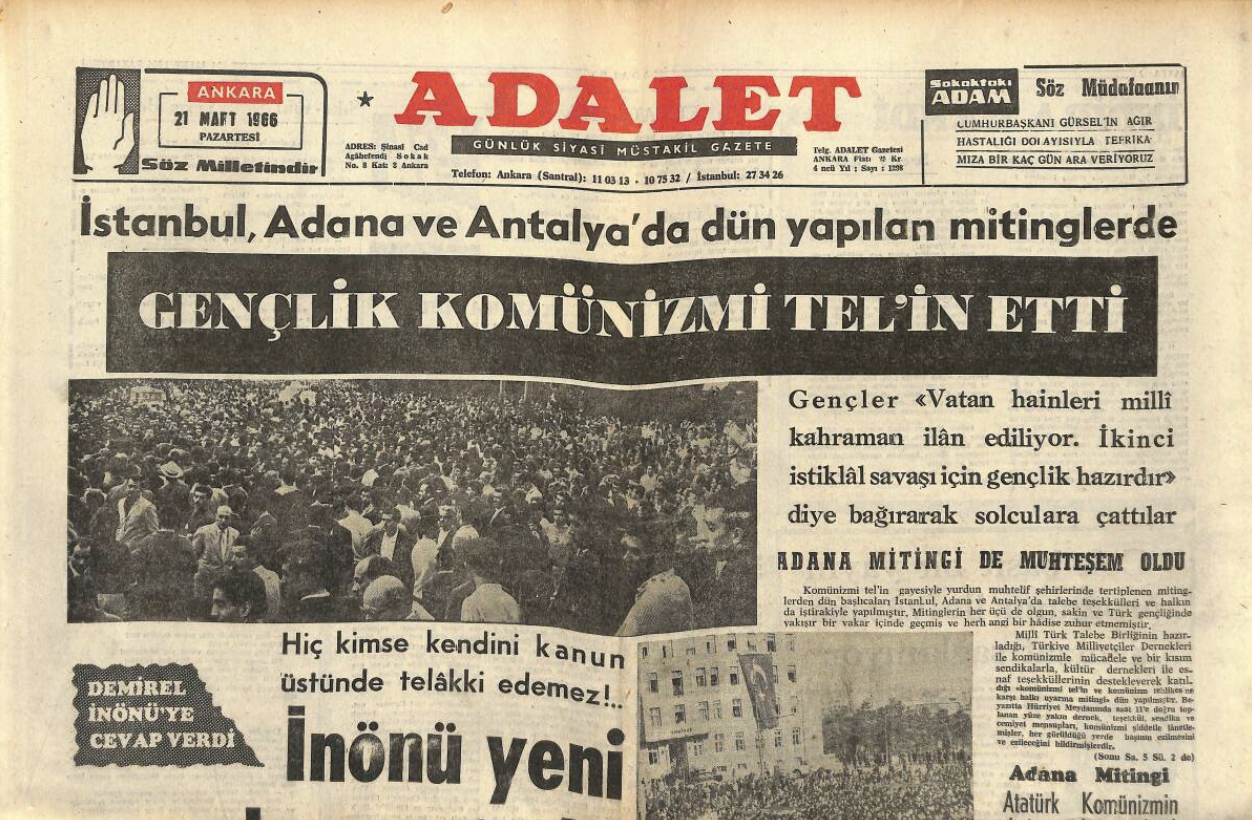
Although Cinisli's election as chairman is characterized as a "turning point" for "Islamic youth," students under the MTTB's roof would have to wait until 1969 before calling themselves "Islamic youth." After Rasim Cinisli, İsmail Kahraman110 would be elected chairman first, followed by Burhanettin Kayhan111 in 1969:
"With Burhanettin Kayhan's election as chairman in 1969, university and secondary-school students under the roof of the Milli Türk Talebe Birliği began to describe themselves as Islamic youth. This date can be regarded as the starting point for the shaping of the Islamic youth who, to this day, still embrace an Islamic way of life at universities and struggle for its sake."
112This transformation the MTTB underwent would later be described in phrases such as "From Turkism to Islamism," "From the Grey Wolf to the Quran," and "From the Grey Wolf to Islamism," and would become the subject of various studies.113
The MTTB's main activities and actions during this period were as follows:
— The Conquest Rally (29 May 1965): The first "Conquest Rally" is held at Sultanahmet Square to mark the 512th anniversary of the "conquest" of Istanbul.
— The Pakistan Rally (9 September 1965): Held to protest India over its military operation against Pakistan and to "commemorate the martyrs of Kashmir."
— The Cyprus Rally (20 December 1965): After the UN General Assembly ruled against Turkey's position on Cyprus, a series of rallies is held, the first in Beyazıt on 20 December. The Beyazıt rally is followed by others in Üsküdar, Ankara, İzmit, Mersin, Erzurum, and many other parts of Turkey.
— The "Damning Communism114 and Awakening from Heedlessness" Rally (20 March 1966): Led by the MTTB, with the participation of unions affiliated with Türk-İş and of the Associations for the Struggle Against Communism and Nationalists. This is the first major "Damning Communism" rally. The Istanbul rally is followed by others in Maraş, Erzurum, Zonguldak, and İzmir.
— On 20–27 December 1966, the visit of the head of state of the USSR (Union of Soviet Socialist Republics) to Turkey is protested, and banners reading "The Captive Turks Will Be Liberated, Our Past Is a Mirror to Our Future" are hung on the MTTB building.
— On 18 March 1967, a ship is taken to Çanakkale for a ceremony commemorating the Çanakkale [Gallipoli] martyrs.
— Prayer at Hagia Sophia (27 July 1967): Following Pope Paul VI's visit to Hagia Sophia, where he prayed together with tourists, a press conference is held, after which prayers are performed at Hagia Sophia for the first time since 1943.
— The Şahlanış [Rising Up] Rallies (1967–1968): These rallies begin as a way of "denouncing" TİP's "Eastern Rallies." The first is held in Erzurum on 12 November 1967, with the participation of nearly 60 nationalist, right-wing organizations. It is followed by rallies held in Istanbul, Ankara, and İzmir in 1968.
— "In response to the hanging of a red flag on the Beyazıt Tower by communist, leftist elements," the MTTB holds a "Rally to Honor the Turkish Flag" in Beyazıt. A Turkish flag is hung on the tower, and the university's walls and classrooms are decked with flags.115
Burhanettin Kayhan was elected Chairman of the MTTB following the General Assembly that began in Kayseri on 25 April 1969 and concluded in Istanbul on 12 August 1969. In this way, the MTTB "found its true identity."116 From this point on, the MTTB would take its place within the youth movements under this new identity.
The process of Islamization that began with Rasim Cinisli's election as chairman in 1965 continued under Burhanettin Kayhan's chairmanship, with the MTTB finding its true identity. This period marks the beginning of the era in which secondary-school and university youth began describing themselves as Islamic youth.
"These were years in which Turkey was highly turbulent, and in which students (both secondary-school and university) experienced actual, armed clashes that went well beyond intellectual and ideological debate. While the MTTB made an effort to stay out of these clashes, it also argued that the solution was not to restrain or set limits on the leftist currents it characterized as negative (since this would only strengthen them further), but to eliminate this negative current at its root. In this period, too, the MTTB emphasized 'the necessity of reclaiming the civilization of faith,' expressing views such as: 'Why should the substance of ours that produced an Ottoman sun out of a declining Seljuk state not bring forth a new civilization once again in the 20th century? Moral and social values do not age, fade, or wither — it is form that withers.'"
117This piece continues: "However much they may have tried to stay out of the armed clashes taking place among students…", going on to explain why they were unable to stay out of them. What follows is an account of how "anarchist," "leftist," and "communist" students attacked them, the schemes they set up against them, and how, as a result, they were forced to fight back.
The MTTB was shut down after the 12 September coup. Efforts to re-establish it began in 2006. It was founded by "a total of eight active university student associations across four provinces, Istanbul foremost among them, with the aim of reviving the MTTB," and a meeting was held on 16 December 2006 "on the occasion of the MTTB's 90th founding anniversary." Abdullah Gül, Bülent Arınç, Abdülkadir Aksu, Hüseyin Çelik, and Ali Coşkun also attended this meeting.118 As a result of these efforts, the MTTB was re-established on 27 March 2008 under the name "Talebe Birliği Federasyonu" [Students' Union Federation], later taking back the name MTTB.
In the end, in 1960s Turkey, and in the events of Kanlı Pazar, the MTTB, too, took its place on the stage as one of the parties to the conflict.
Among today's politicians, too, there are many with roots in the MTTB: President Abdullah Gül, Prime Minister Recep Tayyip Erdoğan,119 Bülent Arınç, former Speaker of the Grand National Assembly, former ministers Beşir Atalay, Ali Coşkun, Mehmet Ali Şahin, and Hüseyin Çelik, Abdülkadir Aksu, Ahmet Davutoğlu, Kadir Topbaş, Mayor of Greater Istanbul Municipality, Ömer Dinçer, former Undersecretary to the Prime Minister, and a great many more deputies, bureaucrats, and journalists… All of these people have roots in the MTTB.120 İsmail Kahraman, a former MTTB chairman, said after the November 2002 election that brought the Justice and Development Party to power that more than 50 percent of parliament had an MTTB background.121
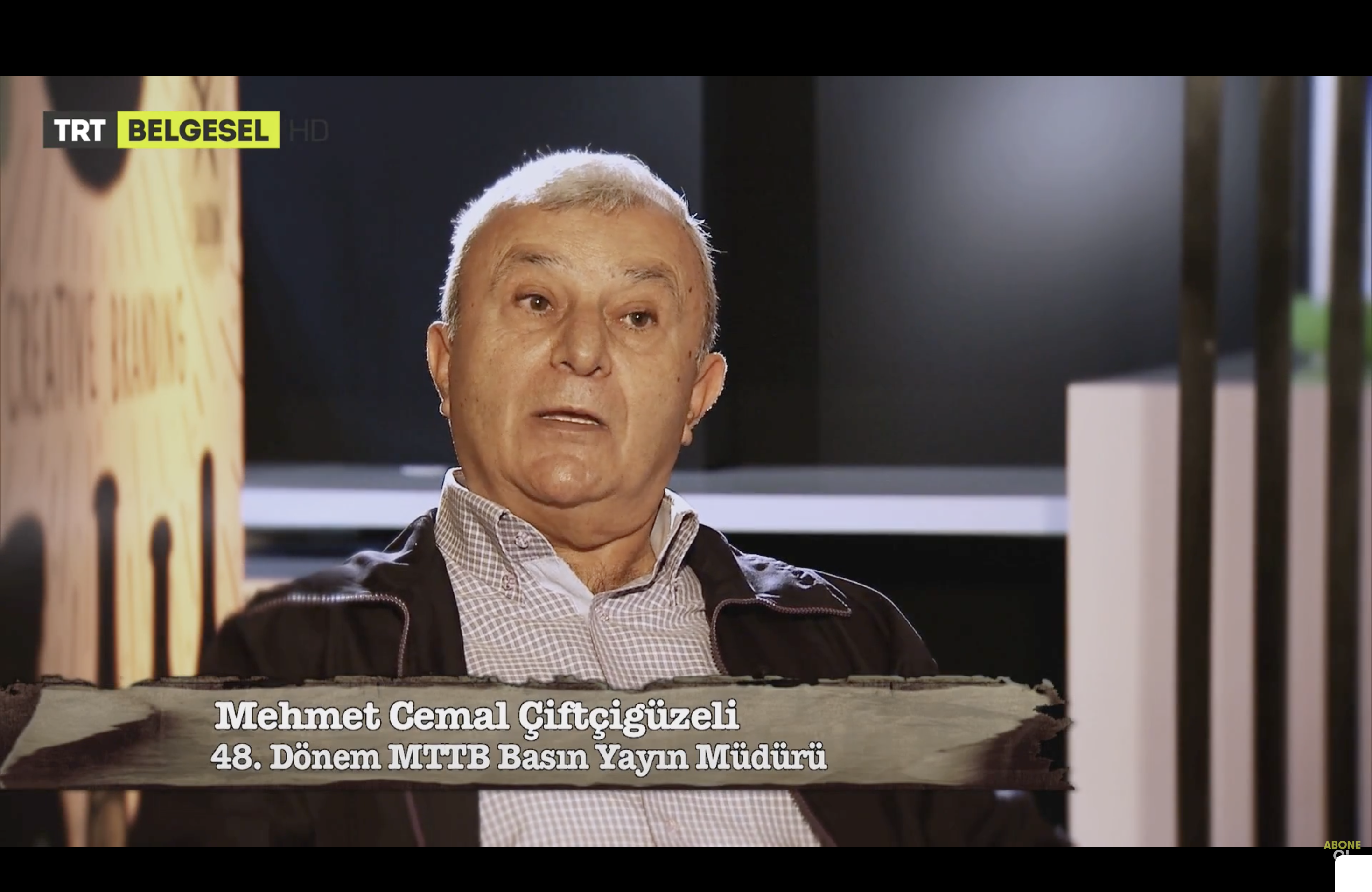
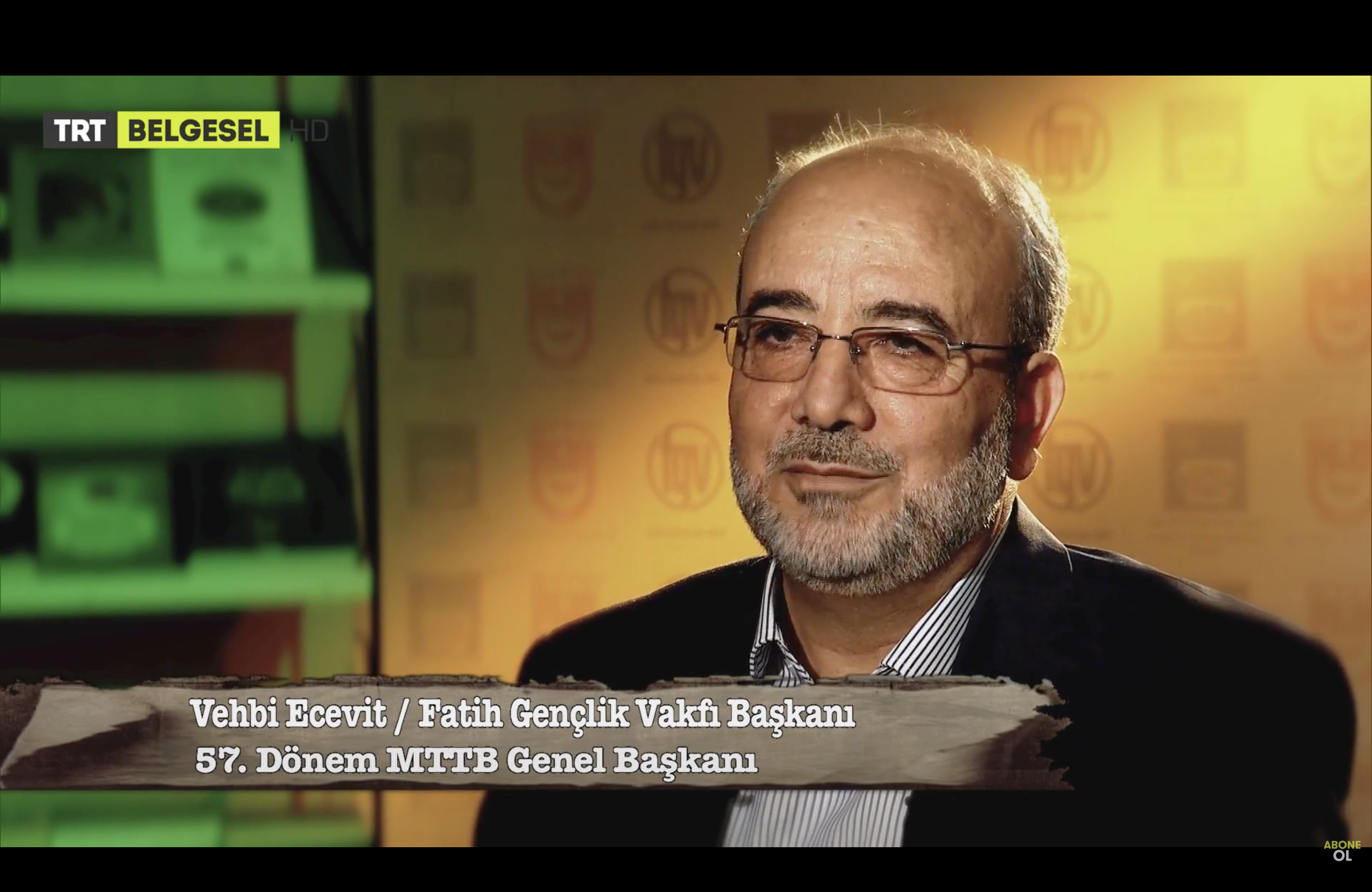
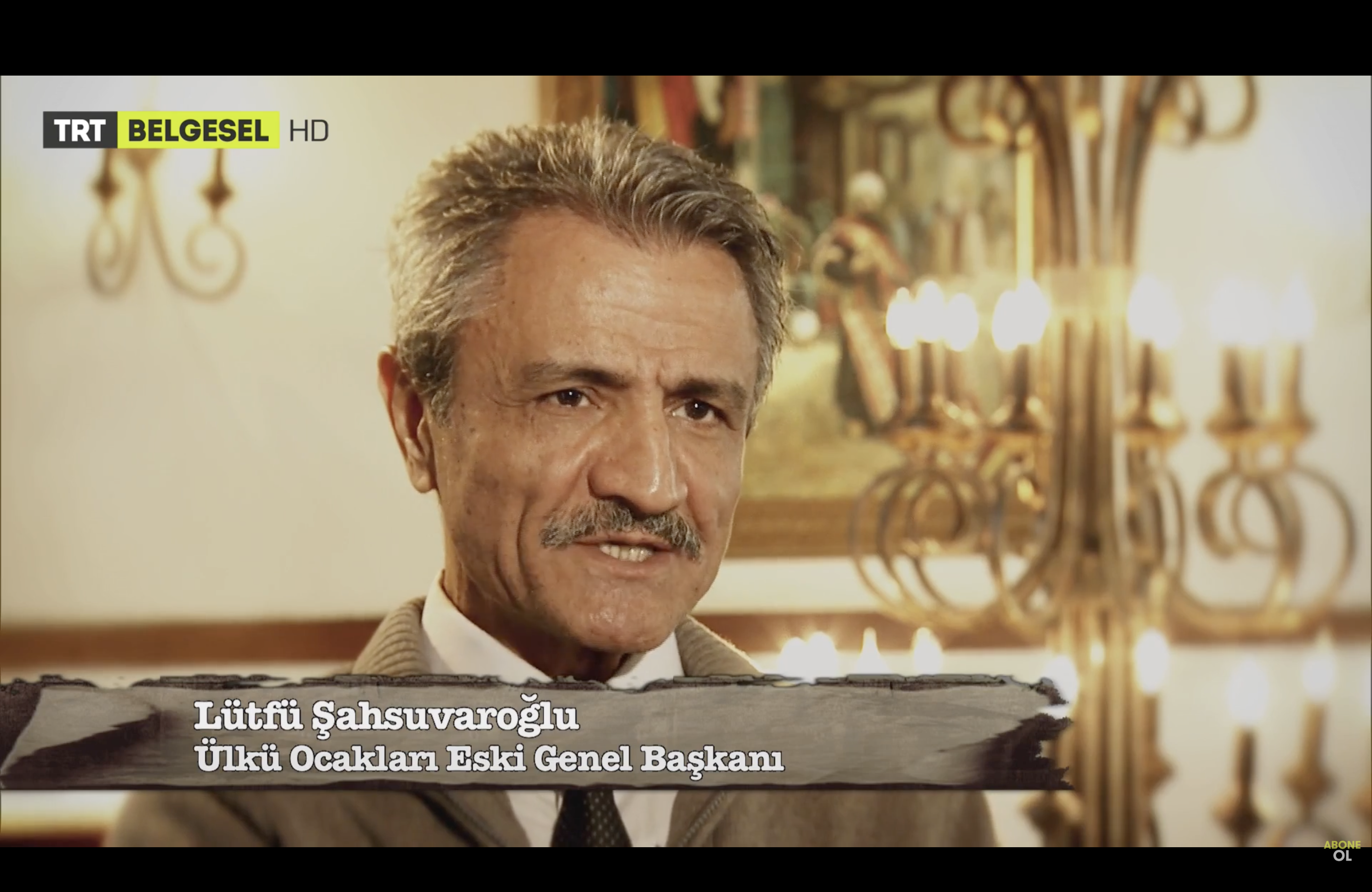
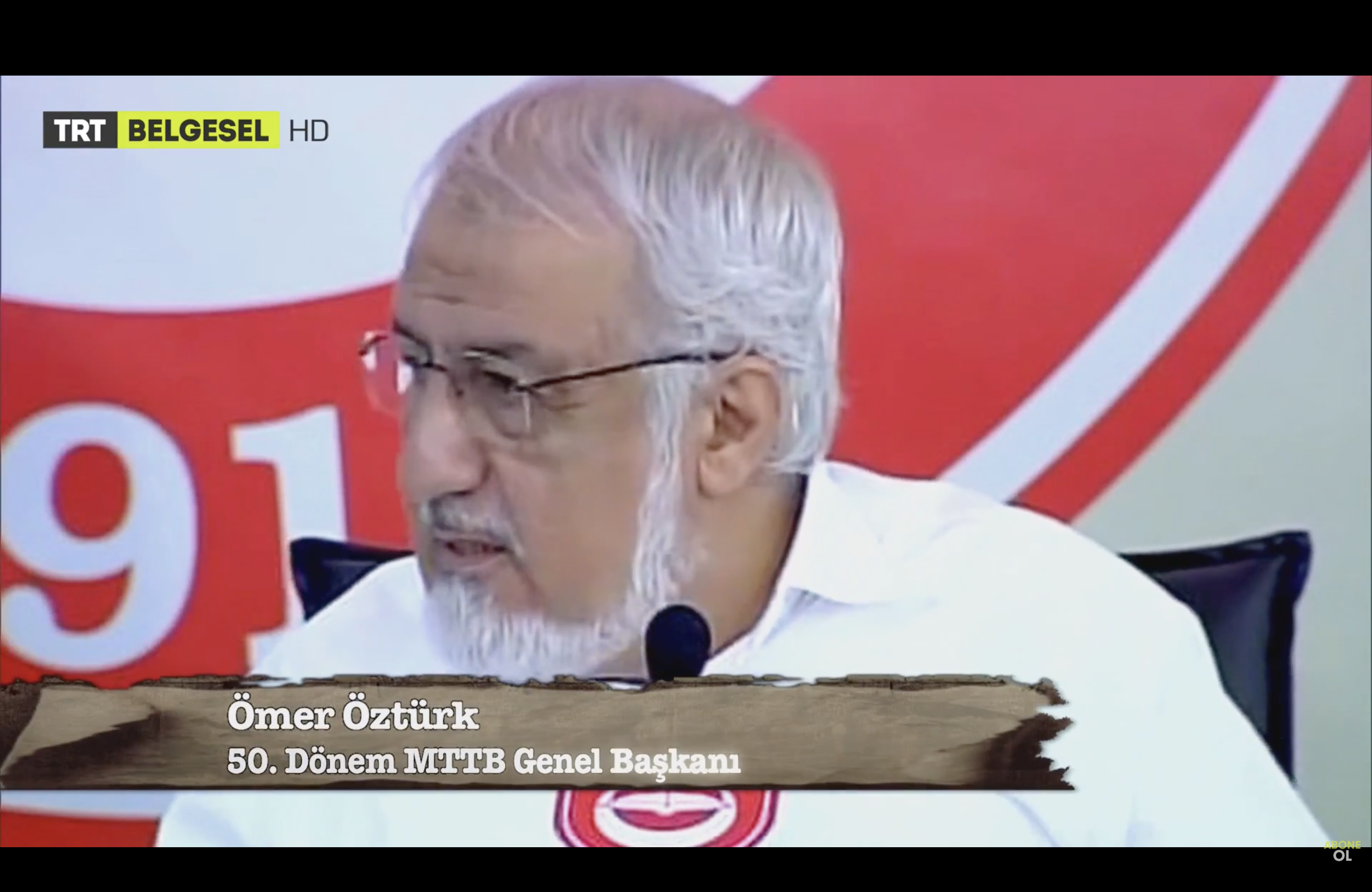
Recep Tayyip Erdoğan, Abdullah Gül, and the MTTB
When this book went to press, Turkey's President was Gül, and its Prime Minister was Erdoğan. Both men's paths crossed with the MTTB from the 1960s onward, and both were active within it. One encounters both names in the MTTB's activities in the '70s, in the Birlik Vakfı — founded with the same mission when the MTTB was shut down after 12 September — and in the MTTB's new period beginning in 2008. The political lives of these two MTTB members, which began in the 1960s, are important for showing the trajectory over the years of the MTTB — one of the central figures of Kanlı Pazar — and the place they came to occupy within the state. For this reason, the political lives of the two men will be examined alongside the MTTB's own story.
Recep Tayyip Erdoğan
Born in 1954, Erdoğan graduated from primary school in the 1964–1965 school year and enrolled at Istanbul İmam Hatip High School in 1965. Erdoğan's first political activities also began that year, when he took on a role in the MTTB's "secondary education" division.122 Turan Yılmaz, a reporter for the newspaper Hürriyet, relates in his book Tayyip — Kasımpaşa'dan Siyasetin Ön Saflarına [Tayyip: From Kasımpaşa to the Front Lines of Politics] that, because of this "political involvement" that began in his middle-school years, Erdoğan used to tell friends, "My political career is older than my teacher Erbakan's."123 Here, Erdoğan is alluding to Erbakan's entry into active politics in 1969 under the "Independents' Movement," implying that his own political involvement began before 1969.
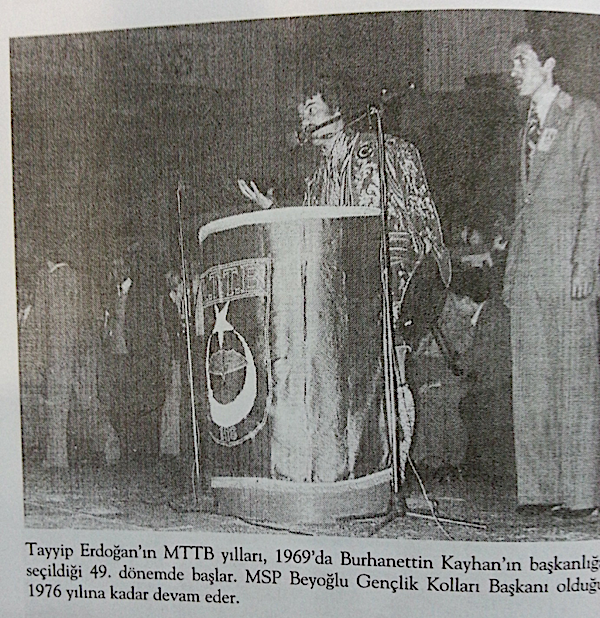
During his high school years, Erdoğan was one of "the school's most active students." He took part in numerous cultural and sporting activities, from poetry recitation to debate and composition competitions, from athletics to football. He headed his class's debate team and was part of the school's debate team as well. It was also in these years that he met many of the people he would later go into politics with. Abdullah Gül was one of them.124
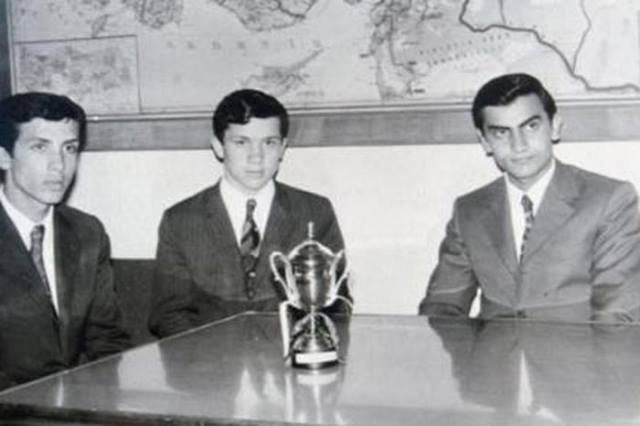
Erdoğan graduated from high school in the 1972–1973 school year and, in 1973, gained admission to Marmara University's Faculty of Economic and Commercial Sciences. During his university years, he continued his activities under the MTTB's roof and took on responsibilities there, serving for a time as MTTB Culture Director.125 Erdoğan was also among the students who received a certificate of achievement in the 1974–1975 term from the Institute of Social Sciences — an institution founded by the MTTB that "operated like a university, set a model, and helped train young people."126
When the MTTB was shut down after the 12 September 1980 coup, Erdoğan was among the 40-member founding board of the Birlik Vakfı, established to carry on the MTTB's mission. In the foreword to the booklet "Birlik'te 20 Yıl" [20 Years in Birlik], the founding of the Birlik Vakfı is described as follows:
"It was 20 years ago… Forty idealistic people, united in thought, faith, and method, came together… The country needed service… What was to be done?.. How was it to be done?.. Their hearts were full of the love of service… They had once stood shoulder to shoulder in service within the largest youth organization, the Milli Türk Talebe Birliği (MTTB)… They had begun this long-distance race of service together, back in their student years… That great organization, the MTTB, was shut down… The organization could be shut down, but the love of service in their hearts could not be destroyed… And it was not… And so the MTTB was closed, but the enthusiasm for service could not be dammed up… The fire of service did not go out — it blazed brighter… Under the chairmanship of İsmail Kahraman, the MTTB's 48th-term chairman… 20 years ago… on 29 May 1985… forty people came together in the name of believing hearts… And with such feeling and such ideals, they founded the BİRLİK VAKFI [Union Foundation]…"
127Important figures from Turkey's right-wing and Islamist politics attended the Birlik Vakfı's General Assembly in 1995. R. Tayyip Erdoğan, Abdullah Gül, Fethullah Gülen, Necmettin Erbakan, Mesut Yılmaz, Muhsin Yazıcıoğlu, Abdülkadir Aksu, Hasan Celal Güzel, and Rauf Denktaş are only the most prominent of those seen in the photographs.
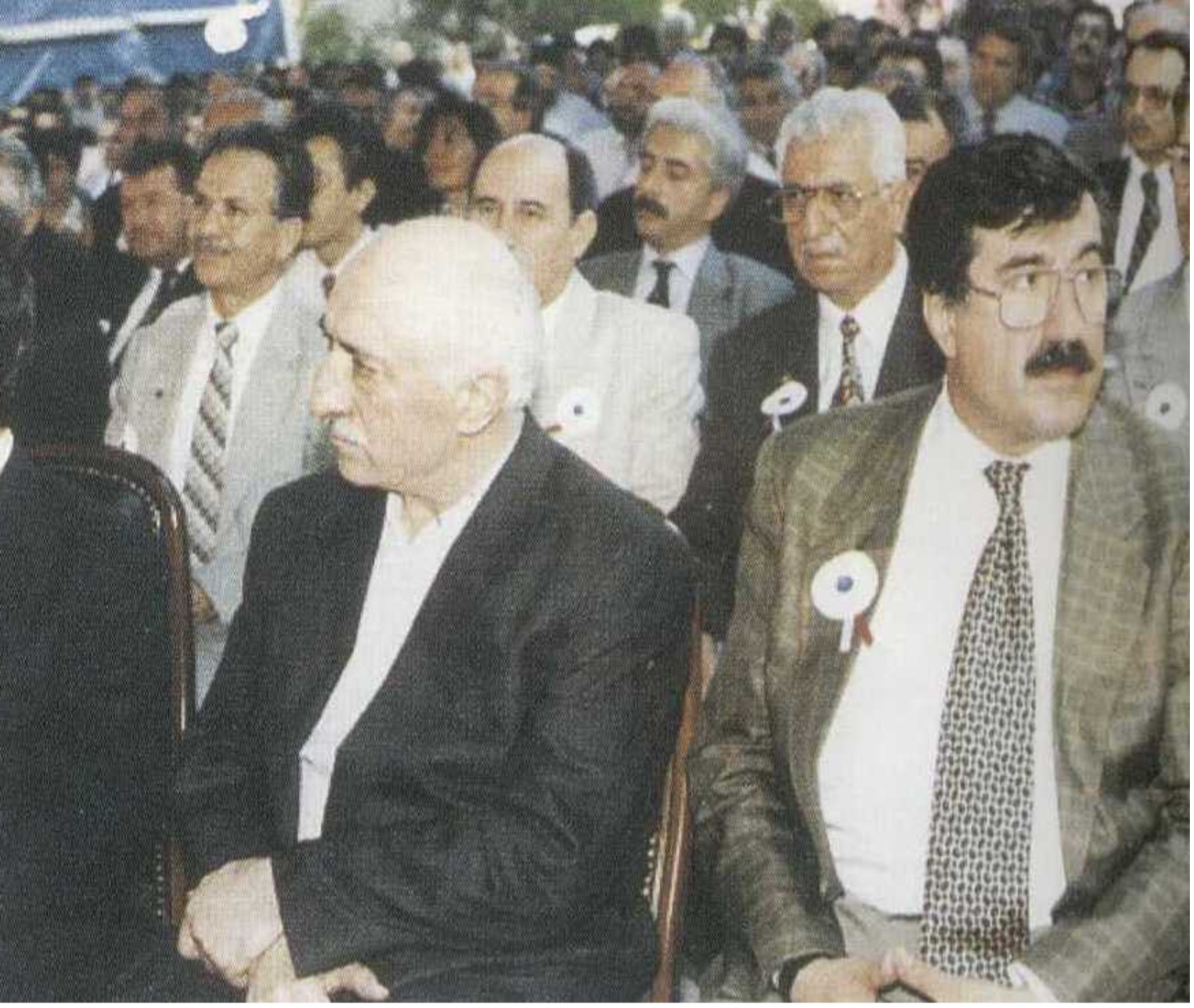
Abdullah Gül
Born in 1950, Abdullah Gül attended Kayseri Lisesi for high school. In 1960s Kayseri, there were three institutions that had become gathering places for right-wing youth: the Türk Ocağı, the Türk Kültür Derneği, and the Kayseri branch of the Büyük Doğu Cemiyeti. During his high school years, Gül was active in these institutions, together with a group of about twenty friends.128
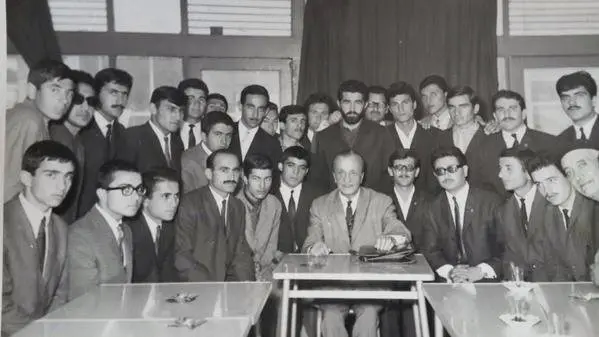
Gül came to Istanbul for his university education and enrolled at Istanbul University's Faculty of Law in 1968. Two months later, he transferred and continued his studies at Istanbul University's Faculty of Economics. During his university years, he took an active role within the MTTB. The following lines are taken from the official website of the Presidency:
"The years Gül spent at university were the period of the most intense student movements in Turkey. During his faculty years, he took an active part in student movements. He was among the student leaders of the Milli Türk Talebe Birliği (MTTB), one of the leading student associations of the period; he took part in rallies and contributed to magazines and publications. The experience and friendships he gained in those years left marks on Abdullah Gül that would last a lifetime."
129In 2007, the year Gül ran for president, striking information can be found in the biography published on his own website. Here, in describing his student years, it is stated that staying out of the violence was almost impossible, and that during these years dominated by violence, Gül served "as a leader in the front ranks" of the MTTB:
"While the sorrowful story of the '68 generation — one that stretched all the way to the 12 March 1971 Memorandum — drew the whole of the youth into its sphere of influence, walking a third path and staying out of the violence was, at the time, almost impossible. Living through this period, which had a major impact on the post-1971 political atmosphere, as a leader in the front ranks of the Talebe Birliği would prove to gain Abdullah Gül a great deal, as it did for every idealistic young person."
130This piece also describes the roles Gül took on within the MTTB:
"While a university student, during Ömer Öztürk's term as chairman, Abdullah Gül served as a member of the Milli Türk Talebe Birliği's Central Executive Council. While continuing his studies in the Department of Finance and Social Policy, Gül also took part in intellectual, cultural, and social activities within the Talebe Birliği. One of the MTTB's major annual activities was taking thousands of young people to Çanakkale for the anniversaries of the Battle of Çanakkale [Gallipoli] and organizing events there. Abdullah Gül organized these programs and delivered his first political speeches at Çanakkale."
And here there is another important piece of information, one that does not appear on the official Presidential website:
"During his university years, Abdullah Gül actively carried on his intellectual struggle under the roof of the Milli Türk Talebe Birliği. Photographs of Gül and his friends were posted on walls by leftist groups, and they were prevented from entering the university for months."
Details of this episode, which Gül does not elaborate on, can be found in the books of journalist Fatih Bayhan and of Tuncay Çelen — who was part of leftist youth in the 1960s and was arrested for setting fire to Komer's car. These books recount how Deniz Gezmiş and his friends put up photographs of leading right-wing youth figures on the university's walls, labeled "fascist," that Abdullah Gül was one of those whose photograph was put up, and that Gül was unable to enter the university for six months because of these posters.131
Another, lesser-known side of Gül, which he mentioned in one interview, is that he was a founder of the Türk Ocağı and the Milliyetçiler Derneği [Nationalists' Association]. In that interview, saying "I too am a nationalist," Gül cited his founding of these two organizations and his tenure as chairman of the MTTB Executive Council as evidence of his nationalism.132
Gül graduated from university in 1974 and began his doctorate at the same institution. Between 1976 and 1978, he was sent to Exeter, England, for his doctoral studies on a scholarship from the Milli Kültür Vakfı. His biography states that he continued to be socially active there as well, founding the Türk Öğrenciler Yardımlaşma Derneği [Turkish Students' Mutual Aid Association] under the umbrella of the Federation of Student Islamic Societies (FOSIS). After completing his doctorate, he began working as a faculty member at Sakarya University.
Gül was one of the 650,000 people133 detained after the 12 September 1980 military coup. He was held in detention for a month. During this period, he was questioned about events from his student years. Gül states that he did not encounter "ill treatment" during this month-long interrogation. His brother Macit Gül, however, detained in Kayseri, was not as fortunate.134
Gül taught economics at Sakarya University until 1983, when he left the university and began working as an economics specialist at the Islamic Development Bank, headquartered in Jeddah. Gül's doctoral thesis was titled "The Development of Economic Relations Between Turkey and Islamic Countries." Gül returned to Turkey in 1991 and was elected as a deputy from Kayseri in that year's election, marking the start of his time in parliament, which would eventually lead to the presidency.
Considered alongside this trajectory, the following lines Gül wrote in Milli Gençlik, the MTTB's publication, are quite telling:135
"Let us see whether the future in our country will belong to the local cadres of the communist-capitalist superpowers chasing after world domination, or to us — the warriors loyal to the Turk's spiritual roots, who will revive the East from within and make the 'Timeless Absolute Idea' prevail?…"
Abdullah Gül, Milli Gençlik, February 1976, No. 11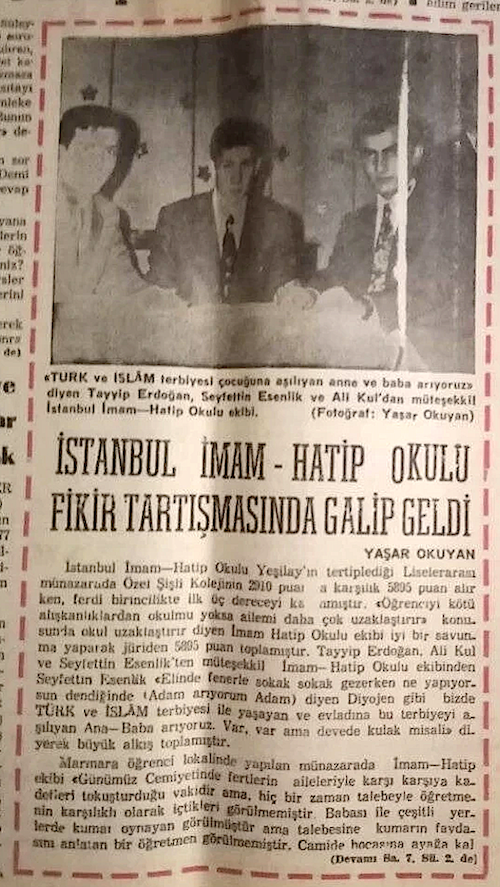
The Associations for the Struggle Against Communism
The first attempt to found an Association for the Struggle Against Communism took place in Zonguldak in 1948. This effort was led by Necdet Sancar, Ziya Özkaynak, Bahattin Yurteri, Kani Engin, Zeki Kandemiroğlu, İsmail Tek, Tahsin Baysal, and Bahaddin Dökerel. Although the effort to found the association began in 1948, the association itself was not founded until 1950. Its first chairman was Dökerel. The association was revived and became active thanks to Necdet Sancar136 and Ziya Özkaynak, both of whom were high school teachers.137 At the second congress, held on 27 September 1951, Talip Taşman became chairman and Necdet Sancar deputy chairman. The association also engaged in publishing activity, putting out works titled "A Response to A. E. Yalman on the Nazım Hikmet Question," "An Open Letter to Turkish Youth," "What Is a Communist," "The Inner Truth of Communism," "The Tale of the Red Paradise," and "Mehmet Emin Yurdakul." It also published a biweekly newspaper called "Turkishness Against Communism." This association, founded in Zonguldak, ceased its activities in 1953 upon joining the Türk Milliyetçiler Derneği [Turkish Nationalists' Association].138
The second attempt to found the association took place in Istanbul. The association founded in Istanbul on 7 December 1956 had Burhanettin Şener as chairman and Altan Deliorman as secretary-general. In his piece "Errors in Pan-Turkism," Altan Deliorman periodizes the Türkiye Komünizmle Mücadele Derneği (TKMD) as the "First TKMD," "Second TKMD," and "Third TKMD," with the first being the 1948 attempt.139
The association founded in Istanbul explained its purpose as follows:
"To struggle against communism through ideas, by reinforcing the elements that form and strengthen our national constitution and enable us to live as a nation. To achieve this aim, to root deeply our attachment to history, homeland, and God."
140Not long after its founding, the association published a declaration titled "We Call Youth to Duty; Let Us Be Watchful and Vigilant":
"Friends, fellow citizens!
While Russia works to disturb world peace through a thousand and one political intrigues and provocations, it also strives, with the aim of wearing down the constitution of free nations, to spread the poisonous seeds of its repugnant regime.
Unfortunately, as in many other places, there are wretches in our own country too who serve this degenerate purpose. Devoid of Turkishness, love of homeland, and religion — devoid of God and every quality that makes a person human — these servants of communism, feeling our laws hanging over them at every moment like a sledgehammer, disguise their activities in all manner of ways.
Their aim is to open cracks in our constitution whenever they find the opportunity, so as to weaken us. Only a vigilant youth can wage the most effective struggle against these sellouts, who never dare show themselves to us in their true colors.
Nationalist friend!
Let us abandon indifference once and for all. Your vigilance and sensitivity will always defeat them. But there are still naive sons of the homeland who have not yet earned the immunity you have gained in national matters. Warning these innocent friends — the communists' first target — is your foremost duty.
Do not forget, and join this struggle at once!
The "Turkey Association for the Struggle Against Communism" has been founded with the aim of achieving more decisive results as a single front against the communists. You, too, must be one of the fists that comes down upon degeneracy, anarchy, and treachery. This beneficial organization will grow, live, and carry out its duty through your efforts. Duty awaits you."
141In a second declaration, published in the name of its Head Office, the association issued a call to "organize":
"The duty now falling to our nationalist, patriotic, anti-communist people is this:
Not to leave alone those who have thrown themselves into such a difficult but honorable struggle; to work toward organizing the association wherever we are; to get in touch with the association's head office on all matters concerning communism; and to spread and promote the association's aim."
The association ceased its activities after 27 May and was refounded in 1963, headquartered in İzmir. Altan Deliorman calls this period of the association the Third TKMD. During this period of the association, already at its founding stage, tension arose between the "nationalist" faction and the "traditionalist" faction. Zübeyir Yetik — who had spearheaded the founding of the association, being "the one who conceived, started, and carried through this undertaking" — was kept out of the association as the leading figure of the traditionalist faction, and the nationalist faction carried out the founding. The traditionalist faction, Yetik included, nonetheless continued its activities within the association. Yetik attributes the attempt to exclude them from the association's work to the association's relations with America. According to Yetik's account, it was discussed and agreed within the association that they would apply to the American Consulate in order to find financial resources and support. Yetik describes what followed like this:142
"As it turned out, our people had met with the Consulate and conveyed their requests. Those at the Consulate said, as if to say, 'As if the likes of these have any say,' that they could provide a small printing press, a jeep fitted with sound equipment, and who knows what else — but they set one condition. Their condition was that 'ties between Zübeyir Yetik and İhsan Emci and the Association be cut, and the work they were carrying out be stopped.' Because, as holders of an Islam-based outlook, we apparently had to be neutralized at all costs."
Zübeyir Yetik, Geçmişten Notlar (2008)Working from this information, and taking into account that he was left off the list of founders, that he was prevented from setting up a branch, and that he was not even accepted as a member, Yetik says he concluded that "this hand had been involved in the matter from the very start."
The activities of this new İzmir-based association spread rapidly after İlhan Egemen Darendelioğlu, owner of the magazine Toprak, took over its chairmanship in 1965;143 the number of branches, 27 in 1965, rose to 110 within a short time. From 1965 onward, the association organized rallies in many provinces. President Cemal Gürsel even served, if only for a few days, as the association's honorary chairman, until his resignation on 16 July 1965.144 During this period, radio spots aired declaring, "by order of the Presidency," "Citizens, beware! Water sleeps, but communism does not," "The communist infiltrates your ranks disguised as a Turk and a Muslim," and "Communism is a snake that stabs you in the back with sweet words."145
Speeches at meetings held at the association's branches were given by Prof. Dr. Nevzat Yalçıntaş, Prof. Dr. Mümtaz Turhan, Prof. Dr. İbrahim Kafesoğlu, Dr. Fethi Tevetoğlu,146 Kadircan Kaflı, Necip Fazıl Kısakürek, Ergun Göze, Aclan Sayılgan, Galip Erdem, and İhsan Taşdelen.
The account of Abdurrahman Dilipak, who says he was taken to Associations for the Struggle Against Communism by some of his teachers at imam hatip high school in the late 1960s, is also important, both in complementing the information Yetik provides and in understanding these associations. Dilipak states that these associations had "printed documents from the United States Information Agency" on hand, and that a military prosecutor said, at one of these gatherings, "Hit them, but don't kill them — let us know while they're still at the police station, before they reach trial."147
Fethullah Gülen, one of today's prominent figures, was also among the association's founders in Erzurum.148 He describes this undertaking as follows:149
"And yet another undertaking from this period was our attempt to open an Association for the Struggle Against Communism in Erzurum. Until then, it had existed only in İzmir. The second one was to be opened in Erzurum, through our own efforts. His name was Ali — we sent a friend to İzmir and had him bring back the bylaws. We were going to found the association. I made an announcement after a sermon, and we gathered with the young people in front of the Caferiye Mosque. Our aim was to organize against communism. I had a relative who understood association and society affairs. He came and warned us, guided us… Of course, none of us knew the relevant laws at the time. In any case, our friends in Erzurum found me a bit too caught up with these associations. They were uncomfortable with my activities. 'Where did this "Association for the Struggle Against Communism" come from?' they said. 'Read the Nur [treatises]. There's no better struggle than that.' Later, though, they would say, 'It seems we were mistaken,' and it would be they themselves who founded the Association for the Struggle Against Communism. But at the time, my efforts were regarded as strange and made the subject of criticism."
Fethullah Gülen, quoted in Erdoğan, L. (1997)Zübeyir Yetik, in assessing the Association for the Struggle Against Communism, says that they were, in fact, unable to see "the things they really needed to see":150
"In those days, communism — even for those of us who knew something of its theory — was like a punching bag set before us, the kind boxers work on with their fists. The thing is, while boxers develop themselves by throwing punches, as we busied ourselves with this punching bag we were, in reality, just being kept occupied, losing strength — we no longer even had the chance to see the things we really needed to see. Of course, I only realized this truth later."
Zübeyir Yetik, Geçmişten Notlar (2008)The association held "Damning Communism Rallies" in İzmir (the first, in 1965), Antalya, Adana, Erzurum, Kars, and Trabzon, and actively took part in all the rallies the MTTB organized in Istanbul, assisting the MTTB. Beyond rallies and conferences, another important area of the association's activity was publishing. A magazine called Mücadele [Struggle] was published until the end of 1965. Alongside this magazine, three "small but quite useful" books were also printed. The first was titled "The Secret Notebook of the Red Colonel Pankovski." The second, written by Hayri Ilgar, was "Communism and Its Critique," and the third, written by the association's Aydın Branch Chairman, the lawyer Orhan Özgedik, was "The Struggle Against Communism and Its Methods."151
The Mücadele Birliği (MB) [Struggle Union]
Called, on the one hand, "the right's Dev-Genç"152 and alleged, on the other, to have been set up by the state,153 the Mücadele Birliği — though its formation dates back to around 1964154 — was officially founded on 18 November 1967. Its founders were three imams and one student from a Higher Islamic Institute. One of the three founding imams, a former "student leader," was Necmettin Erişen, who took on the role of chairman. The "ideologue," the "intellectual father" of this structure, was Aykut Edibali.155 İrfan Küçükköy, who took part in the association's founding efforts, lists its principles as "anti-Zionist, anti-communist, anti-capitalist, loyal to national values, respectful of Islam."156
The MB was organized under the names "Sancak" [Banner] and "Nationalist Culture Unions." Sancaks were established in provinces with a developed membership base. The MB had three Sancaks: Konya, Afyon, and Istanbul. In provinces without a Sancak, Nationalist Culture Unions were established instead.
The MB is described as a structure that did not shy away from violence but stayed clear of armed conflict. Aykut Edibali, the MB's leading figure, expressed this by saying, "I never so much as bloodied anyone's nose; I watched over them like my own children, I never let blood be spilled, whether by selling it or having it sold."157 Within the MB, however, a "striking force" called the "Peace and Order Committee" was formed in February 1969, and a camp was set up for its training in the village of Gürpınar, near Büyükçekmece, Istanbul.158 Erişen ties the meaning of the fist in the MB's symbol to the slogan they used at the time: "He is no Muslim who will not use his fist for his faith."159
A piece appearing in the 23 February 1971 issue of Yeniden Milli Mücadele [Renewed National Struggle], the Union's publication, defending the provocations and attacks in Konya and Kayseri as well as Kanlı Pazar, is enough on its own to give a sense of the Union:
"The nation, having shown its strength and its inclination in Konya, Kayseri, and Taksim, waits with patient excitement, certain of its victory, to throw everything un-national into the trash. There is no power that can delay the nation's victory."
160There was also, for a time, a clash between MB supporters and MTTB students. Standing in the same camp did not prevent conflict between them. Over a dispute stemming from the Conquest celebrations, MB supporters attacked MTTB members on 29 May 1970. In response, Burhanettin Kayhan, then MTTB chairman, issued a statement declaring that the MTTB had no connection to the MB and that the MB was on the wrong path.161
The debates over whether the MB was set up by the state came to the fore particularly in the 1970s. Cemil Çiçek, who had been part of the MB's ranks, states in an interview in 2002 that not just the MB but all "groups of that kind" were founded "with the state's knowledge and involvement," in these words:162
"Indeed, it's become clear that, under the conditions of '68, during that Cold War period, these were organizations operating with the state's close involvement and knowledge. I was there for a certain period, and, having seen certain things as a result, I was among the earliest to leave. (…) Groups of that sort were groups that had real strategic value under the conditions of the day. You'd come up from Yozgat, from Samsun, from Trabzon, to Istanbul. Everyone was saying, 'Russia is going to occupy Turkey, the Turkish state is in danger. O people of the homeland, rise up, take your place, and see off this danger.' And you, too, would join organizations of this kind in good faith. Now here's the strange thing about this state: it has these kinds of organizations set up, and then turns around and asks, 'Why did you get involved in this?'"
Cemil Çiçek, Yeni Şafak, 16 June 2002İrfan Küçükköy, who also wrote a book titled Mücadele Birliği, states that some of his friends within the movement had close ties to intelligence figures, and describes relationships with Hiram Abbas, Mehmet Eymür, and Abdullah Çatlı. Even so, to the question "Was it set up by the state?" he answers: "They were sympathetic to us because we were defending the state, the nation, the army — but it was absolutely not a movement they set up."163 Saadettin Tantan, a police officer assigned at the time to monitor the MB, is alleged to have used the words, when the MB came up, "Oh, you mean that organization Ziya Uygur set up?"164 The Ziya Uygur Tantan refers to was a state official who had been expelled from the army over the "3 May 1944 Turkism events"165 but who continued to serve in military intelligence.
The academic Mümtaz'er Türköne, who was himself part of right-wing youth in the 1970s, speaks quite categorically about the MB. According to Türköne, the MB was set up, from beginning to end, according to standards laid down by the Special Warfare Department.166
In the 1970s, the MB began to fragment, and splits occurred, as the nationalist line grew increasingly dominant within it. Since 23 November 1992, the Millet Partisi [Nation Party], led by Aykut Edibali, has continued to exist as the MB's successor.
Many figures who had been part of the MB later took on important roles within Turkish politics. Some of these figures are: Aykut Edibali, Cemil Çiçek, İ. Melih Gökçek, Prof. Dr. Mustafa Erdoğan, Halil Şıvgın, Ali Müfit Gürtuna, Ahmet Taşgetiren, Taha Akyol, Yavuz Aslan Argun, Necmettin Erişen, and Burhan Özfatura.167
"Şulebaşı," the Forerunner of the Türban, and the First University Boycott
1968 was the year boycotts and occupations began at universities and steadily escalated. Although it was leftist youth who carried out these boycotts, the first boycott was launched for a different reason, by a different group: at the Faculty of Theology in Ankara, the first boycott arose over the expulsion of Hatice Babacan, who wore a headscarf, and Mustafa Demirsöz, who had argued with and "insulted" his instructor, Assoc. Prof. Dr. Bahriye Üçok, in class. The MTTB was active in the boycott. Speaking at a press conference held on the matter, İsmail Kahraman protested Babacan's expulsion, saying, "This is a decision that will go down as a disgrace in university history."168 Despite the MTTB's prominent role, leftist students also lent their support to the action.169
These events, and the developments that followed, are described as follows in the 22nd issue, dated May 1968, of the magazine "Milli Hareket," then being published:170
The situation at the Faculty of Theology
Events developed rapidly at this faculty, where a boycott began after two students were expelled. After Mustafa Demirsöz, who had received an expulsion penalty, pitched a tent in front of the faculty and began a hunger strike, the faculty's students published a declaration setting out the situation and their views; not long after, the dean resigned, in what amounted to an admission of guilt. Some time later, the faculty was put on a month-long recess to let things settle down, but the students, arguing that this recess was deliberate, began coming to the faculty anyway, with upperclassmen teaching classes to first- and second-year students. The situation began taking on a genuinely remarkable character for Turkey. The declaration published by the faculty's students reads as follows:
(…) Again, this same female associate professor [Bahriye Üçok], after provoking Mustafa Demirsöz, a second-year student who said that the ideas she instilled during class reflected an orientalist view and that no such thing existed in Islamic sources, by insulting and belittling him with words such as backward, anti-Western, primitive, and bigoted, then complained to the Administrative Board upon receiving his response and secured his EXPULSION.171
(…) Although the real reason for Hatice Babacan's expulsion was her refusal to remove her headscarf, the decision tied her expulsion to an ostensible reason: "making statements or engaging in conduct, whether inside or outside the school or through the press, that damages the school's moral standing."
Milli Hareket magazine, May 1968, No. 22After her expulsion from the Faculty of Theology, Babacan enrolled at Ankara's Faculty of Language, History and Geography, and graduated from that faculty wearing her headscarf throughout.172
This episode draws particular attention both as one of the first indications of the türban [headscarf] issue that would go on to occupy an important place on Turkey's agenda in later years, and for the resonance the names involved carry today.
At the time, the term "türban" did not yet exist. In the students' declaration, Hatice Babacan is described as "covering her head with a scarf." But it was in those days — or rather, in those years — that the foundation of the "türban" issue was laid. Before Hatice Babacan, Dr. Hümeyra Ökten in the 1950s, and Gülsen Ataseven — a medical student who finished top of her class in 1964 but was barred from giving the traditional valedictory speech — had covered their heads, but these incidents were seen as "isolated" and drew no wider response. From the mid-1960s onward, however, the issue of covering one's head entered the public agenda together with the name Şule Yüksel Şenler.
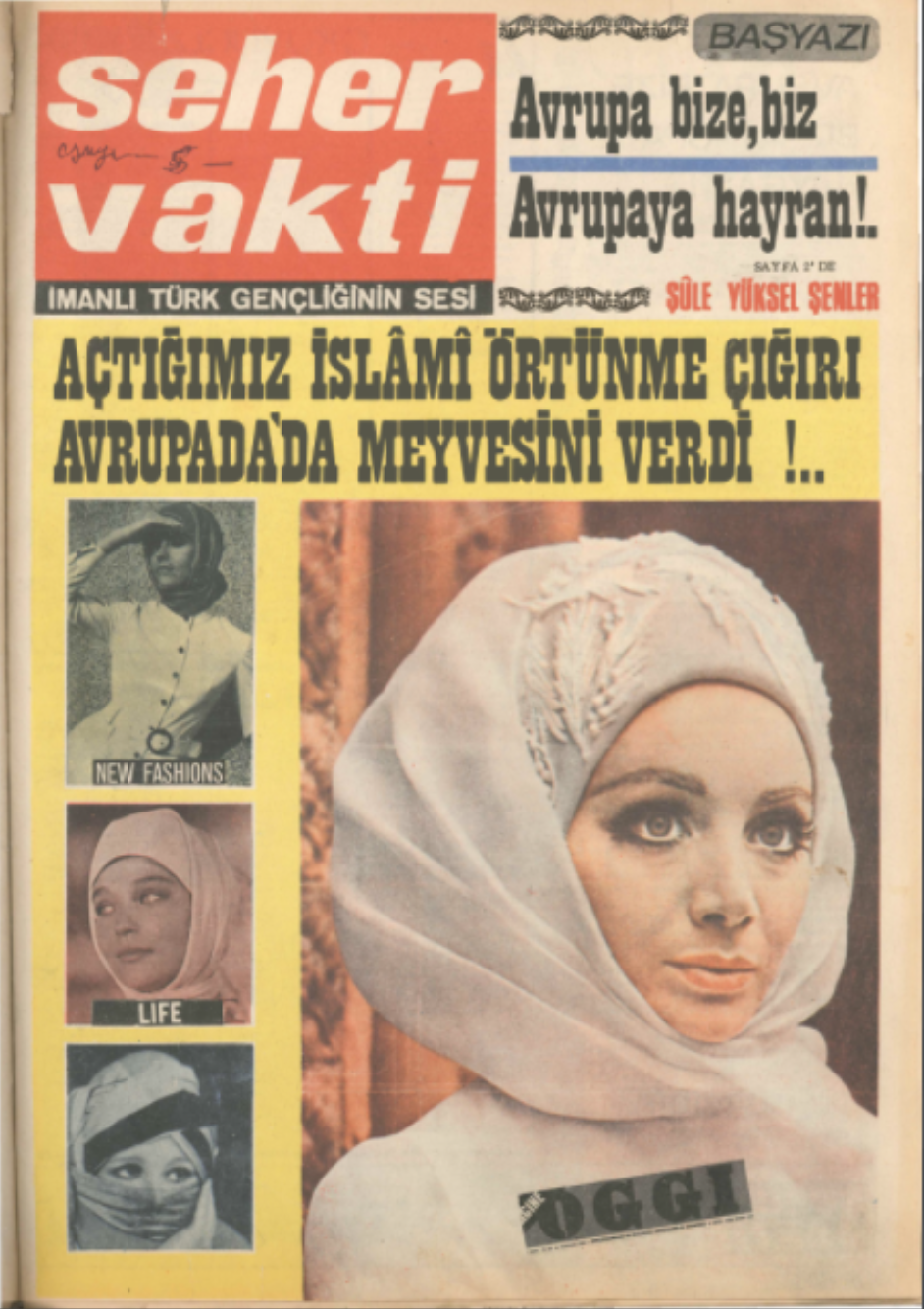
Şule Yüksel Şenler — after hearing whom speak at a conference Hatice Babacan is said to have decided to wear a headscarf at school173 — is one of the symbolic names in Islamist circles. What makes Şenler so significant is that she brought the türban issue into public debate and was the first woman to stand out through her struggle on this front.
"In the late '60s, we see another 'star': Şule Yüksel Şenler. Born in 1937, Şule Yüksel adopted Islamic dress in 1965, and case after case was brought against her over her columns in the newspaper 'Yeni İstiklal.' Meanwhile, when President Cevdet Sunay declared, 'The pioneers of the covered women on the streets will face their punishment,' Yüksel published an open letter: 'The President ought to apologize to God and to the nation.' She was immediately sentenced to 9 months in prison. Cevdet Sunay pardoned her two months later. But Şule Yüksel refused the pardon and served seven more months in prison. This episode further stirred up Islamic circles and further burnished Yüksel's profile. She traveled the length and breadth of Turkey giving lectures. Some young girls who took her as their model began covering their heads in a style called 'Şule-başı' or 'sıkma baş' [squeeze-head]. (Şulebaşı is considered the ancestor of today's türban.)"
174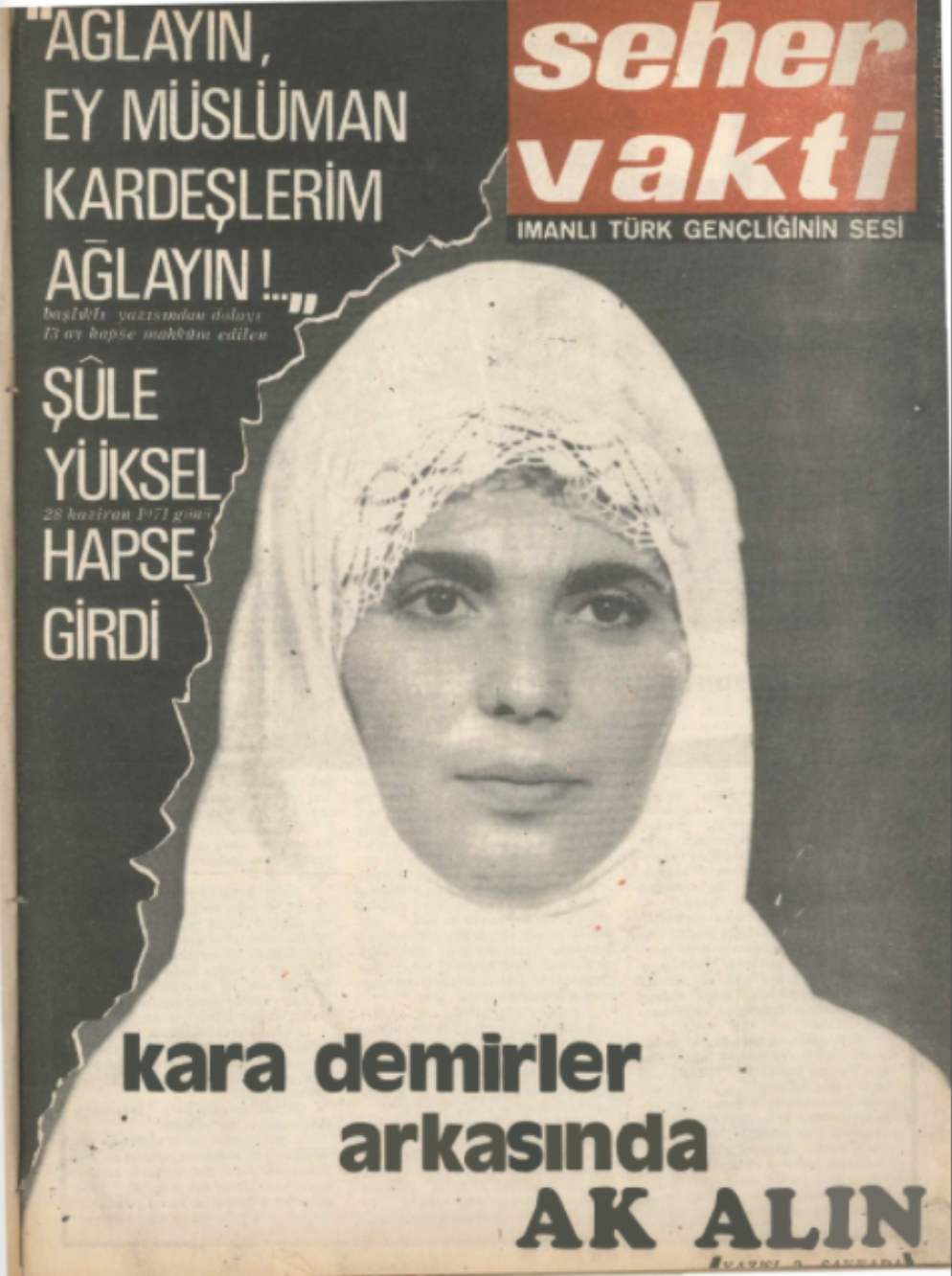
The names "sıkmabaş" and "şulebaş" were given by the media to the new style of covering Şenler introduced. Şenler explains why a new style was needed as follows:175
"Back then, women who covered were dismissively called 'Ayşes' and 'Fatmas.' These names had been reduced to something so crude that the assumption was always that only maids, doorkeepers' wives, and the like covered themselves. Our young girls and women, caught up in this complex, didn't want to resemble Ayşes and Fatmas. I wanted our young girls and women to free themselves from this inferiority complex. (…) Since I was raised in a modern family at the time, I used to go to the cinema too. There was an actor who wore a türban [turban-style headscarf]. I liked the look, though of course it was open in front, tied only halfway. We adapted it to cover the neck as well. We tied it at the back, covering the neck, without showing the hair. This later came to be called 'sıkma baş.' That's how it first came about."
Şule Yüksel ŞenlerThrough her columns on covering and on women, written in the newspapers Yeni İstiklal and Bugün, published by Mehmet Şevket Eygi, Şenler became one of the symbolic names in Islamic circles, followed by lectures she gave across many parts of the country.176 With her imprisonment added to this, Şenler's standing among the Islamic figures of the period was further cemented, and the issue of covering took its place on the public agenda around the name Şule Yüksel Şenler. Şenler also served as chairwoman of the AP's Literature and Youth Branches.
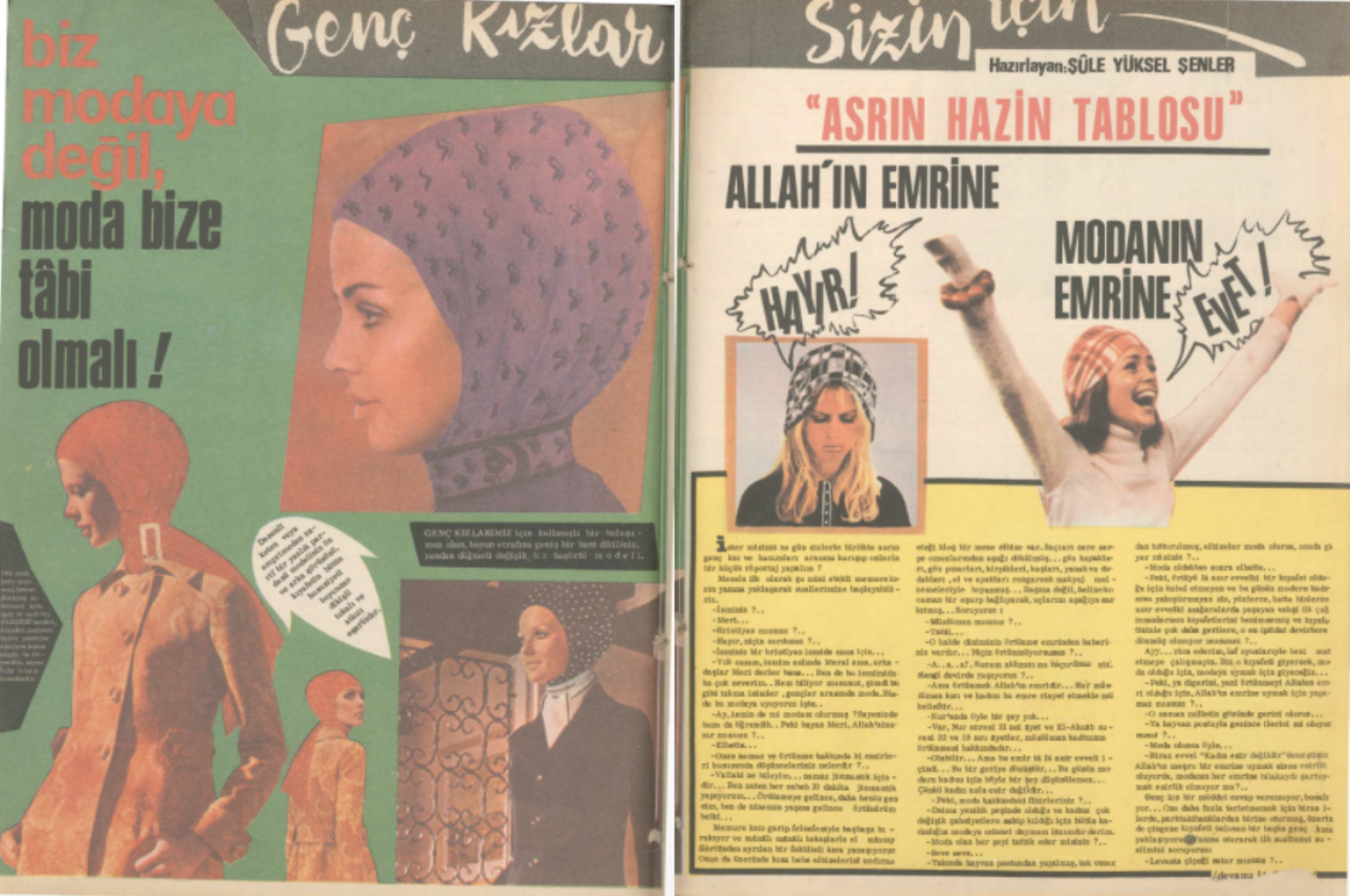
The following words, written in the newspaper Milli Gazete, dated 15 March 2011, to promote the "First Cemre: Şule Yüksel Şenler Night of Loyalty, organized by the İHL [İmam Hatip High School] Sözlük under the patronage of Üsküdar Municipality," show the mission attributed to Şenler:177
"After years of crisis and floundering, devout women's identity had at last found the representative it had been searching for, the light it had been searching for. The people of Anatolia would take to their hearts Şule Yüksel Şenler, who entered into an arduous struggle for the sake of her faith at a time when the number of women writers could be counted on one hand…"
Milli Gazete, 15 March 2011Turning to what this evokes today: the surname Babacan will be familiar to almost anyone who has followed Turkish political life even a little. Hatice Babacan is the aunt of Ali Babacan, who served as Minister of State Responsible for the Economy in the Justice and Development Party (AKP) government formed on 19 November 2002 (the 58th Government) and in the subsequent 59th Government, was appointed Chief Negotiator for talks with the European Union on 3 June 2005, and served as Minister of Foreign Affairs and Chief Negotiator during the 60th Government.178
Second, mention can be made of Şule Yüksel Şenler's connection to Prime Minister Recep Tayyip Erdoğan. Let us quote, on this point, from the newspaper Milliyet, dated 22 March 2004:
'I was the one who introduced Emine and Tayyip'
After Emine Erdoğan stated that she had taken up covering out of admiration for her, the writer Şule Yüksel Şenler, speaking to Habertürk, claimed that she was the one who had introduced Recep Tayyip Erdoğan and Emine Erdoğan. Şenler said: 'We met Emine Hanım in 1967–1968. She was very active, someone who loved working in cultural fields. I was the reason Emine Hanım and Tayyip Bey met. Erbakan was speaking in Taksim. Tayyip Bey was doing the announcements. He'd also read stirring poems and introduce those who came up. We were in the front row. There was a mutual attraction. Afterward I said to Emine, "What happened, your face went red?" She answered, "I saw this man in my dream. I was told I would marry him." I spoke with Tayyip Bey. Once I understood he had the same intention, they got together.'
Milliyet, 22 March 2004Setting the "matchmaking" aspect aside, these details are interesting for what they reveal about the positions and relationships of figures who would go on to occupy important places in Turkey's official politics in the 2000s.
As one final resonance, we might mention the name Bahriye Üçok. Accounts of Bahriye Üçok's life generally use the stock phrase, "She began receiving threats from the 1960s onward, and had to take a break from her academic work because she no longer felt safe."179 Having taken a break from her academic life, Üçok was elected an appointed senator by President Cevdet Sunay in 1971, served on the Presiding Board of the Senate of the Republic for five years, joined the CHP in 1977, became a founding member of the Halkçı Parti [Populist Party] established after 12 September, was elected as a deputy from Ordu in the 1984 election, and became a member of the SHP in 1986. She lost her life on 6 October 1990 when a bomb exploded as she tried to open a parcel bomb mailed to her home. At the time of her death, it was known that Üçok, as a faculty member who had served at the Faculty of Theology, had been receiving threats because she had stated that "covering and fasting are not obligatory in Islam."180
What Hatice Babacan and Şule Yüksel Şenler experienced in those years offers at least limited insight into the state of "Islamic" activity at the time. Islamists were increasingly making themselves visible in political life, emerging with their own demands, and — perhaps more significantly — coming to public attention through demands touching on everyday life, in other words, becoming popular.